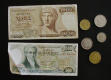
Greek Coins
 click to see big
Cattle were the prized commodity on which the Greek monetary system was based. The Greek islands of Cyprus and Crete during the 16th to 10th centuries B. C. were international trading ports where Assyrians, Mesopotamians, and Egyptians met to trade their goods. With each territory having its own unique currency (Egypt traded in gold, Greece in silver and copper), it was necessary to find a monetary common denominator on which to base trade. The value of an ox was universal in antiquity and became the basis on which all currency was evaluated. A 25.5 g copper ingot, 8.5 g grams of gold were of equal value to a whole ox. This association of monetary values with cattle is well illustrated by the appearance of copper and bronze tablets cut into the shape of ox hides. Coins eventually replaced bars and ingots as currency because they were easier to transport.
click to see big
Cattle were the prized commodity on which the Greek monetary system was based. The Greek islands of Cyprus and Crete during the 16th to 10th centuries B. C. were international trading ports where Assyrians, Mesopotamians, and Egyptians met to trade their goods. With each territory having its own unique currency (Egypt traded in gold, Greece in silver and copper), it was necessary to find a monetary common denominator on which to base trade. The value of an ox was universal in antiquity and became the basis on which all currency was evaluated. A 25.5 g copper ingot, 8.5 g grams of gold were of equal value to a whole ox. This association of monetary values with cattle is well illustrated by the appearance of copper and bronze tablets cut into the shape of ox hides. Coins eventually replaced bars and ingots as currency because they were easier to transport.
Familial coats of arms were the first patterns imprinted on coins. Later, when rulers of the city-states had taken control of minting, the arms of monarchs became the symbol of the city-state itself. Very often a coat of arms was determined by a particular deity for which the city-state had an affinity. For example, periodically, throughout its history the city-state of Athens minted owl coinage which was decorated on the obverse with the head of Athena, the patron goddess of Athens, and on the reverse with the owl, associated with her worhip. Other symbols might be animals or plants which typified a certain region. Until the Hellenistic period the images of monarchs and great men were never depicted on Greek coinage.