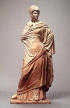
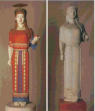
 The Doric Chiton was folded and worm as the Peplos, but had larger dimensions. It was about twice the width from elbow to elbow with arms bent and lifts to a horizontal position. The Doric chiton consisted of two pieces of rectangular cloth equal to the height of the wearer. It was shown either closed or open down the right side. It was worn closed in Corinth and Attica. The chiton was maded of fine pleated linen. One of the main differences between the peplos and the Doric chiton was the length of the over fold, which was called the apotyga. On the peplos, it ended well above the waistline. However, on the Doric chiton it was worn longer. With the Doric chiton, the waistline declined so that the lower edge of the blouse, which was formed by pulling the excess length above the girdle, could reach the hipbones. This portion of the blouse was called the kolpos.
In the middle of the fifth century, when the Persian Wars ended, the Ionic chiton came into style.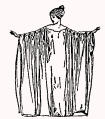 One of the most beautiful versions of the Ionic chiton can be found on the Birth of Aphrodite, which is a Bas-Relief, currently located in the Terme Museum in Rome.
Colors played a big role in ancient greek women's fashion because different colors symbolized different things. A dark veil was a sign of mourning. Dark blue is seldom applied to garments, yet it is scarcely likely that the color was unknown to the Greeks. The commonly used colors by the Greeks are violet, green or gray.
In 500 B.C.E., to 400 B.C.E., ancient Greek women wore many fashions. Their clothing became more elaborate and more detailed as the century passed. The colors became brighter, and new styles were developed. The changing of fashion for the Greek women relates to all societies. As time goes on, fashion everywhere changes, just as it did for ancient Greek women.
Click to go to previous page
Click to go to next page
Click to go to Home Page