Greek Architecture
The first people of the Greek peninsula, who are believed to be the Neolithic, built basic, primative structures. The houses were mainly circular, oval, apsidol, or rectangular shape. The rectangular house was a square, and had the entrance at one end of the shorts ends. The materials used were bricks and stones in the mud with reeds or brush. Most of this houses had only one room, rarely some had two.
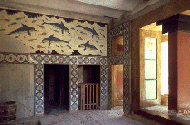 The next settlers on the Greek Peninsula were the Minoan architects. The towns they built had no temples or public places. The Minoan houses were private and had many rooms separated by pillars. The stairways were very prominent for this massive homes.This began a new era for Greek Architecture.
In the Classical Greek Architecture three different orders made up the temples. These three orders were the Doric, Ionic, and the Corinthian.
The Corinthian order was not used as widely as the Doric of Ionic. The Corinthian order was the fancier and the most detail. 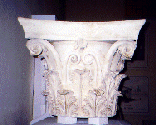
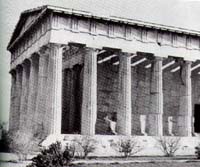
The Doric is the most basic order used in temples. The Doric was mostly used by Spartans. It all starts with some wood shafts, which latter was replaced by stone. On the top of the shaft, were circular pads with a square block of wood over it. The vertical columns were used to support the beams called architraves. In order to form the ceiling, other beams were laid across the building with their ends on these architraves. On the end of these beams, they could be channeled to make a triglyph. On the top of a triglyph there would be another beam which would be placed for the overhanging rafters. These type of beams were referred as to a mutules. The finishing touches for the roof had to have a flat gables called pediments. The gutter ran along the top of the pediments and ended at a lion's mouth. This acted like a drain. The materials that were used for the roofs were thatch and the terra-cotta and marble. The Doric temples were similar to those of the Ionic order in lay out and design.
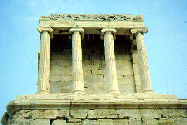 The Ionic order had columns more slender than those of the Doric. The dimensions used were eight to nine meters high, instead of four to five. The columns had a molded base which was placed under them and then sculpted figures on the lower part of the shaft were added. At the top of these shafts, were rectangular blocks of stone, which were carved in the shape of hair or other wave and line shapes.
Click to go to previous page
Click to go to next page
Click to go to Home Page