Greek Money
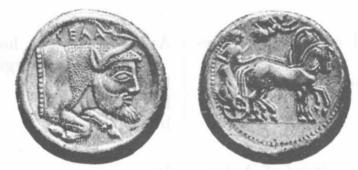 Greek Money was very rare to get in greece.
Money in form of coins is as strange as sounds one of the main reasons for the scientific revolution that started in the Ionian Greek islands. It abstracted the value of commodities or objects in exchange and helped to initiate a new mode of abstract thinking.For a period of 1000 years and considering the small cities states and the colonies we can assume that there exists a rich set of different coins. The drachma was a currency that also the new Greek State adopted and that is now replaced by the EURO. This ends the history of the drachma which lasted for more than 1 millennium.Money was divided in :1 Talent = 60 minae = 6000 drachmae = 36000 oboloi.
Aegina (c. 595 BC), Athens (c. 575 BC), and Corinth (c. 570 BC) start to mint their own coins. Prior to the introduction of coinage the Athenians had used iron spits or elongated nails as money. 546 BC Production of Athenian Owls Coins by the tyrant Peisistratus, using silver from the Laurion mines 25 miles south of Athens.
c. 490 BC Discovery of a Rich Seam of Silver in the Laurion Mines. Themistocles subsequently persuades the Athenians to use some of the proceeds to build a fleet of 200 warships. 456 BC Athens forces Aegina to take Athenian owls and to stop minting her own turtle coinage .449 BC Athens issues an edict ordering all foreign coins to be handed in to the Athenian mint and compelling all her allies to use the Attic standard of weights, measures and money Bc.407 BC Sparta captures the Athenian silver mines at Laurion and releases 20000 slaves.
Athens issues bronze coins with a silver coating . The Athenian public hoards silver coins which, as a result, quickly disappear from circulation, leaving only the inferior bronze ones.