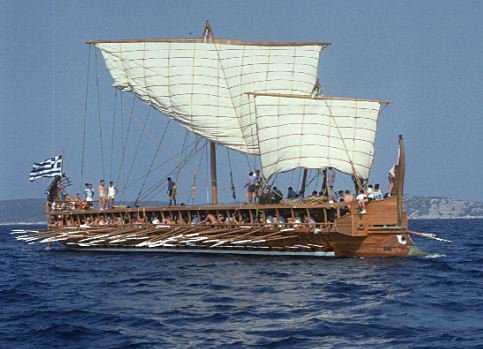
 The ancient Greek navy was one of the most powerful at the time. While the ancient Greek trireme would be no match for today's cruisers, frigates and destroyers, at the time they represented the best that naval technology had to offer. The trireme was built for speed and mobility. The triremes were 120 feet long, small by today's standerds, and were powered by 170 rowers arranged in three rows. They were built low to the ground, the bottom row of rowers were just 18 inches above the waterline, and very narrow which meant that the triremes were not built to handle open ocean. The rough seas would make short work of a trireme because of its very low weight. The triremes were built for short, close in, battles. They were not made to handle long, open ocean campaigns.The Greeks invented athleti contests and held them in honour of their gods. The Isthmos game were stagedevery two years at the Isthmos of Corinth. The Pythian games took place every four years near Delphi. But the most famous games were those at Olympia, a town in south- western Greece. These took place every four years. The ancient Olympics seem to have begun in the early 700 BC, in honour of Zeus. No women were allowed to watch the games. Pottery dating from around 550 BC shows men taking part in the games naked or wearing only a thong.
The games were greatly expanded from a one-day festival of athletics and wrestling to, in 472 BC, five days with many events. The order of the events is not precisely known, but the first day of the festival was devoted to sacrifices. On the second day, the foot-race, the main event of the games, took place in the stadium, an oblong area enclosed by sloping banks of earth. On other days, wrestling, boxing, and the pancratium, a combination of the two, were However, the triremes were very fast and maneuverable which gave them a critical advantage in the close-in battles that were typical of ancient naval engagements.The most obvious is the ship's armor. Both the trireme and the Perry class frigates have a relatively thin coat of armor. The trireme's had wood, good enough to stop arrows and spears but not the battering ram of another ship. The Perry class has a sheet of steel, good enough to stop naval gunfire, small mines or topedoes but not strong enough to withstand a hit from one of today's sea-skimming cruise missiles.
The ancient Greek navy was one of the most powerful at the time. While the ancient Greek trireme would be no match for today's cruisers, frigates and destroyers, at the time they represented the best that naval technology had to offer. The trireme was built for speed and mobility. The triremes were 120 feet long, small by today's standerds, and were powered by 170 rowers arranged in three rows. They were built low to the ground, the bottom row of rowers were just 18 inches above the waterline, and very narrow which meant that the triremes were not built to handle open ocean. The rough seas would make short work of a trireme because of its very low weight. The triremes were built for short, close in, battles. They were not made to handle long, open ocean campaigns.The Greeks invented athleti contests and held them in honour of their gods. The Isthmos game were stagedevery two years at the Isthmos of Corinth. The Pythian games took place every four years near Delphi. But the most famous games were those at Olympia, a town in south- western Greece. These took place every four years. The ancient Olympics seem to have begun in the early 700 BC, in honour of Zeus. No women were allowed to watch the games. Pottery dating from around 550 BC shows men taking part in the games naked or wearing only a thong.
The games were greatly expanded from a one-day festival of athletics and wrestling to, in 472 BC, five days with many events. The order of the events is not precisely known, but the first day of the festival was devoted to sacrifices. On the second day, the foot-race, the main event of the games, took place in the stadium, an oblong area enclosed by sloping banks of earth. On other days, wrestling, boxing, and the pancratium, a combination of the two, were However, the triremes were very fast and maneuverable which gave them a critical advantage in the close-in battles that were typical of ancient naval engagements.The most obvious is the ship's armor. Both the trireme and the Perry class frigates have a relatively thin coat of armor. The trireme's had wood, good enough to stop arrows and spears but not the battering ram of another ship. The Perry class has a sheet of steel, good enough to stop naval gunfire, small mines or topedoes but not strong enough to withstand a hit from one of today's sea-skimming cruise missiles.
 This is because armor is a "double-edged sword." On one hand armor makes a ship less susceptible to damage in battle, but it is also significantly increases a ship's weight. The Perry class frigates are also rather small for a warship, 445 feet long and weighing 3973 tons, (Naval Register).The design of the temple was known as dipteral, a term that refers to the two sets of columns surrounding the interior section. These columns surrounded a small chamber that housed the statue of Apollo. With Ionic columns reaching 19.5 m (64 ft) high, these ruins suggest the former grandeur of the ancient temple.The northern portico, tetrastyle Ionic, stands at a lower level and gives access to the western cella through a fine doorway. The southern portico, known as the Porch of the Caryatids (see caryatid) from the six sculptured draped female figures that support its entablature, is the temple's most striking feature; it forms a gallery or tribune. The west end of the building, with windows and engaged Ionic columns, is a modification of the original, built by the Romans when they restored the building. One of the east columns and one of the caryatids were removed to London by Lord Elgin, replicas being installed in their places
day of the festival was devoted to sacrifices. On the second day, the foot-race, the main event of the games, took place in the stadium, an oblong area enclosed by sloping banks of earth. On other days, wrestling, boxing, and the pancratium, a combination of the two, were held. In wrestling, the aim was to throw the opponent to the ground three times. Boxing became more and more brutal; at first the pugilists wound straps of soft leather over their fingers as a means of deadening the blows, but in later times hard leather, sometimes weighted with metal, was used. In the pancratium, the most rigorous of the sports, the contest continued until one or the other of the participants acknowledged defeat. Horse-racing, in which each entrant owned his horse, was confined to the wealthy but was nevertheless a popular attraction
This is because armor is a "double-edged sword." On one hand armor makes a ship less susceptible to damage in battle, but it is also significantly increases a ship's weight. The Perry class frigates are also rather small for a warship, 445 feet long and weighing 3973 tons, (Naval Register).The design of the temple was known as dipteral, a term that refers to the two sets of columns surrounding the interior section. These columns surrounded a small chamber that housed the statue of Apollo. With Ionic columns reaching 19.5 m (64 ft) high, these ruins suggest the former grandeur of the ancient temple.The northern portico, tetrastyle Ionic, stands at a lower level and gives access to the western cella through a fine doorway. The southern portico, known as the Porch of the Caryatids (see caryatid) from the six sculptured draped female figures that support its entablature, is the temple's most striking feature; it forms a gallery or tribune. The west end of the building, with windows and engaged Ionic columns, is a modification of the original, built by the Romans when they restored the building. One of the east columns and one of the caryatids were removed to London by Lord Elgin, replicas being installed in their places
day of the festival was devoted to sacrifices. On the second day, the foot-race, the main event of the games, took place in the stadium, an oblong area enclosed by sloping banks of earth. On other days, wrestling, boxing, and the pancratium, a combination of the two, were held. In wrestling, the aim was to throw the opponent to the ground three times. Boxing became more and more brutal; at first the pugilists wound straps of soft leather over their fingers as a means of deadening the blows, but in later times hard leather, sometimes weighted with metal, was used. In the pancratium, the most rigorous of the sports, the contest continued until one or the other of the participants acknowledged defeat. Horse-racing, in which each entrant owned his horse, was confined to the wealthy but was nevertheless a popular attraction