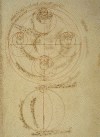
 In the thirteenth and fourteenth centuries, a number of recent Arabic and Persian astronomical works were translated into Greek by scholars who traveled to Persia under the Ilkhanid Empire. One short and confused treatise, translated by Gregory Chioniades, describes Tusi's lunar theory, illustrated, not altogether correctly, in this figure along with Tusi's device for producing rectilinear from circular motions (shown also in Vat. ar. 319 (math19)). A part of the planetary and lunar theory of the astronomers of Maragha was later utilized by Copernicus, though scholars do not know how he gained access to this material. Vat. gr. 211 fol. 117 recto math16 NS.04
 One of the most powerful creations of Greek science was the mathematical astronomy created by Hipparchus in the second century B.C. and given final form by Ptolemy in the second century A.D.
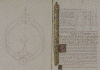 Ptolemy's work was known in the Middle Ages through imperfect Latin versions. In fifteenth-century Italy, however, it was brought back to life. George Trebizond, a Cretan emigre in the curia, produced a new translation and commentary. These proved imperfect and aroused much heated criticism. But a German astronomer, Johannes Regiomontanus, a protege of the brilliant Greek churchman Cardinal Bessarion, came to Italy with his patron, learned Greek, and produced a full-scale "Epitome" of Ptolemy's work from which most astronomers learned their art for the next century and more. Copernicus was only one of the celebrities of the Scientific Revolution whose work rested in large part on the study of ancient science carried out in fifteenth-century Italy