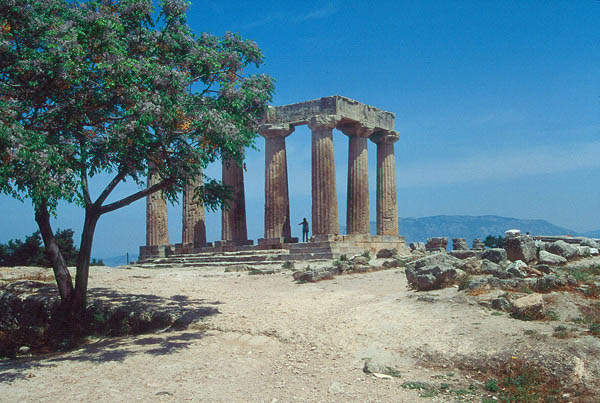
 Most religious buildings today are intended for congregational worship, where groups of people get together on a regular basis to celebrate their god and receive spiritual comfort. Ancient Greek temples were rarely used this way. They were meant to serve as homes for the individual god or goddess who protected and sustained the community. It was the needs of the gods that were most important. They controlled the forces of nature� the sun and rain which nourished their crops and the winds which drove their ships. Although generally benevolent, the gods could be quite capricious and were liable to turn against the community� so it was in everyone's interest to make sure that they should feel completely at home. They received daily offerings of food and drink along with a proper share of the harvest and the profits of any trading or military activity.
The temple building normally stood inside a sacred enclosure known as the temenos� reflecting the rural origins of most cults. It generally included a natural feature such as a spring, a grove of trees or a cave which was the actual focus of public worship. It was the only part of the complex open to the general public� ordinarily, only priests were admitted into the divine presence to perform the necessary rituals on behalf of the community. Private groups and individuals were encouraged to contribute to the upkeep of the temple by means of offerings and dedications but otherwise, public participation was limited to taking part in religious festivals and processions. These generally culminated in lavish sacrifices of prime livestock at the god's altar which stood within the temenos but outside the temple proper . These were occasions of great public celebration highlighted by feasts, athletic competitions and dramatic productions. The god or goddess was presented with gifts of jewellery and fine garments along with tableware and cutlery of silver and gold. Statues of young men and young women were dedicated to the deity as votive offerings and evidence of personal.They prayed for success in any venture that their city might have been undertaking� a war, a trading expedition or the foundation of a new colony
Most religious buildings today are intended for congregational worship, where groups of people get together on a regular basis to celebrate their god and receive spiritual comfort. Ancient Greek temples were rarely used this way. They were meant to serve as homes for the individual god or goddess who protected and sustained the community. It was the needs of the gods that were most important. They controlled the forces of nature� the sun and rain which nourished their crops and the winds which drove their ships. Although generally benevolent, the gods could be quite capricious and were liable to turn against the community� so it was in everyone's interest to make sure that they should feel completely at home. They received daily offerings of food and drink along with a proper share of the harvest and the profits of any trading or military activity.
The temple building normally stood inside a sacred enclosure known as the temenos� reflecting the rural origins of most cults. It generally included a natural feature such as a spring, a grove of trees or a cave which was the actual focus of public worship. It was the only part of the complex open to the general public� ordinarily, only priests were admitted into the divine presence to perform the necessary rituals on behalf of the community. Private groups and individuals were encouraged to contribute to the upkeep of the temple by means of offerings and dedications but otherwise, public participation was limited to taking part in religious festivals and processions. These generally culminated in lavish sacrifices of prime livestock at the god's altar which stood within the temenos but outside the temple proper . These were occasions of great public celebration highlighted by feasts, athletic competitions and dramatic productions. The god or goddess was presented with gifts of jewellery and fine garments along with tableware and cutlery of silver and gold. Statues of young men and young women were dedicated to the deity as votive offerings and evidence of personal.They prayed for success in any venture that their city might have been undertaking� a war, a trading expedition or the foundation of a new colony