Greek cities
 First, there was the vision. In the fifth century before Christ, an unprecedented idea rose from a small Greek city on the dusty plains of Attica and exploded over the Western Hemisphere like the birth of a new sun. Its light has warmed and illuminated us ever since; sometimes obscured by shadows, then bursting forth anew as it did when our own nation was created on the model of the Greek original. The vision the classical Greek idea was that society functions best if all citizens are equal and free to shape their lives and share in running their state: in a word, democracy.
"With this new day came an explosion of the creative spirit in Greece, producing the architecture, the art, the drama, and the philosophy that have shaped Western civilization ever since. Jason's harvest of armed soldiers, grown in a day from dragon's teeth, seems no more miraculous. "What was then produced in art and thought has never been surpassed and very rarely equalled," wrote the classicist Edith Hamilton, "and the stamp of it is on all the art and all the thought of the Western world."
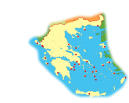 The Greeks, every forlmal social gathering was also a religious gathering and the Panhellenic santuaries were the great meeting places. No santuary in Greece was as sacred as that of Delphi, a city state situated on the lower slopes of Mount Parnassus, in Phocis, an ancient province of Central Greece. According to the ancients , Delphi's staus as a legendary site began with Zeus.
The sacred birds met at Delphi belived to be the navel of the earth. Therefore, since remotest times, Apollo's satuary has contained a sacred omophalos, or navel stone, surmounted by the two eagles of Zeus that flew from the ends of the world to meet at its center, at.
 Delphi, Treasury of the Megarians:Temple like building in the suthern half of the Santuary of apollo, eats of the point where the Sacred Way 1st curves and ascends to the northeast and across the Sacrends way from the Treasury of them Siphnians.