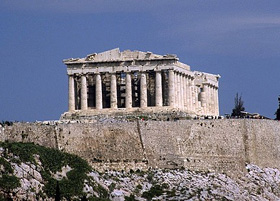
AKROPOLIS
 Greece is no longer dirt cheap. A rock-bottom daily budget would be US$20 a day. You'd be hitching, staying in youth hostels or camping, staying away from bars, and only occasionally eating in restaurants or taking ferries. Allow at least US$40 per day if you want your own room, plan to eat out regularly, and intend to see all the sights. If you want a real vacation - comfortable rooms and good restaurants all the way - you will need closer to US$70 per day. Hotel rates vary enormously according to season - you can save as much as 30% if you travel outside high season (mid-June till end of August).
Banks exchange all major currencies in cash, travellers' cheques or Eurocheques; the commission is lower for cash. Post offices exchange cash but not travellers cheques, and usually charge lower commissions than banks. Travel agencies and larger hotels change cash and travellers cheques but usually charge higher commissions than banks. Banknote exchange machines can be found in most tourist areas. All upmarket shops, restaurants and hotels accept credit cards. Visa, MasterCard (Access) and Eurocard are the most widely accepted. Most banks have ATMs where you can access your debit or credit account.
The service charge is included in the bill in restaurants, but it is customary to leave a small tip. And it is standard to leave a small gratuity in taxis and hotels. Bargaining is usually found in the markets. Shop prices are mostly clearly marked and non-negotiable. However, it�s always worth bargaining over the price of hotel rooms, especially if you are intending to stay a few days.
Greece's mountainous terrain is perfect for trekking. The countryside is crisscrossed with donkey and goat tracks, and Byzantine cobbled paths link most villages. Although some of the alpine trails are a tad overgrown, most of the popular routes are well maintained. The forested Pindos mountains of Epiros, the Peloponnese and the southwest of Crete are the among the best areas for trekking. The meltemi and the lakelike surface of the Aegean provide perfect conditions for windsurfing , which is the most popular water sport in Greece. Although snorkelling is encouraged and well worthwhile anywhere along the coast, scuba diving is strictly forbidden, unless under the auspices of a diving school, so that underwater antiquities are protected from pilferers. Greece is one of the cheapest places in Europe to go skiing and has around 20 resorts which provide a pleasant alternative to the glitz of the Alps. The most developed resort is on Mt Parnassos near Delphi.