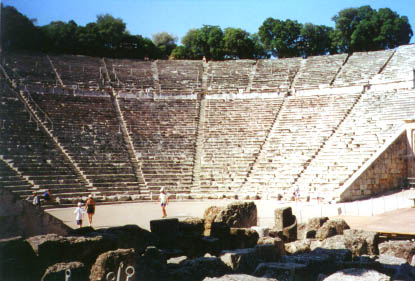
 During the Mycenaean period, the female deity of Earth was worshipped in the small settlement of Delphi. The development of the sanctuary and oracle though, began in the 8th century B.C. with the establishment of the cult of Apollo. Under the protection and administration of the Amphictyony, the sanctuary continued to be autonomous after the First Sacred War and, as a result, increased its panhellenic religious and political influence. The Pythian Games were re-organized, the sanctuary was enlarged and it was enriched with nice buildings, statues, and other offerings. In the 3rd century B.C. it came under the domination of the Aetolians and later, in 191 B.C., was conquered by the Romans. During the Roman occupation the site was sometimes plundered but was also favoured by some of the emperors. With the spread of Christianity, the sanctuary lost its religious meaning and was permanently closed down with a decree of emperor Theodosius the Great.
The ruins of Delphi were uncovered by the systematic excavations of the French Archaeological School, which began in 1893. The village of Kastri, which had occupied the area of the sanctuary since medieval times, was moved to its present position. After the removal of huge quantities of earth that had been accumulated with the landslides, the remains of two sanctuaries, dedicated to Apollo and Athena Pronaea, were finally uncovered. The excavations revealed more than five thousands inscriptions of all kinds, statues, several miniature objects, architectural decorative pieces, all exquisite works of art, representing the major cities of Greek antiquity. Outside the area of the Sanctuary, the Stadium, the Gymnasium, the settlement of Delphi and its cemeteries have also been excavated.
The ruins of Delphi were uncovered by the systematic excavations of the French Archaeological School, which began in 1893. The village of Kastri, which had occupied the area of the sanctuary since medieval times, was moved to its present position. After the removal of huge quantities of earth that had been accumulated with the landslides, the remains of two sanctuaries, dedicated to Apollo and Athena Pronaea, were finally uncovered. The excavations revealed more than five thousands inscriptions of all kinds, statues, several miniature objects, architectural decorative pieces, all exquisite works of art, representing the major cities of Greek antiquity. Outside the area of the Sanctuary, the Stadium, the Gymnasium, the settlement of Delphi and its cemeteries have also been excavated.