Judo Club
Cross Training Judo for improve Jiu-jitsu Stand Up Game
By Roberto Pedreira
Kane-ei (金榮)
Most of the regular customers of Kane-ei, a small izakaya in Chigasaki, Japan, have permed hair and look and talk like characters out of a Takeshi Kitano movie. That's because the characters in Kitano movies are based on guys like them. Guys with tattoes and missing fingers, and not infrequently large scars across their faces, evidence of defeats--or possibly victories--in inter-gang street brawls.
I don't have permed hair, tattoes, or facial slashes, but I am a regular too. One reason is that it is close to my house, and cheap, but mostly because the "master" is a kakutogi fan and he tapes all of the Prides, Rings, King of Kings, K-1s, and boxing that are offered either free or on pay per view in Japan. After watching them once, he gives them to me. GTR's video reference collection is extensive, for this reason.
Once in a while, people who aren't not yakuza or otherwise working in the mizu-shobai stop into Kane-ei. One such was Saiin Tamio (picture below, facing camera). Although he could certainly pass for a yakuza, based on appearance alone, it turned out that he was a printer by trade, and a 5-dan judoka. "How can I avoid to be thrown by a good judoka?" I logically asked him. Logically, because as a jiu-jitsu guy with no judo background, and training in Japan with lots of jiu-jitsu guys who do have judo backgrounds, I was concerned about getting thrown. Having been thrown repeatedly by a short 2-dan judoka with a jiu-jitsu blue belt, whose specialty was seionage (over the shoulder throw), I wanted to be able to avoid that in the future.
Saiin's answer was, "if you want to avoid being thrown, first you have to be thrown one thousand times". He invited me to come to his judo club in the nearby town of Fujisawa, where he would demonstrate. I eagerly accepted, hoping he was exaggerating about the "one thousand times" part.
Training at Fujisawa Judo Club
The difference between a dojo and a club is in the formality
and rigidity of the practice routine, and the cost. A club is a place where
guys who already know their art get together to train. Beginners are welcome
too, but their instruction is very individualized and spotty compared to a dojo.
Or to put it another way, 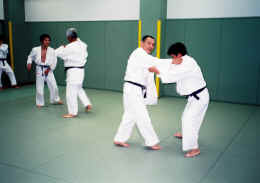 it is more efficient, since they are taught what they
want to learn, and they decide what they want to learn as they go along and
discover what they need to be able to do to throw and pin, and avoid being thrown
and pinned--which is what judo is all about. A judo club will tend to have
relatively many older guys who have been in judo for a very long time, know a
lot, and are very good at a few things. They might have been national champions
in the past. Some continue to compete. The Fujisawa Judo Club (FJC) meets twice
a week (Wednesday and Friday) from 8 to 9:30. On a typical night there would be
between 8 and 10 people training. One or two (including me) would have white
belts, the rest black belts. Some of the black belts have been training for
a short time, one or two years. Most however have been doing it for 20 or more
years. Saiin for example has been training since he was 15, and he is 52
now. That's 41 years of judo, if my math is correct.
it is more efficient, since they are taught what they
want to learn, and they decide what they want to learn as they go along and
discover what they need to be able to do to throw and pin, and avoid being thrown
and pinned--which is what judo is all about. A judo club will tend to have
relatively many older guys who have been in judo for a very long time, know a
lot, and are very good at a few things. They might have been national champions
in the past. Some continue to compete. The Fujisawa Judo Club (FJC) meets twice
a week (Wednesday and Friday) from 8 to 9:30. On a typical night there would be
between 8 and 10 people training. One or two (including me) would have white
belts, the rest black belts. Some of the black belts have been training for
a short time, one or two years. Most however have been doing it for 20 or more
years. Saiin for example has been training since he was 15, and he is 52
now. That's 41 years of judo, if my math is correct.
Kids who are still in primary school (grades 1-6 in Japan) are awarded different colored belts to encourage them to be ambitious (koujoushin [向上心] o mottaseru tame no mono). According to GTR's sources at Kodokan, it is each dojo's choice as to which colors the belts can be. Brown belts (representing 3rd through 1st kyu) are given to middle school students (grades 7-9). When a middle school judoka turns 16, he can exchange his brown belt for a black one. The first (hence beginning, "sho", 初 ) level (or "dan", 段) of black belt simply signifies that the wearer knows and can apply the basics of judo (approximately like a blue belt in jiu-jitsu). For an adult student, there are no particular techniques that you have to excel at to earn your sho-dan. One technique is all you need to know, if you can do it well enough to throw other sho-dans with it in randori, Saiin sensei says. In reality, however, it's difficult to be able to consistently execute one throw against sho-dans without knowing the other basic throws that you can threaten with and thereby set up the first throw. It typically takes about a year to get to this level, often less--six months is enough, according to Saiin, if you train hard. One white belt at the FJC showed up one day with a new black belt. How long had he been training, I asked him? "Eight months", he answered.
People arrive at the club when they want to and do their own warm-up, which is usually just light stretching. There is no formal starting time, although the doors are always open no later than 8:00. A typical training session consists of about 80-100 repetitions of uchikomi (20 each of four or five of the basic throws), and then randori with 3-4 different people. The randori is not timed, and continues until one guy wants to stop. At 9:30, or when no one wants to do any more randori, the session is closed, everyone lines up, kneels in seza, closes their eyes and meditates. They then bow to the front, bow to the sensei, bow to each other. Finally, everyone grabs a broom and sweeps up the floor.
Two of the guys training at FJC are Brazilians
of Japanese descent from Saõ Paulo, Flavio and Alexandre (picture
below). 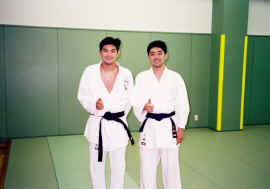 They had never heard of jiu-jitsu, they said, which wasn't totally
incredible. When I was in Saõ Paulo in 1997, the only Paulistas I met who had
heard of jiu-jitsu were the ones I trained with at the Top Form Jiu-jitsu
academia of Prof. Ricardo Kowarick. Most
Paulistas have heard of jiu-jitsu by now. Flavio and Alexandre are two of them.
They had never heard of jiu-jitsu, they said, which wasn't totally
incredible. When I was in Saõ Paulo in 1997, the only Paulistas I met who had
heard of jiu-jitsu were the ones I trained with at the Top Form Jiu-jitsu
academia of Prof. Ricardo Kowarick. Most
Paulistas have heard of jiu-jitsu by now. Flavio and Alexandre are two of them.
Dogi
A good dogi (judo gi) costs about $190 in Japan, not
including belt. I didn't
have $190 to spare but had three jiu-jitsu kimonos so I just wore one of them.
Everyone was curious about the design and wondered what kind of dogi was it? Saiin
already knew that I had been to Brazil for jiu-jitsu so he mentioned that.
Some of the guys had heard of Gracie Jiu-jitsu via Rickson's fights with Takada and
Funaki and thought it was a kind of wrestling with punches and kicks--vale tudo,
in other words. I tried to explain that it was more like judo ne-waza. But for
judo guys, ne-waza is mostly osaekomi (pinning). They'd generally ask me if I
wanted to do ne-waza, and I'd generally say "betsu ni" (not
particularly), but they'd often insist anyway. For my purposes, that was
counter-productive. Not because they were clueless on the ground. On the
contrary, they knew what they were doing on the ground, and they were good at
it. It just wasn't what jiu-jitsu guys do. What judo guys do and what they are
good at is holding you down for 25 seconds. That scores ippon and they win the
match. They obviously have no incentive to risk their match winning hold-down by
attempting a submission.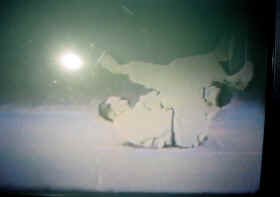 Some of the older guys do in fact know some
sophisticated submissions, the same ones you can see on that old Kosen judo
training film, and for that matter in jiu-jitsu academies (on the right is a
still from the Kosen film). But, to put it
charitably, they require a naive opponent to be able to pull them off.
Some of the older guys do in fact know some
sophisticated submissions, the same ones you can see on that old Kosen judo
training film, and for that matter in jiu-jitsu academies (on the right is a
still from the Kosen film). But, to put it
charitably, they require a naive opponent to be able to pull them off.
It could be mentioned that the younger guys who are training for competitions are probably going to be focusing on a few high payoff match winning stand up techniques. Knowing three techniques well is going to benefit them more in the near term (upcoming matches) than knowing 65 techniques less well. Few matches are won using techniques other than the basics anyway, like seionage and uchimata. The older guys however have had plenty of time to soak up techniques and are under less pressure to win matches, and so are much more likely to be interested in knowing and using a wider variety of judo techniques
There may be and probably are some judo guys (who haven't
studied jiu-jitsu) some where today who can execute juji gatame or sankaku jime correctly, or for that
matter any submission. They don't seem to be common however.  What might have
seemed adequate technique before doesn't necessarily seem adequate now that the
Brazilians have invented dozens of escapes and counters for every move. These
(probably) didn't exist back when Kimura and his colleagues were kicking ass at
Tenri University in Kyoto. Or to put it in another perspective, judo guys who
are good on the ground (apart from pinning) are as common as jiu-jitsu guys
(those who haven't learned judo) who can throw well.
What might have
seemed adequate technique before doesn't necessarily seem adequate now that the
Brazilians have invented dozens of escapes and counters for every move. These
(probably) didn't exist back when Kimura and his colleagues were kicking ass at
Tenri University in Kyoto. Or to put it in another perspective, judo guys who
are good on the ground (apart from pinning) are as common as jiu-jitsu guys
(those who haven't learned judo) who can throw well.
I finally decided to fork over the dough for a gi, hoping that they'd think I was more into stand up and less into ne-waza. The tactic worked. They still like to go to the ground if they can but they no longer assumed that that's what I wanted. Since they like to train on the ground, I use the opportunity to try to fix my weakest point, which is attacking guys who turtle up and wait. They do this constantly, so I have abundant opportunities to work on my relogio (clock) chokes (originally a judo choke, known as koshi jime (hip choke) in Japanese). It is also easy to anticipate when ground fighting will start--any time I turn my back to attempt a seionage, that is when ground fighting is likely to begin. (Ordinarily, I would never attempt this kind of throw, but since it is judo training......). Now if I, the jiu-jitsu guy, wanted to play from the ground, this wouldn't be difficult, although in judo you can't take the fight to the ground unless you do it by way of an attempted throw, which makes it a lot less certain that you will be in the position you want when you get there. But obviously, if you go to a judo club, you are going for stand up, and it doesn't make much sense to spend a lot of time on the floor.
Useful Lessons Learned
Luckily, Saiin had been exaggerating. I didn't have to be thrown a thousand times to learn how to avoid being thrown. I almost instantly figured out how to avoid being thrown. But I soon learned that most of the things I was doing were illegal. For example, one very effective way to avoid getting thrown is to cross grip your opponents collar--left hand deep in opponent's left collar for example. This will make it almost impossible for him to throw you. Probably for this reason, it is illegal to take this grip for more than 6 seconds. You can do it, but you have to attack from it (within 6 seconds). Otherwise it is considered stalling and you will be penalized. If the judo guy naively thinks he can't be choked while standing up, and lets you insert the other hand, then he may be in for a surprise. Using this grip, you can also throw him with a te guruma (hand wheel), which apparently is a legal throw but not part of the standardized Kodokan curriculum. Once you have the hand in the cross collar, use it to push his head out. If his right leg is forward, close to you, scoop it up and lift, while bringing his head down (steering wheel motion). This will only work if his near leg is close enough to scoop up, and the more advanced guys will never let that happen. Even the sho-dans will wise up to it after a few trips to the floor.
Keeping your hip way back is another thing that works well, but if done to excess would be penalized as stalling. The best way to avoid penalties for stalling is by attacking aggressively. This is also a good way to get thrown, but that's life. Ideally, you practice enough, get better, and can attack without getting thrown. But even in the most optimistic scenario, you can get thrown.
There are a lot of other ways to beat judo guys but on closer
inspection they usually turn out to be illegal. One more example: when the
judoka throws you with a big momentum throw, you simply have to hang on and roll
inside, and invariably (like 9 times out of 10) you will roll him and end up on
top.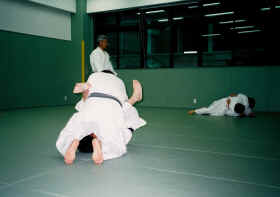 Wrestlers avoid this by "throwing for distance", but in judo you
are supposed to let go when you are thrown, in theory so that you can do your
ukemi safely, but it seems to this observer that the actual reason is so the
thrower won't get rolled by his own momentum. In any case, hanging on is viewed
as "cheating", or so I was told. The rules make it irrelevant anyway
because once your back hits the the floor, you lose the match by ippon. It
doesn't matter that you rolled and mounted him--you already lost the match.
Wrestlers avoid this by "throwing for distance", but in judo you
are supposed to let go when you are thrown, in theory so that you can do your
ukemi safely, but it seems to this observer that the actual reason is so the
thrower won't get rolled by his own momentum. In any case, hanging on is viewed
as "cheating", or so I was told. The rules make it irrelevant anyway
because once your back hits the the floor, you lose the match by ippon. It
doesn't matter that you rolled and mounted him--you already lost the match.
Another way to beat judo guys is to be better than they are at their own game. That won't be easy when they've been working on their game for 10-30 years and you've just started.
One thing that makes it a bit easier is uchikomi. In fact, the most useful part of judo training, from the perspective of a jiu-jitsu fighter who wants to avoid being thrown, is letting other guys do their uchikomi on you. If you did nothing else, your defense would get pretty good. The reason is that being the uke for uchikomi gives you a lot of experience seeing and feeling the approaches and set ups. Doing it with your eyes closed is even better. When you feel your opponent's shifts in position before the throw, you can automatically adjust to them. (Incidentally, holding the pads for a striker offers similar benefits.)
My primary objective in judo training was, above all, not to break anything. My second and closely related objective was to avoid getting thrown by seionage (which, while classified as a hand technique, is actually an over the shoulder throw), and to a lesser extent, over the hip throws like harai goshi. Uchimata is classified as a leg technique but in terms of how you hit the floor, it is similar to harai goshi, so I wanted to avoid that as well and any others than would put me flat on my back from my opponents hip level. I didn't mind osotogari and the other leg techniques. They would cause you to lose the judo match, but for randori, the falls are easier to take.
My third objective was to learn how to throw people. Given that there was only one other white belt there, and he didn't always come, I didn't think my chances would be good.
I was too pessimistic. Judo throws are taught in stages and the first throws anyone learns are the throws you can practice in uchikomi, such as seionage, osotogari, uchimata, haraigoshi, taiotoshi, hizaguruma and a few others. Most other throws cannot be so conveniently practiced in uchikomi--the sacrifice throws (sutemi-waza) for example. As you'd therefore expect, most people get good at doing the throws they practice a lot and good at defending the throws they are attacked with a lot. Conversely, they don't get as good at doing or defending the other throws. I reckoned my chances of throwing anyone with seionage, uchimata, osotogari etc. as close to zero (which subsequent experience showed was an accurate assessment), so I decided to work on the less orthodox throws, such as ukiwaza and yokogake. They are taught last not because they are harder to do, but only because they are harder to practice in uchikomi. But as a consequence of this, many younger judo guys aren't familiar with them.
I attempted many osotogaris, taiotoshis, uchimatas, hizagurumas, and even dared to risk a few seionages, all to no effect. My counter-throws were more successful, but there is nothing worse than stalling, and constantly waiting for other people to initiate attacks borders on stalling, in my own opinion, at least in a training environment. As mentioned previously, my te guruma stopped working after a few weeks too. I tried tomoenage and it's many variations. It never worked in the sense that I never threw anyone for ippon with them (although they worked great in a different sense, in that I always pulled to guard as a result. However, I didn't join a judo club to practice my guard).
The judo technique morote gari, is basically a double leg take-down, but it is typically done (when it is done at all, which is rarely) from very close up, reaching down to pull the opponent's legs out. Judo guys seem to dislike morote gari as a competition technique because, oddly enough, it is too "easy", or so they say. They like to see people floating through the air and being slammed on the mat (even so Kimura describes using a morote gari to pull out a victory over Masayuki Nakajima in their epic battle in 1937.) Another reason may be that morote gari is extremely difficult to pull off, since you need to have both hands free, and it is unlikely that your opponent will let that happen. I am interested in getting people to the ground. I don't mind if it looks ugly. So I attempted many morote garis. None succeeded. Mifune Kyuzo (10-dan) demonstrates the technique on an old documentary, by disengaging grips and reaping the uke's legs out with both hands. I attempted to do this. It was impossible. No one would let me be that close without having at least one and if at all possible two grips. So it was impossible to apply morote gari from the mutual grip position that one is expected to use in randori (a match would be different of course).
I tried to apply morote gari like a wrestler would, from far outside, following a deep penetration step. It seldom failed. The judoka's upright rooted stance is good for defending judo techniques, but it isn't good for sprawling.. In fact, they didn't really seem to be trying to defend the shot, but rather to try to land on their butt, which would avoid a loss by ippon, after which they could start ne-waza. It also seemed that they are so accustomed to grabbing cloth that if they missed the chance to do that, they felt the jig was up and didn't know how to use their forearms or hips for defense. But as before, I didn't really want to spend a lot of judo training time on ne-waza, so I stopped shooting doubles.
I needed something else. Ukiwaza was it. At least I thought it was ukiwaza. Someone said it wasn't ukiwaza, it was yokogake. Judging from the Mifune documentary, it might actually have been yoko wakare or yoko otoshi. Anyway, it was one of the yoko-sutemi techniques (side sacrifice throws, as opposed to for example tomoenage, which is a front sacrifice throw (ma-sutemi)), and it was working very reliably. This throw is incredibly easy to do. Basically, you are simply falling back and dragging him down with you. The tricky part is the timing and the angulation, which is necessary to end up with you, rather than him, on top. I modified Mifune's technique slightly. When he does it, he finishes on his back, which is ok in judo because he initiated and controlled the throw. But I didn't want that. I made sure to hang on to the opponent's sleeve and collar and use his momentum to pull myself up and over into either a side control or knee on belly position.
This ukiwaza or whatever it was worked surprisingly well. I caught many people, many times with it. Surprise had to have been a factor the first few times, but it kept on working. In the case of Saiin himself (5-dan), it may have been that he wanted to practice recoveries because most of time he was able to land in such as way as to avoid ippon. However, it utterly failed to work on a pair of heavy, short guys, both 3-dans, which shows that every technique has it's limits, and also that some opponents are simply too good, or too big, or both. With these guys, I just concentrate on not being slammed too hard. Fortunately, as in jiu-jitsu, defense develops faster than offense and it's considerably easier to avoid getting thrown than to throw. In order to minimize my chances of taking a big seionage or similar throw, I deliberately make myself a bit more open to the less devastating foot throws (assisted trips, actually), such as deashi harai and kouchigari.. The trade-off is well worth it.
An important consideration to keep in mind for anyone who wants to upgrade their jiu-jitsu stand up game with judo cross training is that, obviously, many of the things your opponent can't do in judo, he can do in jiu-jitsu. It cannot be assumed the techniques that work well in a judo randori will work well in a jiu-jitsu stand up fight. Since I haven't been able to test my yoko-sutemi against a jiu-jitsu fighter, I can't be sure what would happen if I attempted to take him down with one. I am pretty confident that he'd go down, but I have no idea where he'd land or what he'd do next. After all, the fight isn't finished when the jiu-jitsu man lands on his back. Not at all--it's just getting started.
Post Script: Since writing the above article, I've had a chance to test the yoko-sutemi against a variety of jiu-jitsu fighters at around my own skill level. The conclusion is that the throw works excellently on them too. The key is to make them plant their weight on the foot that is on the side that you are going to throw them to.
******
More interested in Judo? Check out Keith Shwartz's Judo vidoes.
Also, check out the article about George Mehdi (judo sensei of Rickson Gracie, Marcello and Sylvio Behring, Mario Sperry, Wallid Ismael, Murilo Bustamante, Carlson Gracie Jr. and many others).
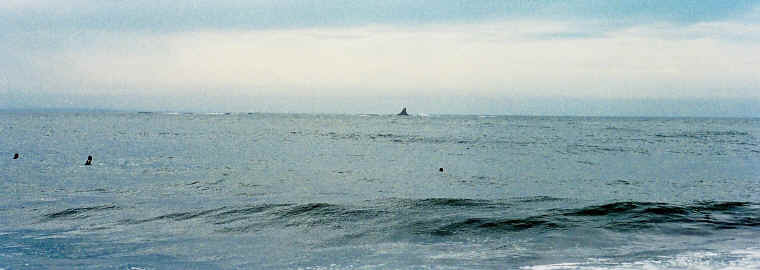
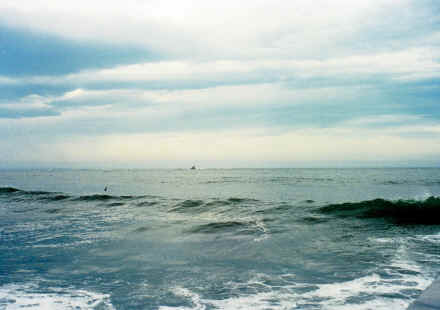
Below: Two pictures of the beach of Chigasaki.


(c) 2001, Roberto Pedreira. All rights reserved.