Murilo Bustamante
By Roberto Pedreira
 |
Only
eight students were training that Friday evening at Academia Murilo Bustamante
Jiu-Jitsu on Rua General Artigas, 239/201 in Leblon. Cariocas don't
like to train on Friday evenings, Murilo explained.
But
eight seemed about right for the room. Murilo's academy—like most newer
academies—was in what is known as a sobreloja, which is the 2nd
floor, but specifically in a mixed use building. It is the floor above the
commercial ground floor (loja means “shop”, sobre means
“above”) and below the residential third floor. As in most sobrelojas,
enormous pillars (usually well padded) take up a lot of space in the middle of the room, which makes
sobrelojas less attractive for both commercial and residential
purposes. Being therefore cheaper as a result, many jiu-jitsu academies and musculacão
(bodybuilding) gyms are located in sobrelojas. Training fees can be
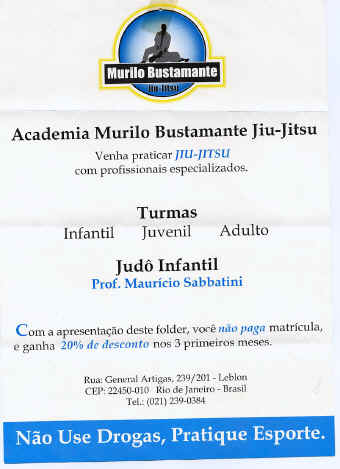
kept reasonable. Murilo's were typical: 50 reais for matriculacão,
and 100 reais for mensalidade (monthly). It was unusual in
having a sliding scale of fees (100 for white belts, 90 for blue belts, 85 for
purple belts, 80 for brown belts, and 70 for black belts). Since it's
relatively easy to get a blue belt and relatively hard to get a purple belt in
Brazil, most guys would be paying 90 reais most of the time. As cheap
as that was, there was a promoção in progress. If you showed up with
the Academia Murilo Bustamante Jiu-Jitsu flyer in hand, “você não paga
matricula, e ganha 20% de desconto nos 3 primeiros meses.”
Murilo
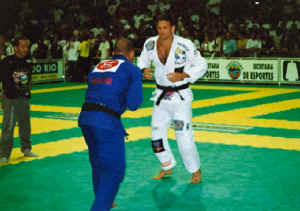
had just won the title in
the pesado (heavyweight) black belt category,
and might have had stand-up on
his mind. You can’t win a jiu-jitsu match with stand-up skills alone, but it
certainly helps to get off to a good start.
Like his friend Mário Sperry, and
many many other jiu-jitsu stars, Murilo studied judo with George Mehdi, just
down the road in Ipanema. Unlike judo, jiu-jitsu training typically begins in medias
res, so to speak (although unlike jiu-jitsu, judo training, and matches
too, tend to end in medias res). In other words, rolling starts in what
would be the midst of the match, after it has already gone to the ground. But
getting opponents who don’t
want to be there big time and know how to avoid it real good to the ground
(judo-ka and wrestlers for example) isn’t a foreordained matter.
Matches begin on stand-up, of course, but prior to the take-down there is
something even more fundamental (and neglected), which is the tie-up. Murilo
is not someone who believes in leaving anything to chance, if it’s possible
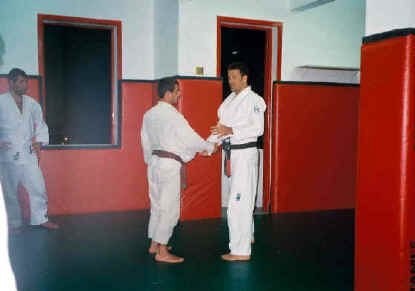
to avoid it. The posicãos segment of the class was devoted to grips.
The guy who gets the better initial grip has a big advantage. It's important
both to be able to get a good initial grip and to nullify your opponent’s
good initial grip if he gets one first, and get a good counter grip. This was
the same material he and Zé Mário covered on their Master Series video.
Speaking of that, I asked Murilo why Mário did all the talking. “Mário
speaks English better than I do”, was the reason.
After
rolling a bit, brown belt Paulo came over and said he wasn't in good shape,
got tired too easily. Paulo had lived in San Diego (every carioca's
favorite city), was 31, and had gotten an MBA there. It wasn't too useful.
"Business is different here. The important thing in Brazil is knowing
when to get in and when to get out". I guessed that the best way to know
things like that would be to have family or friends in government ministries.
“Very true”, he agreed. An American MBA can’t help you much in that
direction.
Paulo
started jiu-jitsu in San Diego with Nelson Monteiro, who had opened his school
in 1993, two weeks before UFC 1. People flooded in—"yeah, yeah, that's
the 'guard' I saw", they’d typically say.
Paulo
was from the neighborhood. He could remember when Vitor Belfort, who was also
from Ipanema, was a skinny kid. It wasn’t long ago. "How did Vitor get
so huge and muscular so suddenly?" I asked. "Anabolics are a big
problem now”, he said, leaving me to draw the logical conclusion.
Another
problem, he said, was that young guys tended to get into "brigas na
rua" (street brawls). They
want to try their skills and their professor hasn't taught them how to behave
well. Who do they fight with? Homeless
people usually. Where? Right around here, anywhere. (They don't go into the favelas
or even far from the rich "South Zone" neighborhoods where they
live).
Murilo
earns a living fighting and teaching people how to fight. He understands that
it will be a problem if the people he teaches to fight get into fights in the
wrong places. ”Não briga na rua, pratique esporte,“ he advises. There’s a lot of self-defense wisdom contained in that
brief admonition.
|
|
|
Murilo emphasizing the importance of getting a good grip |

A Arte Suave index
GTR index
©2000,
R.A. Pedreira. All rights reserved
Revised December 2001