Moebius Band appears degenerate Torus, not disoriented
I am trying to learn Topology. As a first step I would seek your comments on what to me looks to be untenable in Moebius Band’s orientability. The following describes how/why the Moebius Band (MB) appears orientable (to me) in a three dimensional appreciation of MB. I do hope some of you would take a few minutes to point out where exactly there is an error or misconception. On previous posts
and
http://groups.google.co.nz/groups?hl=en&lr=&ie=UTF-8&threadm=200408171334.i7HDYL223798%40proapp.mathforum.org&rnum=1&prev=/groups%3Fq%3D%2Blee%2Brudolph%2Benlightened%26hl%3Den%26lr%3D%26ie%3DUTF-8%26group%3Dsci.math.*%26selm%3D200408171334.i7HDYL223798%2540proapp.mathforum.org%26rnum%3D1from Professor Lee Rudolph who mentioned about a double cover situation. I made two square section rubber cord and steel MBs, experimentally traced out the two tracks before arriving at presently stated views. Also twisted shape of MB and its segments generated in 3D Studio Max drawing software are displayed at:
http://www.geocities.com/glnarasimham/Moebius_Band.htmlDISCUSSION:
By varying number of parameter points on a generated surface for surface discretization we get a set of inter-homeomorphable surfaces, coarser or more refined. Examples are a circular cylinder, square or triangular prisms, bendable/twistable/stretchable among themselves as a rubber sheet.
Topological character of any 3D smooth surface (x,y,z)=f(u,v) in terms of its genus, integral curvature and orientability does not change by choosing any number of sub-divisions for parameters u and v, or by extending their domain on either side of u- and v- limits.
Here a half-torus is spirally twisted by adding half of torus polar angle parameter v to meridional parameter u (latitude), to twist/manipulate the tube by half of polar angle, using transformation u-> u+v/2. This Twist parameter ½ can change amount of tube twisting arbitrarily. Some plots made on Mathematica with code are shown here, animations are also possible for clearer view. Code will be sent on request.
Values of number of plot points for u parameter 2< nppu<Infinity, and v parameter 3<nppv<infinity give rise to a regular orientable torus set including the MB (2, nppv). As is commonly known, parametric variation provides means to differentially morph/create members into a set or family of surfaces.
The 3D plots appear to show MB more as a torus degenerate case, preserving a definite surface normal direction over parameter changes. Its cyclic period is 4 Pi, not 2 Pi. 3D plot repeatedly plots goes over itself for v >2 Pi due to 4 Pi periodicity. It can be seen that in the x-z projection for continuous variation of v first and third quadrants are filled at first and then next fourth and second. Also, it is not a self-intersection, it is just cyclically repetitive, and like the trace of elliptic geodesics on a sphere indefinitely any number of times.
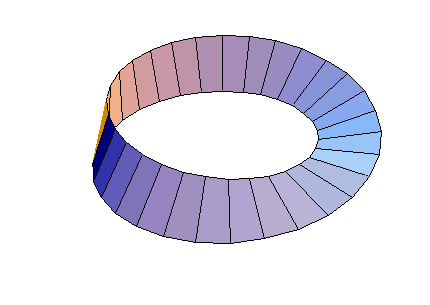
Fig 1. Half Moebius Band for nppu=2 . Note a slight color shade difference at v=0, v= 2 Pi junction crossover at mid-point of interval.
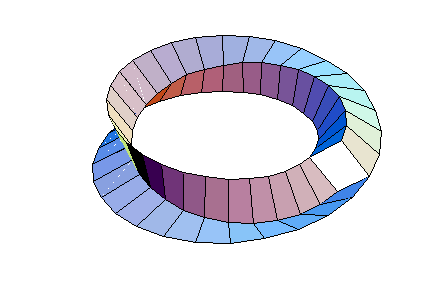
Fig 2. A half square tube with nppu=3. Full tube can be drawn if v is extended from 360 to 720 degrees. Note how the midpoint going in opposite directions of a degenerate Moebius Band. This does nothing to the continuity of surface for higher nppu as parts of a smooth manifold seen in the figures following.
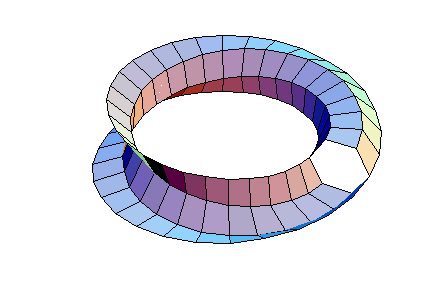
Increasing the number of sides towards a more circular tube section…
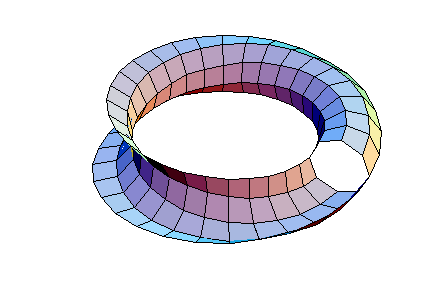
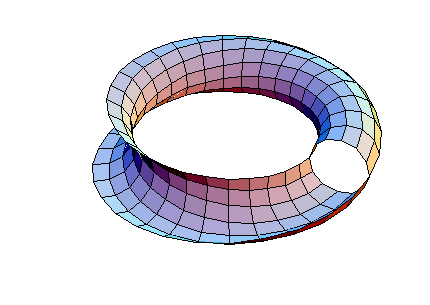
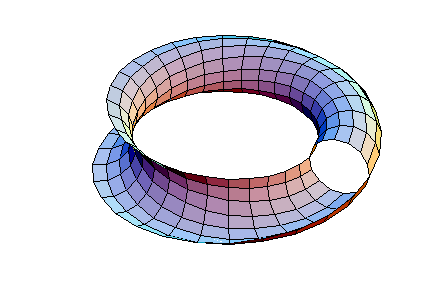
Fig 3. Approximating to a circular torus at nppu=8, as "polyband" or a spirally partitioned Half-Torus. Note the surface normals are in opposite directions at start and end of this half torus. (Inside of tube normals are directed towards tube center and normals on tube exterior are directed away). The orientation of half-torus is fully determinate as shown here, just the way it is for MB. Vector directions of differential area elements are same for all parameter choices, not upsetting surface orientation.
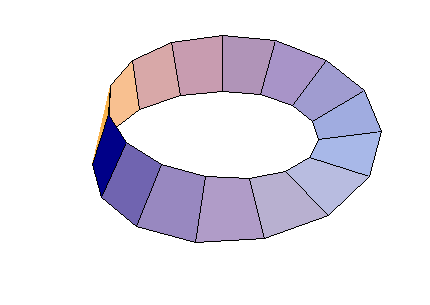
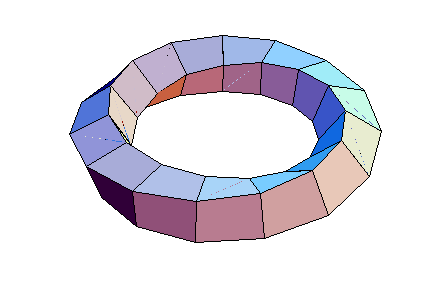
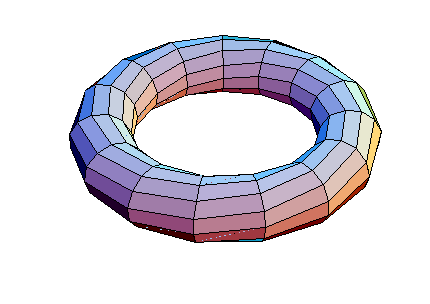
Fig 5. After cutting a toroidal tube or rod, bending and twisting without tearing is topologically permissible even at the point of incision before re-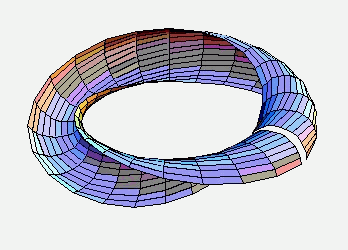 gluing or re-welding. In the animation of this program such permissible half –tube rotations (shearing deformation of parameter lines or filaments) are shown. There is a re-establishment of topological status quo ante after re-gluing or welding, restoring the original torus geometry, and embedding in R3.
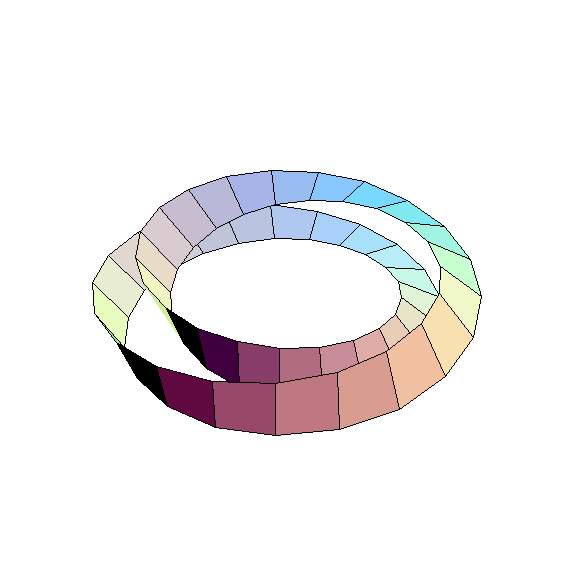
Fig. 6. The Band depicted alongside has two loops. For time being I call it Twisted Half Torus. When two such Bands are glued edgewise, it makes a whole square section torus. Twisted Half Torus is acceptable also as a Moebius Band topological variant, if not equivalent. No self-intersections occur here. It is formed by continuation of Half-Torus in Fig3 by making two such pieces. Also, its orientability is unambiguously homeomorphic to a half-torus.
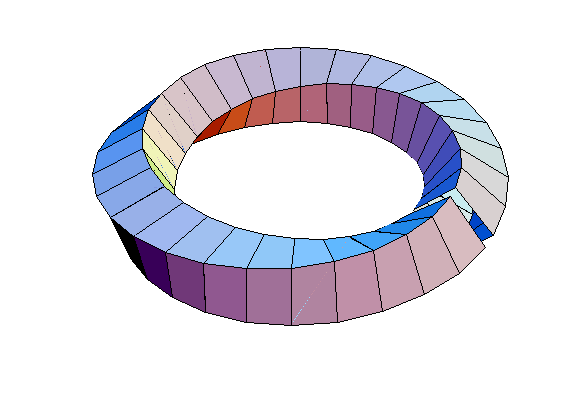
Fig 7. In the square tube below two tracks are clearly visible, and more so on spinning the picture on a program. Any one of the two tracks shown above separately is supposed to be a boundary when the other one is the right royal Moebius Band as per widely held current notion of the "non-orientable" MB (forgive quotes). This arbitrariness and incongruity can be removed by recognizing the thickness dimension of MB not as a boundary but as an interchangeable one-half constituent of a total toroidal surface.
Please comment on any related aspect. I am not sure what is error/loophole here, whether or how it may be related to tangent bundles, fibration, RP2, connection with Klein Bottle, etc. in single package of understanding, all that which I may take up after this doubt is cleared up.
Best Regards,
Narasimham G.L.
September 18, 2004
Emails:
[email protected] [email protected]