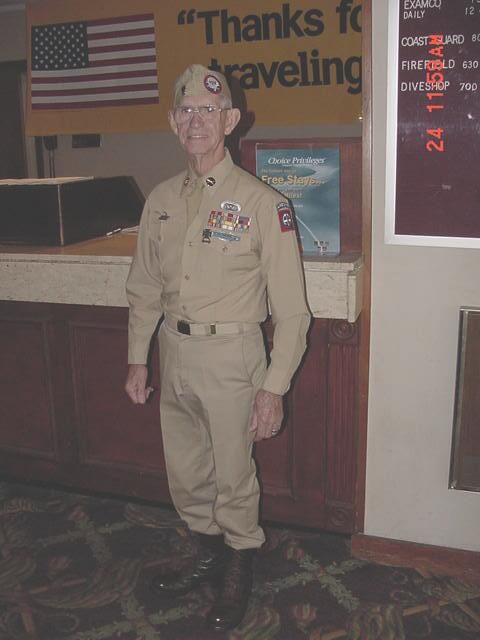
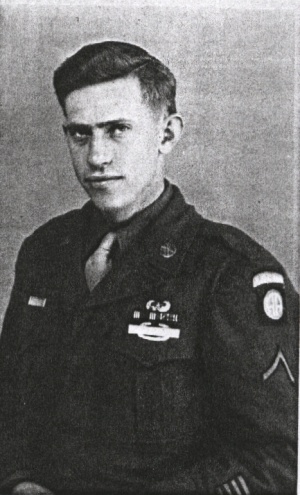
I was acting co-pilot on the American CG-4A going into Holland. My thoughts were upon what to do in case our pilot was hit and I had to take over and be able to land. Our company strength had been increased from 155 to 195 men before we left England. We caught a lot of enemy fire going in. Our glider had several holes showing where they had hit. I was in the co-pilots seat and when we landed the runners caught in the soft ground, standing us on the nose of the glider. It cast me against the crash bar, causing a great deal of pain. During the battle on the "Plain of Mook" one of our officers was killed. Someone buried him and he was not found for almost 50 years later. I was there when he was killed in 1944, and in 1994 I was there for his Mass and burial. We were surrounded for almost three weeks and cut off from our supplies. I ate my first horse meat during that time.
We were stationed at Sissonne, France when Von Rundstedt launched the attack in the Ardennes. We rode open trucks to Bastogne, sent on to Werbomont on the northern shoulder to the defense. It started to snow on the way up there and continued to snow from time to time until it was deep and very cold. The weather continued to grow worse. The planes could not be used upon the enemy. General Patton went to a small chapel and offered up a prayer. he asked God for a few hours of clear weather. The day before Christmas was a beautiful day with plenty of sun. They loaded our company on top of twelve tanks and went several miles behind the enemy lines and we took a little village of Regne. When we were about 150 yards from the village we jumped off the tanks and came into the village with rifles blazing. In some of the houses Christmas cakes were still warm where they had been baking them that day. I was in the snow and cold weather from December 17 to February 15, 1945. My hands and feet were frost-bitten. Many of our men were overcome with the cold. They did pull us back off the front to a little town of Pepinster, Belgium. They put us in an old warehouse without heat. Some of the townspeople felt sorrow for us and invited us into their homes. By February 2, 1945 we broke through the Siegfried Line and took two villages of Neuhof and Udenbreth. These villages were on the main road leading through the Siegfried Line.
As for the people and countries I was in... in Africa, Sicily and Italy I felt like they were all my enemies and always on guard. In Ireland, a very beautiful place but I couldn't get along with those people, I was too much Irish myself. England was a very beautiful place and I learned to love many of the people. I didn't like most of the people of France or the places I fought. The people in Holland and Belgium seem to appreciate what we done for them. As far as Germany, by the end of the war I hated the country and all the Germans. I had suffered and been through hell for three years. It was hard being away from home for three years. I never got to be home from the day I left for the Army until the day after I got my discharge. I missed my parents and being home. I was the only child of our family.
I was high point man when the point system came out. I moved to Company B, 194th Glider Infantry, to come home. I was discharged September 19, 1945. After returning to civilian life I worked as an Electronic Technician. I married two years after coming home, and we had two girls and one boy. I attended Electronic School for four years, then studied and became a Minister and Pastor for several years.
There have been many battles fought, but only those of us who fought in World War Two saved the world from destruction and having a dictator as a ruler. The American soldier will find a way to bring victory. Being in the service made me realize how important life is and to make use of every day. We only live in the NOW of time... enjoy it!
Airborne!! All the way!!
|