2 June 1999
Dialectology, or the study of regional dialects, has a long tradition in the United States, dating back to the formation of the American Dialect Society in 1889. In 1929, linguist Hans Kurath began directing a project that sought to develop an atlas containing speech patterns of United States English. Kurath's study yielded two important texts, the Linguistic Atlas of New England and A Word Geography of the Eastern United States. The data for the Kurath projects were collected through field workers speaking directly with local inhabitants and recording such information as word usage, or vocabulary, and pronunciation. (Cipollone et. al. 379) Since this time numerous other studies have been conducted, many with the aid of new technologies such as recording equipment, spectrographs, and computers, in order to accurately map the dialectal patterns in the United States.
In the mid-1990's, linguists from the Linguistics Laboratory at the University of Pennsylvania began work on the Telsur, or "Telephone Survey," Project. The goal of the Telsur Project, directed by William Labov, was to compile data that would allow for the creation of a Phonological Atlas of North America. To achieve this goal, the Telsur Project researchers contacted individuals across North America by telephone and collected data that would yield information concerning vowel usage, specifically certain vowel shifts that have occurred in various regions of North America. The participants in the study were selected from inhabitants of large populations centers, the logic being that these cities, as centers of high population density, represented areas of the most advanced stage of linguistic change. Generalizations could then be made concerning the language patterns of the inhabitants of the territory surrounding these cities. These generalizations were made by dividing the area of study into "zones of influence" in which the language patterns of the speakers of these zones was assumed to follow those of the "central city." "Zones of influence" were determined primarily by distribution of major newspaper circulation, but other geographical factors, such as proximity to another central city, were considered. (Ash)
The first publication of the Phonological Atlas of North America contains information based on the analysis of 240 of the 640 total participants in the Telsur project. Although the analysis is not yet complete, the available data were sufficient to map out approximate dialectal isoglosses for the United States. In this first edition of the atlas, the dialectal isoglosses for the State of Ohio are quite specific. Ohio represents a near merger of all three of the major dialect patterns in North America. The Inland Northern dialect pattern is present in Ohio in and around the city of Cleveland. The Southern dialect of Unites States English is stated to exist in extreme Southern Ohio near the cities of Ironton and Chesapeake, which are, themselves, part of the urbanized area containing Ashland, Kentucky and Huntington, West Virginia. The remainder of the state is divided between the Northern and Southern Midland zones, with the isogloss marking the distinction between the two midland dialects bisecting the state, roughly along the line of U.S. Route 40. (see figure 1) It has been the experience of the author of this paper that dialect patterns of inhabitants of Southern Ohio demonstrate qualities that could be described as "southern" at lines of latitude well north of the isogloss given in the Phonological Atlas of North America between the Southern and South Midland dialects. Therefore, I set out to research dialect patterns in Southern Ohio in an effort to challenge the findings of the Telsur Project regarding dialectal patterns in Southern Ohio.
In conducting my research I discovered that perhaps my attempt to disprove the findings of the Telsur Project regarding Southern Ohio was impossible. The Phonological Atlas of North America defines the Midland dialectal zone as the region in which speakers have not completely undergone the vowel shifts of Inland Northern and Southern speech. The dialect of the Southern Midland region, however, is defined as one in which speakers often show aspects of the southern vowel shift, but have not undergone the complete shift, the distinction between the Northern and Southern branches of the midland dialect being that speakers in the Northern Midland show no characteristics of the Southern vowel shift. This allowed for presence of features characteristic of the Southern vowel shift to be present in the South Midland, thus accounting for the appearance of a "southern" quality to the speech of Southern Ohioans.
Earlier literature has questioned the very existence of a Midland dialect and might have supported my claims that the dialect patterns of Southern Ohio bear close resemblance to their southern neighbors. Charles-James Bailey, in a speech to the Linguistic Society of America in 1968 challenges the very notion of a midland dialect and submits that the so-called "South Midland" should be considered "Outer Southern" and that the "North Midland" should be considered "Lower Northern." (Bailey) His claims were somewhat justified, in that the "Southern Midland" region at the time of his speech was believed to contain Kentucky, West Virginia, and parts of Northern Tennessee, all regions found by the Telsur Project to be situated within the Southern dialect region. As a Kentuckian, Bailey believed that his language had more in common with his neighbors to the South than with his neighbors to the north and he was right. Also, this notion is based on evidence that predates William Labov's extensive research into the North and North Midland isogloss, which is a much more distinct boundary than the South-South Midland frontier.
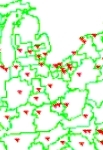
With this in mind, my research took on a different scope. As discussed above, the Telsur Project team collected data by dividing the country into "zones of influence" based around urbanized population centers. (see figure 2) Thus, no interviews of inhabitants of "rural areas" or of towns of fewer than 40,000 inhabitants were made in Ohio. My empirical research was thus geared towards confirming, or refuting, the methods used in collecting data for the Phonological Atlas of North America, in regards to speakers outside of major cites, by conducting interviews with individuals native to rural Southern Ohio and comparing their speech to the criteria for inclusion in the Southern and South Midland dialect zones.
To conduct my research I selected three subjects who are personally known to me and who grew up very near to one another in Ross County, in Southern Ohio. Subjects B and C were raised in the town of Chillicothe, Ohio, the county seat of Ross County, and the first capital of the State of Ohio. Subject A is a native of Frankfort, Ohio, a small town in rural Ross County, midway between Chillicothe and Washington Court House on U. S. Route 35. My decision to select subjects whom I personally know was prompted by a desire to create a comfortable testing environment. If the subject is personally known to the researcher, the subject is likely to be more relaxed, and personal familiarity with the speech patterns of the subjects by the researcher can prevent manipulation of the data by the subjects, themselves. The manner by which I collected data was the recording of interviews in which I asked the subjects to recite a list of words, designed to determine whether that speaker has undergone the vowel shifts characteristic of the Southern dialect of United States English. The list consists of 59 words which serve as indicators as to how the speaker pronounces various vowel sounds. The words selected are: bad, bait, bat, beat, bet, bit, bite, boat, bone, book, boot, bought, bout, butt, buyer, cad, card, caught, coat, code, cord, cot, dawn, die, Don, far, fire, hat, hate, hawk, hide, hock, Irish, Keds, keyed, kid, kind, know, liar, like, low, mad, made, miles, night, pay, pen, pie, pin, pot, put, ride, sad, sew, tire, tired, toe, tone, and why. The words are presented first in alphabetical order and then in a series of pairs, designed to recognize mergers of vowel phonemes in minimal pairs and to confirm the monophthongization of the phoneme /ay/. The pairs selected were: caught and cot, hawk and hock, Don and dawn, pin and pen, far and fire, and bet and bat. Additional words were also added from the above complete list to offset the significance of the minimal pairs in the mind of the subject. Following the reading of the list of test words, I had each subject then read a paragraph from a newspaper article in order to check for additional inconsistencies. After thoroughly analyzing the recorded data of the pronunciation of each of the test words and minimal pairs by each of the three subjects, I found that each speaker demonstrated aspects of Southern speech, but none had undergone the entire Southern vowel shift.
The Southern vowel shift is defined by William Labov as a series of consistent changes in the pronunciation of certain vowel phonemes (Labov) (see figure 3). The first stage in the Southern Shift is the monophthongization of the phoneme /ay/. Thus /ay/ -> /æ/, or the pronunciation of the word "hide" would sound more like the word "had" to speakers who have not undergone this shift. Subjects A and B demonstrate this stage in the Southern vowel shift. Subject C clearly demonstrates the diphthongal /ay/. Stage two is the shift in the diphthong /ey/ towards /ay/, thus the word "pain" would sound like "pine" to a speaker of another dialect. None of the subjects demonstrated this stage of the Southern Shift. Stage three is the lowering and backing of the phoneme /iy/, such that the word "keyed" would sound more like the word "kid." Again none of the subjects demonstrated this stage in the Southern vowel shift. Stage four is characterized by the parallel raising and fronting of the vowel phonemes /i/, /e/, and /æ/. None of the shifts in stage four were demonstrated by any of the three subjects. Stage five is characterized by the fronting of the /uw/ phoneme such that the pronunciation of this phoneme sounds like a rounded version of the phoneme /iy/. Subject B, but not Subjects A and C demonstrate this stage in the Southern vowel shift. Stage six is characterized by the fronting of the phoneme /ow/. Only one of the subjects, again subject B, demonstrated this shift. Stage seven is characterized by the raising of the phoneme /ohr/ as to approach /uhr/. Similarly, stage eight is characterized by the raising and backing of the phoneme /ahr/ as to approach /ohr/. Thus, the word "card" would sound like the word "cord" to a speaker of another dialect. Subjects A and B both demonstrated the seventh and eighth stages of the Southern vowel shift.
Table 1: Research Results

Phenomenon                           Subject:   A      B      C
/ay/ monophthongization (stage 1)              yes    yes    no
/ey/ shift (stage 2)                           no     no     no
/iy/ shift (stage 3)                           no     no     no
/i/ shift (stage 4)                            no     no     no
/e/ shift (stage 4)                            no     no     no
/æ/ shift (stage 4)                            no     no     no
/uw/ shift (stage 5)                           no     yes    no
/ow/ F2 > 1350Hz (stage 6)                     no     yes    no
/ohr/ -> /uhr/ (stage 7)                       yes    yes    no
/ahr/ -> /ohr/ (stage 8)                       yes    yes    no
"pin/pen" merger                               very   yes    very
                                               close         close
"cot/caught" distinct                          no     yes    no*


*"Cot" and "caught" and "Don" and "dawn" were not distinct for Subject C, however, "hock" and "hawk" were.
Two other characteristics of the Southern dialect that the three subjects were tested for were the merger of the phonemes /i/ and /e/ before nasals, or the "pin/pen" merger, and the distinction between the vowel sounds of "cot" and "caught." In the case of the "pin/pen" merger, Subject B demonstrated a complete merger between these two phonemes. Subjects A and C did not pronounce the two phonemes precisely the same, however in their speech the /i/ and /e/ phonemes before the nasal were sufficiently close that a speaker of another dialect might not be able to distinguish one phoneme from another when heard independently. In the case of the distinction between the vowel phonemes in the minimal pairs of "cot" and "caught," "Don" and "dawn," and "hock" and "hawk," Subject A made no distinction between the two phonemes, Subject B pronounced the two phonemes distinctly, and Subject C distinguished between the two phonemes only in the case of "hock" and "hawk." The reason for the distinction made by Subject C between minimal pair "hock" and "hawk," but not in other minimal pairs of the same phonemes, is unclear. The fact that in the case of "hock" and "hawk," the phoneme precedes a velar stop means that the word ends with the tongue toward the back of the mouth. This could account for distinction between the two back phonemes of /a/ and /)/. Perhaps the speaker views the word "hawk" as having a greater significance than "hock," "cot," "caught," "Don," or "dawn," all of which are pronounced by the subject with an identical vowel phoneme. The distinction made by Subject C between the vowel phonemes of "hock" and "hawk", if not consistent, is, nonetheless, a distinction not made by most speakers of the Northern Midland dialect.
One aspect of the study that is of particular interest is the criteria for stage six of the Southern vowel shift. Stage six is the fronting of the phoneme /ow/, specifically raising the F2 value of the vowel sound to greater than 1350Hz on the spectrograph. The Phonological Atlas of North America uses stage six as an indicator to define the Southern Midland dialect. This is clearly stated in the atlas in a passage in which it is stated that "The criterion for South Midland membership is a simple one: the fronting of checked /ow/ as registered by an F2 of greater than 1350Hz." (Labov et. al.) What is of interest regarding this statement is that only Subject B demonstrated any fronting of the /ow/ phoneme. The fact that all three subjects are clearly within the Southern Midland dialect, as all three live within the defined zone, and none of the three have undergone the complete Southern vowel shift, though each of the three demonstrates characteristics of the Southern vowel shift, means that perhaps the fronting of the /ow/ phoneme is not an accurate criterion for South Midland membership, as defined by the Project.
In conclusion, the results of my research are conclusive. The three subjects of this study are, indeed, speakers of the South Midland dialect, as defined by the Telsur project. Although only one of the subjects, Subject B, demonstrated stage six of the Southern vowel shift, the fronting of the /ow/ phoneme, explicitly stated in the Phonological Atlas of North America as the criterion for South Midland membership, all three subjects, to varying degrees, demonstrate elements of the Southern vowel shift without exhibiting the complete shift. Therefore, according to the broad definition of the South Midland dialect, as a dialect of which speakers have not undergone either complete vowel shift, but may exhibit elements of the Southern vowel shift, the three subjects of this study are, indeed, speakers of the South Midland dialect. Furthermore, this research confirms that speakers of rural Southern Ohio share the same dialect patterns of the major cities from which the generalizations by the Telsur Project team about the speech patterns of non-urban residents of Southern Ohio were made. My research has thus affirmed that findings of the Telsur project regarding the dialect patterns of Ross County in Southern Ohio. Furthermore, I have found no evidence to disprove the validity of the Telsur Project team's process of creating "zones of influence" in which the speakers share the dialect patterns with the "central cities." Therefore, my research confirms the findings of the Phonological Atlas of North America concerning dialect patterns in Southern Ohio. The isogloss between the Southern and South Midland dialects is, as far as my research can indicate, accurate.
Ash, Sharon. "Sampling Strategy for the Telsur/Atlas Project." Article. Date Unknown.
Bailey, Charles-James Nice. "Is There a 'Midland' Dialect of American English?" Edited Speech. July 1968.
Cipollone, Nick and Steven Hartman Keiser and Shravan Vasishth ed. Language Files: Materials for an Introduction to Language & Linguistics. Seventh edition. Columbus: Ohio State University Press. 1998. pp. 43-76, 368-85.
"Dane." Subject A. Interview. 14 May 1999.
"Jesse." Subject B. Interview. 14 May 1999.
Labov, William and Sharon Ash and Charles Boburg. "A National Map of the Regional Dialects of American English." Article. 15 July 1997.
Labov, William. "The Organization of Dialect Diversity in North America." Edited Speech. 6 October 1996.
"Scott." Subject C. Interview. 14 May 1999.
Return to My Essay Page.
Return to The Domain of Depravity.