2 December 1996
The Holy Name Roman Catholic Church, located at 154 East Patterson in Columbus, Ohio is a marvelous example of medieval rivivalism in Twentieth century America. Designed by Edward A. Ramsey of Columbus, and completed in 1926, the Holy Name Church is a testament to the architectural achievements of Western civilization. This paper will attempt to determine the exact architectural influences that went into the design of the Holy Name Church, first by examining the structural elements of the building and then analyzing the historical influences that led to these elements.
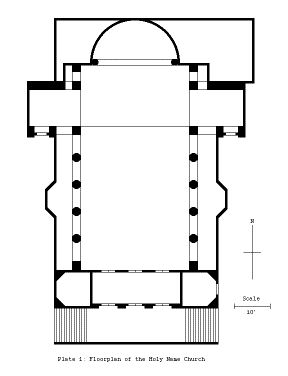
The Holy Name Church, itself, is an intriguing structure. The floor plan (plate 1) indicates that this structure is a transept basilica, which is topped by a timber superstructure. The nave is flanked by a single pair of aisles, defined by rows of columns, linked by arches, covered by wooden shed rooves. To the North, just beyond a chancel, flanked by shallow transept arms, lies a single apse topped by a half dome. To the South stands a narthex with three arched doorways, flanked by two low towers. This brief description of the architectural elements does not provide any true clue to the church's roots. A closer look must be taken in order to determine what influences went into building this intriguing structure.
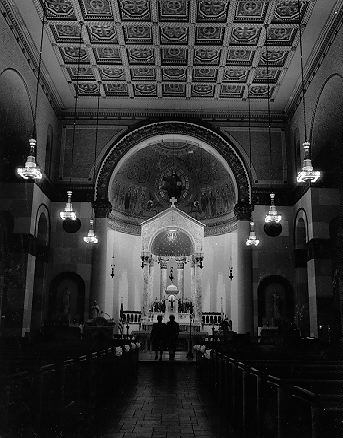
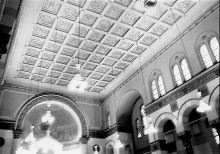
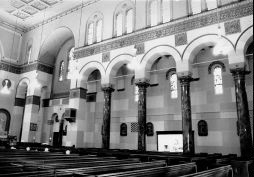
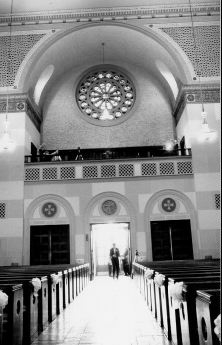
The first thing that the viewer notices upon entrance into the nave through the South doors is the brightly illuminated apse directly to the north (plate 2). This semicircular apse is framed by an arch resting on Corinthian columns, covered by a half dome, and decorated by a painting of the Christ and the twelve apostles. After the apse, the viewer is struck with the magnificently spacious interior. The nave is very wide. The ornately coffered wooden ceiling (plate 3) is very high. The tall aisle arcade screening the narrow aisle and the tall, albeit shallow, barrel-vaulted transept arms create a sense of openness (plate 4). The flanking of the aisle arcade, itself, by piers, combined with the piers to the North of the transept arms subtly articulates the division between the nave and the chancel. This subtle articulation does not diminish the sense of continuity of space within the nave. Behind the viewer, to the south, above the entrance doors, lies a false barrel-vaulted, "choir space" crowned by a rose window (plate 5). Although the different "spaces" within the nave, the apse, chancel, nave itself, and "choir space," are "defined" architecturally, the continuity of space is uninterrupted from end to end. Only the aisles are at all divided from the rest of the interior space, but the narrowness of the aisles, combined with their height, diminishes the sense of division between aisle space and nave space.
The entire space is dimly lit by windows of all sorts and a number of electric light fixtures. The majority of the natural light comes from the second storey, clerestory, windows. These units are comprised of double arched windows, housed in a slightly recessed, larger, arch. This series of five pairs of paired clerestory windows correspond to the five pairs of arches in the aisle arcades. Additional side light comes from smaller arched single windows in each aisle, which also correspond to the aisle arches. Each transept arm is lit by a set of three arched windows. These appear in the form of one large window flanked by two smaller windows. To the North of each arm of the transept, in the "chancel," exists one smaller, single, arched, clerestory window. These smaller "chancel" windows, like the clerestory windows of the nave, are set within a slightly recessed arch, albeit much smaller versions than those around the double windows of the nave. Additional sunlight enters the nave via the large rose window in the narthex. The placement of the rose window at the South end of the building provides for proportionately greater amount of light from the end opposite the alter than would be present in a structure whose axis corresponded to the standard, Eastern apse, configuration. Conversely, the situation of the apse to the North would preclude the admittance of much light from that direction, so no windows are present in the apse.
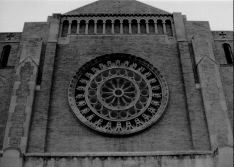
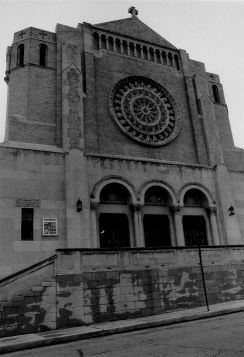
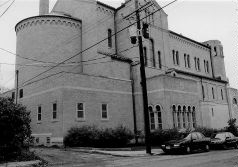
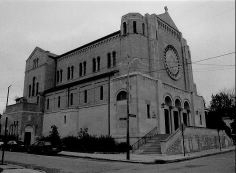
The exterior of the Holy Name Church is a magnificent as the interior (plate 6). The sheer mass of the structure dwarfs all other buildings around it. The most prominent feature, aside from the mass of the structure, is the rose window of the facade (plate 7). The window is very large and ornately carved. The size, however, is deceptive, insofar as the glazed portion of the rose is surrounded by an ornately carve frame which appears, at first glance, to be part of the window proper.
The prominent rose window is framed on all sides by architectural elements (plate 8). Beneath the rose lies a cornice which extends beyond the center section and divides the first storey of the narthex from the second. To both sides of the rose window spring pilaster strips which extend towards a dwarf gallery which forms the top edge of the "frame." To both sides of the "rose window section" of the facade lie "semi-octagonal" engaged towers. These towers only reach to the heighth of the nave ceiling and are "engaged" in the sense that they are not free standing. Furthermore, the towers would form perfect, equiangular octagons, in plan, if not for the fact that three sides appear to be consumed within the narthex. Near the top of these towers, between two cornices, are situated a number on unglazed windows. On four sides these arched windows are housed within recessed arches, but on the lateral sides of the "octagon," in relation to the long axis of the narthex, are situated windows framed by extending arches, supported by columns on corbelled tables (plate 9). Below the second storey of the facade lies a three porticoed entranceway. The three doors are covered by arches of equal dimensions resting on columns of Byzantine extraction. To the sides of the center, entranceway, section lie the quadrilateral bases to the polygonal towers above. On the Southern face of the these tower bases exist small, rectangular, windows. To the lateral sides of the bases of the towers are arches which appear to have once covered windows. On the North tower the arch covers an area of unmatching stone. On the South tower, however, the arch tops a street-level doorway.
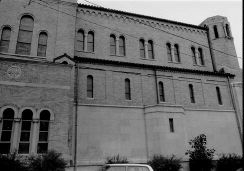
In contrast to the relatively complex facade, the exterior walls of the nave are elegantly simple in their articulation (plate 10). At street level, corresponding to the lower half of the first story of the interior of the nave, is a belt made of large stone blocks separated from the upper portion of the building by a cornice. The lower "belt" is interrupted only by a shallow protruding "chapel-like" extension of the wall which lies at the center of the wall between the narthex and the transept. Directly above this lower portion of the wall sits a series of recessed squares wherein lie the five arched aisle windows. This portion of the wall and all of the wall above are made of bricks. Above the series of recessed squares is a shed roof above the aisles above which sits the clerestory. The clerestory windows, as noted before, are series of arched windows arranged in pairs which are divided by single columns. Above the clerestory windows, directly below the line of the double-pitched nave roof, lies an arched corbelled table frieze which runs the length of the wall.
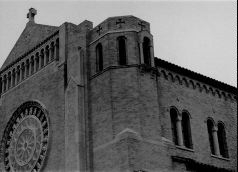
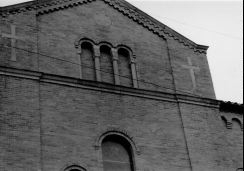
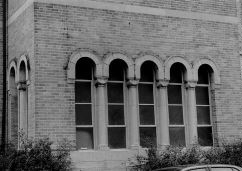
The transept arms appear to grow out of the otherwise almost uninterrupted wall. They, like the nave, are topped by a double pitched roof, albeit over the shallow barrel vault. The transept, also like the nave, is divided into three storeys. These storeys, however, are not aligned with the storeys of the exterior nave wall. The top storey extends above the clerestory and is characterized by three small blind arches at each end of the transept (plate 11). Like the arches in the clerestory windows, these arches are linked by small colonettes, but unlike the arches in the clerestory, these are high-shouldered. The second storey of the transept houses the triple, arched, end windows that were discussed earlier. The bottom storey of the transept is an interesting case. This storey extends beyond the plane of the upper storeys on both ends to form two small rooms with doors on each side leading to the South. These rooms are brightly lit through a number of arched windows, five on the ends and two on both North faces of the transept arms (plate 12). These arches, like the blind arches above, are high-shouldered and connected by columns.
The exterior of the chevet, if it can be called such, consists of a shallow chancel extension, which mimics the nave wall, and the hemicycle apse, surrounded by modern office space (plate 13). The apse is completely unadorned with the exception of a continuation of the corbelled table, as from the nave and chancel walls.
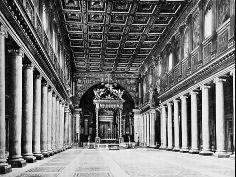
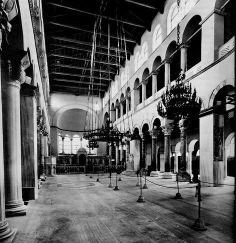
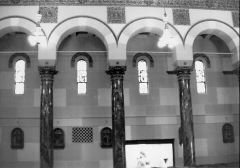
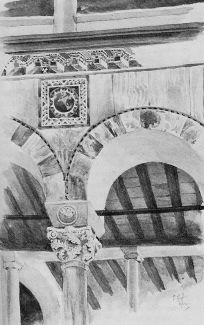
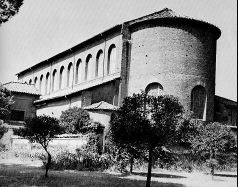
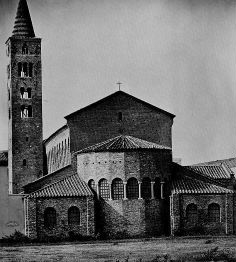
At first glance, the Holy Name Church may appear to be modelled in the Early Christian style. A look at the interior (plate 2)(plate 3)(plate 4) gives the viewer a similar feeling as when viewing the interiors of fifth century Early Christian buildings such as S. Maria Maggiore in Rome (plate 14) or H. Demetrios in Salonica (plate 15). Indeed, the arches above the aisle arcade in the Holy Name Church (figure 16) are strikingly similar to those in Hagia Demetrios (plate 17). Similarly, the relatively unadorned exterior also suggests a similarity to Early Christian structures. For instance, the Northern end of the Holy Name Church (plate 13) bears a similarity to such monuments as S. Sabina in Rome (plate 18) and S. Giovanni Evangelist in Ravenna (plate 19). This association of the Holy Name Church with Early Christian, however, is not accurate. There is no doubt that Ramsey was influenced by architectural styles that were influenced by Early Christian architecture, nevertheless, the assumption that this monument is entirely and Early Christian structure is highly questionable.
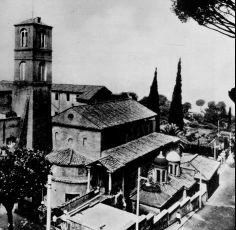
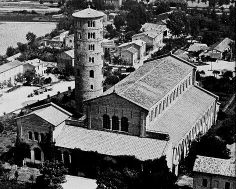
The architecture of the late Roman empire and early Christianity influenced the architecture of the Byzantine empire. Consequently, the assumption that the Holy Name Church is an early Christian copy is disproved by the existence of architectural elements that are distinctly Byzantine. Again, the exterior, at first glance, may appear to be of a style somewhat similar to Byzantine basilicas. If one compares the Holy Name Church to the the church of S. Agnese in Rome (plate 20) or S. Apollinare in Classe (plate 21), one again notices similarities, but again these similarities are superficial. None of the early Christian or Byzantine basilicas mentioned have a transept, narthex towers, rose window, or corbelled table frieze. Although the building has a definite Byzantine "feel" about it, as inherent in the double arched clerestory windows, and the high-shouldered arched windows on the transept arms, there are enough elements that preclude this church from being a Byzantine copy.
Many of the puzzling architectural elements in the Holy Name church can be found in the Lombardic proto-Romanesque style. Kenneth Conant states that "The Style created about the year 800 in Lombardy became the first really international Romanesque style" (Conant 107). This Lombard Proto-Romanesque can account for the Byzantine influence. The proximity of Ravenna, the seat of Byzantine power in the age of Justinian, to Milan, the cultural capitol of Lombardy. The location of Lombardy in the extreme North of Italy also allowed the Lombards access to the influence of the Carolingian North. These two conditions allowed for the development of an architectural style which would spread across the Mediterranean world and which would possess all of the elements in the Holy Name Church which were not present in the early Christian or Byzantine periods: the arched corbelled table frieze, the rose window, and the narthex towers.
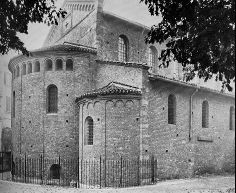
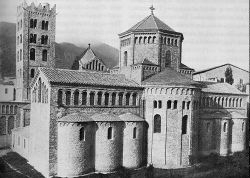
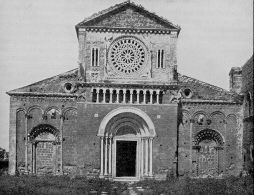
The development of the corbelled table frieze was an early event over the course of the development of Lombardic Romanesque. S. Vicenzo in Prato, in Milan (Plate 22) is one of the earliest examples of a Lombardic basilica with a corbelled table. S. Maria at Ripoll (plate 23) is another excellent example of a Lombardic style building, this time in Catalonia, one of the regions outside of Italy most influenced by the Lombardic style, which has many similar traits to the Holy Name Church. The frequent use of the arched corbelled table frieze, the existence of dwarf galleries, and the use of double arched windows separated by a single colonette are all architectural elements used at Ripoll which also appear on the Holy Name Church. The rose window of the Holy Name Church is characteristic of later Lombardic buildings, in particular the rose window of S. Pietro at Toscanella (plate 24) is nearly identical to that of the Holy Name Church (plate 5).
Unfortunately, the consideration of the Lombardic Romanesque style is not complete. For example, there are remarkable few early Lombardic churches of note that have transepts, and even fewer that have double towers on the narthex. Very few Lombardic churches have but one apse, most have at least three. As the Lombardic Romanesque style spread, at first throughout Italy, Catalonia and Northern Spain, and along the Dalmatian coast, then later throughout Western Europe, many other influences combined with the Lombardic style to create new architectural styles. For instance, in the north, in Germany and especially in France, the Lombard style played a part in the development of mature Romanesque. The Lombardic influence on the Holy Name Church may be a result of a later style being influenced, which might solve the transept and tower dilemmas. Nonetheless, the Lombardic stylistic influences are unmistakable. It is the opinion of the writer of this paper that the design of the Holy Name Church was heavily influenced by Lombardic Romanesque architecture, which was, in turn, influenced by early Christian and Byzantine architecture.
Chierici, Sandro. Lombardie Romane. Milan: Zodiaque. 1978.
Conant, Kenneth John. Carolingian and Romanesque Architecture 800-1200. New Haven: Yale University Press. 1993.
Insurance Maps of Columbus, Ohio. Volume 3. New York: Sanborn Map Company. 1949.
Jackson, Sir Thomas Graham. Byzantine and Romanesque Architecture. Volume I. New York: Hacker Art Books. 1975.
Krautheimer, Richard. Early Christian and Byzantine Architecture. New Haven: Yale University Press. 1986.
Mabius, Friedrich and Ernst Schubert. Architectur des Mittelalters. Weimar: Hermann Bshlaus Nachfolger. 1983.
Polk's Columbus City Directory. Volume 1932 LVI. Columbus: R. L. Polk & Company. 1932.
Rivoira, G. T. Lombardic Architecture: Its Origin, Development, and Derivatives. Volumes I and II. New York: Hacker Art Books. 1975.
Salmi, Mario. Chiese Romanche Della Toscana. Milan: Electa Editrice S. p. A. 1961.
Schütz, Bernhard and Wolfgang Müller. Deutsche Romanik: Die Kirchenbauten der Kaiser, Bischsfe und Klsster. Freiburg: Herder. 19
89.
Whitehill, Walter Muir, F.S.A. Spanish Romanesque Architecture of the Eleventh Century. London: Oxford University Press. 1941.
Return to My Essay Page.
Return to The Domain of Depravity.