(in conjunction) with the Teflon-coated (throttle) plate and shaft eliminated all ice deposition".
|http://www.ez.org Carburetor Ice Ken Clunis
In 1970 the Fuels and Lubricants Laboratory of the
National Research Council of Canada conducted a study of carburetor icing in
aircraft engines. A report submitted by L. Gardner and G. Moon of the laboratory
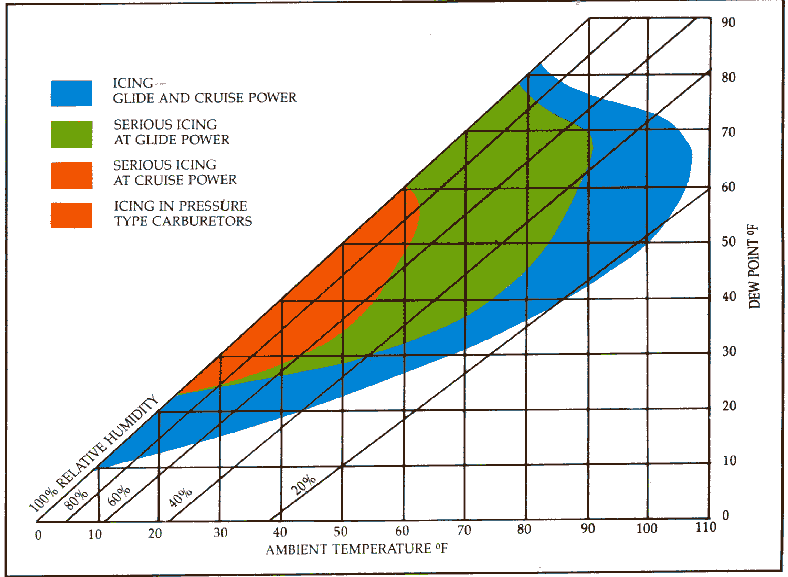
contained a chart of the icing probability of light aircraft engines which was
based on the data by the D. O. T. Accident Investigation Division (C.A.I.E.).
This chart was printed in black and white and is a little difficult to read. In
1988 The AOPA published an article written by Arthur A. Wolk on Induction Icing
wherein he used the same chart as the Canadians but used colors to separate the
various degrees of icing making the chart much more understandable. This later
chart was used to generate the GIF for this web page but the data is the same as
the one found in the Fuel Laboratory Report. For further details
about the findings of the Research Council on carburetor icing, refer to the
article on Carburetor Icing in the January issue of Central States Newsletter,
the April 1988 issue of AOPA PILOT or , better yet, the report itself, published
by the National Research Council - "Mechanical Engineering Report LR-536" by
Gardner and Moon. The findings are startling, to say the least, and once you
read the report, you may be very inclined to replace your carburetor heat system
with something much simpler, but more importantly, one that works. To quote from
the report "The use of ethylene glycol mononmethyl ether
(in conjunction)
with the Teflon-coated (throttle) plate and shaft eliminated all ice
deposition".