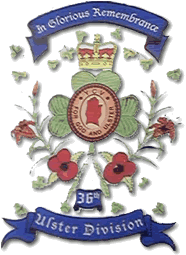
| In october, 1915 after several month`s of preparatuon in England, men of the 36th (ulster) division sailed across the channel and began to disembark in France. The soldier`s drawn from all part`s of the nine countie`s of Ulster, had previously trained at finner camp in Donegal, ballykinlar in county down, and the clandeboye estate near bangor. All were volunteer`s with an overwhelming majority of them in their late teens and early twenties and, while many perhaps sought adventure and a chance to see some of the world beyond the confine`s of their own home town`s and villages , they believed absolutely that their cause in going to war to free France and Belgium from german oppression and invasion was just and honourable.During the next winter and spring they learnt their combat and trench skills in the quieter regions of the western front before moving in june, 1916, to take over the alloted areas on either sides of the river Ancre and west of the village Thiepval in preparation for the forthcoming battle of the Somme which started on 1st july, 1916. For the british, commonwealth, and empire soldiers the outcome on that day was little short of a massacre. The Ulster division, which gained a few hundred yards of ground from Thiepval wood up the hill towards the dauntingly fortified schwaben redoubt, suffered some five and a half thousand casualtues-out of a total divisional complement of ten or eleven thousand men. (IN WRITING OF "CASUALTIES" IT IS A GENERALLY ACCEPTED ASSUMPTION THAT ONE OUT OF EVERY THREE WAS KILLED OR DIED OF THEIR WOUNDS ,LATER).Unable to advance or retreat, and impossible to reinforce because of unrelenting german shell, and machine-gun fire , those soldiers in the redoubt and elsewhere in no-mans land held on until night gave them cover to slip back to the precarious safety of their own lines. The next day the division was withdrawn from the front and moved the the areas around st.omer where it regrouped, recieved large numbers of fresh soldiers to replace those who were killed or wounded, and made ready for it`s next engagment-battle of messines. The small town of messines lies at the southern ond of a low, rounded ridge which stretches eight kilometers northwards towards ypres. The ridge overlooks the flat flanders plain and, in 1917 in the hands of the germans, it dominated the southern sector of the ypres salient held by the british. It`s capture was vital if the commander-in-chief`s (field marshal Haig)strategic attack eastwards out of the salient was to succeed.The 36th had been kept back from the original assault so that it could be used at a later date.But in the area northwest of ypres and near the village of st.julien the division there was so badly battered and it`s soldiers so tired that it was decided to withdraw them and replace them much earlier than expected with the Ulster division. This was accomplished in the rain and mud of the night of 2nd august and completed by the early hours of the next mornibg.There they existed for another fourteen days where all were soaked by the continual rain and suffered from a lack of food, of heating and of drinkable water.Lying in trenches which were little more than watery scratches scooped out of the morass and feebly protected by sandbags filled with mud,the soldiers endured perpetual shelling and small arms fire.It was out of these conditions that with the 16th (IRISH) division on it`s right, they were ordered to make an attack on the 16th august in what has become known as the battle of langemarck.The Ulster division was to advance about two and a quarter miles to reach it`s objective-an imaginary "red line".At 4.45am the men left their trenches but:pounded by high-explosives,shrapnel,and gas shells;ravaged pitilessly by machine -gun fire from impregnable concrete pill boxes protected by barbed wire entanglements;saturated by the rain;lost in a featurless landscape;and encumbered by the clinging mud:only a little ground on the left was gained,and by nightfall most of those still alive were back where they had started.That any progress at all was made is a tribute to the bravery and determination of the men,for the ambitious plan,concieved in the comfort of a distant headquarters,defied reality and was fataly flawed.In the dreadful conditions of the battle field the british artillery`s preminary barrage and it`s subsequent"creeping"covering fire,which went far ahead of the attackers,were innefective;and a few supporting tanks,bogged down in impassable mire,never appeared.Furthermore,a weary division which had already sustained some 2,000 casualties due to enemy action durung the previous two weeks,should never have been ordered to attack in the face of such overwhelmingy adverse odds.For the capture of a few worthless yards of mud the attack resulted in 58 officers and 1278 men being gassed or wounded.During it`s sixteen days in the line,from 2nd to 18th august, the division suffered the total loss of 144 officers and 3,441 men either killed,wounded or missing.The 16th (irish) division suffered greviously also,and together the two divisions suffered about 7,800 casualties-amounting to perhaps 50% of their original numbers.However,the efforts and sacrifices of the men were not enough for the 5th army`s commanding general; for Haig confided to his diary that Gough - was not to have gone forward but failed to keep what they had won.....The men are Irish and apperently did not like the enemy`s shelling.The pitful tragedy of "third ypres" continued it`s bloody course untill on 4th november the battle ended when the Canadiens captured the muddy mound which had once been the village of Passchendaele- a name now associated irrevocably with the battle and which. perhaps,recalls more poignantly the sorrows of the men who fought there.After langemarck the division was withdrawn to rest and to recieve reinforcments.It did not , however ever have the same character again for most of it`s original men had been lost in everyday hazards of war,and in the battles of the SOMME.MESSINES, and PASSCHENDAELE. Manu of the recruites which filled the empty ranks were from diverse other parts of the british isles-often young conscripts aged about nineteen or twenty.Neverless,the division dtill had a significant part to play in many of the remaining battles and campaignes of the war such as: the battle of CAMBRAI in november,1917; the german spring offensive of 1918, and it`s advance through Belgium during the war`s final hindred days. Everwhere it fought it aquitted itself with courage and fortitude and by 11th november,1918, nine victoria crosses and a multitude of other gallantry medals had been awarded to the doughty men of the 36th(ULSTER)DIVISION). |