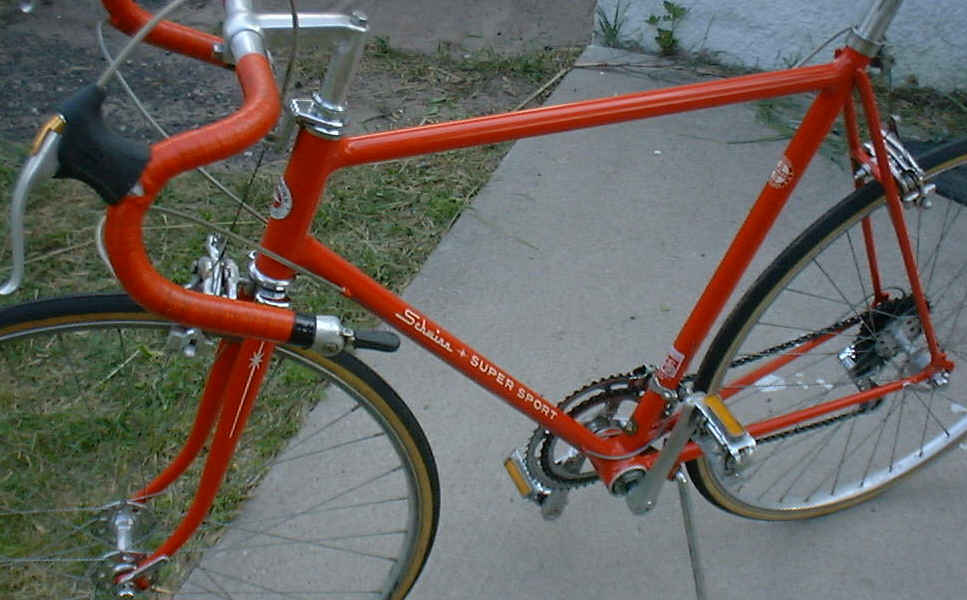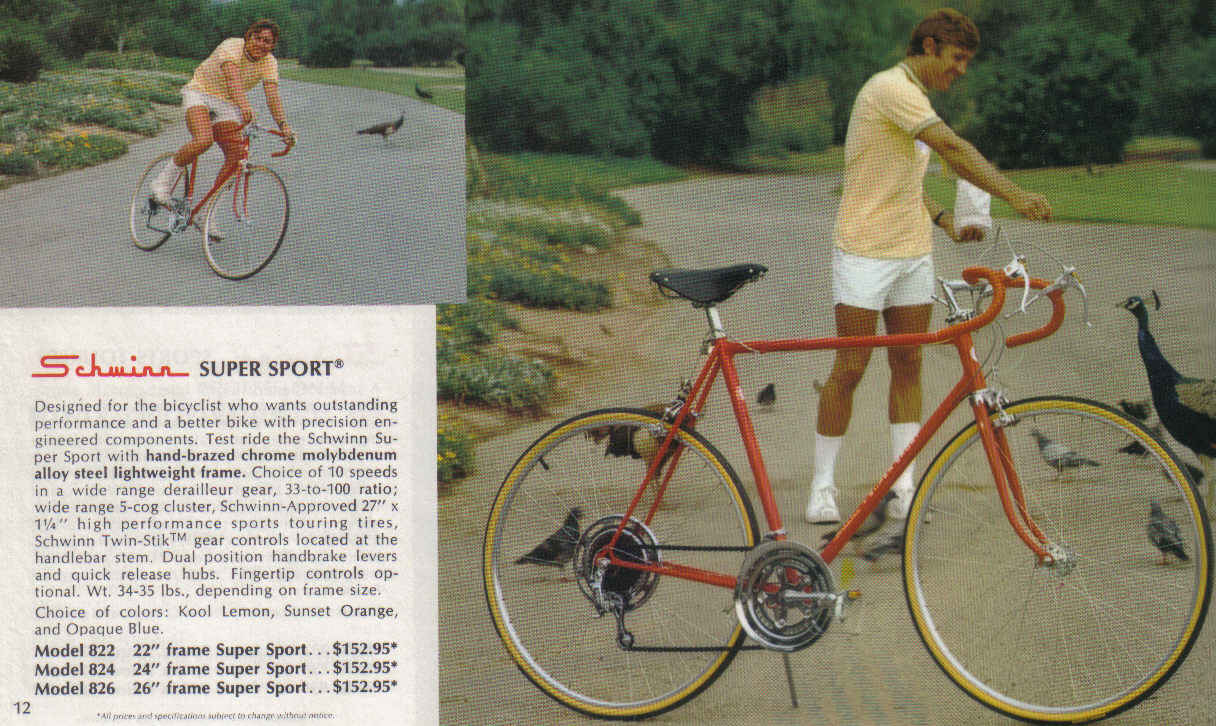
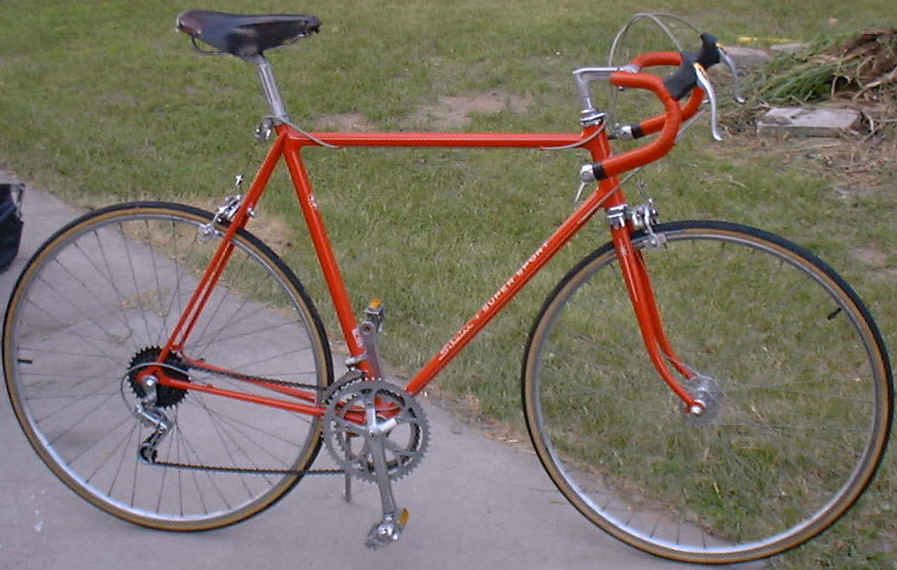

For additional strength the frame tubes and stays are reinforced with internal sleeves at the brazed joints; a sort of "butting." Schwinn's goal in building these framesets was to achieve greater strength at the expense of a little more weight. Customers could replace components as they wore out, but Schwinn's frames had to live up to the their well-advertised lifetime warranty. Frame strength was a basis of Schwinn's design philosophy.
Schwinn did cut a few corners on one of the most time-consuming aspects of fillet-brazing bicycle frames: cleaning up and smoothly finishing the joints. Schwinn's fillets at the head tube are usually well finished, but other joints are sometimes sloppy or not fully smoothened. Schwinn's policy seemed to be to finish the fillets to the extent that they are visible at first glance. So seatstay-to-seat-tube and rear-dropout brazing was often just partially smoothened, and the undersides of the chainstay-to-bottom-bracket joints were rarely finished or smoothened at all.
The finished frames were strong, durable, and relatively lightweight. They feature contoured joints, thin seatstays with bullet-point tips, and those slightly oversize seat- and downtubes. Their frame geometry includes long chainstays and fork rake, a low bottom bracket shell, a 73 degree seat-tube angle, and a 72 degree head-tube angle, all of which provide a smooth and stable, "sweet handling" ride. With these models Schwinn achieved a nice balance of frame rigidity and smooth handling.
Although they were fabricated in the same shop as the Paramounts, from there Schwinn's fillet-brazed frames took a different production path. Paramounts continued through their own paint and assembly processes, while the fillet-brazed models were added to the assembly line with high-volume Schwinn flash-welded frames for serial-number stamping, electrostatic painting, and final assembly. Hence Paramount serial numbers are unique to Paramounts and serve as a tally of Paramount production, while serial numbers on the fillet-brazed models were mixed in with other Schwinn models. This is also why the fillet-brazed models came in the same colors as lower-priced Schwinns, which contributed to their obscurity.