Nissan SR20DET powered Locost – Greg's Build Page
Clubman cars are derived from the Lotus 7, designed by Colin Chapman. The Lotus 7 was buiilt by Lotus (1957-1973) and then by Caterham (1973-Present). Many clubman kit cars are available for the road and the race track. The clubman is a lightweight road going sports car with nimble handling and stunning acceleration.
The Locost (low cost) is the generic name for the various homebuilt clubman sports cars that have been inspired by the book "How to build a sports car for UKP250 and race it" by Ron Champion.
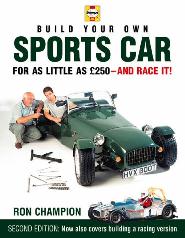
The Book and others like it are readily available from online and retail booksellers. They includes plans for building a low-cost clubman sports car, with a steel tube chassis and largely using donor parts from popular cars like the Ford Escort Mk II, Ford Sierra or Mazda MX-5. This has inspired many people to build their own locost, and not so low-cost, car, using a wide variety of donors. Many of these builders web pages can be found on the
locost-webring and forums on Yahoo Groups and Oz-Clubbies . Back to TopThe Puma is the creation of John Karnon and Neville Darwin. They followed the Book, but departed from it, where required, to meet the requirements for road registration and to use an engine with more power than the average clubman. The result was a car 4 inches wider and 2 inches taller, additional chassis tubes to meet a torsional rigidity requirement and using the Ford Cortina TC (otherwise known as the Mk III) rear axle, but otherwise to the Book.
Puma #1 (Rego 'PUMA 98') was featured in Fast Four’s (B&W only Pages
1,2 & 3) and on Autospeed.At that time John and Neville were quoted as saying the wanted to produce the Puma as a kit car. Ultimately, John started supplying tack-welded chassis and access to the Engineers report for registration in South Australia to other builders.
John is now supplying not only chassis (now fully welded) but practically a kit. Further details can be found at
Puma Back to TopIn Australia locost, kit and one-off cars are known as Independently Constructed Vehicles (ICV’s). The rules for road registration in Australia are more restrictive for ICV’s than in UK, and many other countries. ICV’s must comply with some of the Australian Design Rules (ADR’s) applying to mass produced cars. The ADR’s are applied differently by each State Road Transport Department. A brief summary of the ADR’s applying to ICV’s is usually available from each State Road Transport Department, which thankfully avoids the need to read the whole ADR. Generally, the State Road Transport Department will require a report on the ICV by a qualified Engineer, on the design, the construction (i.e. welding quality) and some tests (torsional rigidity, engine emissions, lane change, etc). Qualified Automotive Engineers may be found in the
Yellow Pages, from State Road Transport Departments or from other builders, who may be contacted via the forums mentioned abovce. Kit cars still require an engineers report for road registration, however the master report for the first-of-type generally removes the need for testing and reduces the cost of the engineering. The choices available to the locost builder in Australia are to build either a kit, or a one-off car, or to form a syndicate and share costs. In Adelaide, 3 Clubman builder syndicates have/do exist (Sirius 7, ASP and Clemente), and for similar reasons a Cobra syndicate exists (Ex-TAFE).The ADR restrictions applied to ICV’s will force the locost builder to pay for engineering and use a modern engine. As a result, most Australian clubman builders anticipate a cost upward of $AUS20,000. An
article on the locost in Australiaappeared in The Australian. Back to TopSouth Australia has a healthy clubman community.
Puma, ASP, Elfin and Kestrel marques have/are been produced locally. Many other kits and a number of one-off cars have been registered, including locosts. Agents for most kits are also present in SA. Sean Power, who owns and races a Kestrel Clubman, brought the owners, agents and builders together to form an informal ClubbiesSA meeting. In November 2000, about 30 people, met at the Skillogalee Winery in the Clare Valley for an informal gathering. Since then there have been numerous motoring, social and technical activities. The most notable being the third Great Aussie Clubman Roundup. Back to TopMy interest in building a kit car started in 2000. I had a chance meeting Sean Power, the week before the inaugural ClubbiesSA gathering. I met John and Neville at the event. After much research, I committed to building a Puma in late 2001. By then, John had sold one chassis to Victoria and another builder had bought a chassis, but was not ready to take delivery. However my build paused while life got in the way.
Puma #4 Greg N
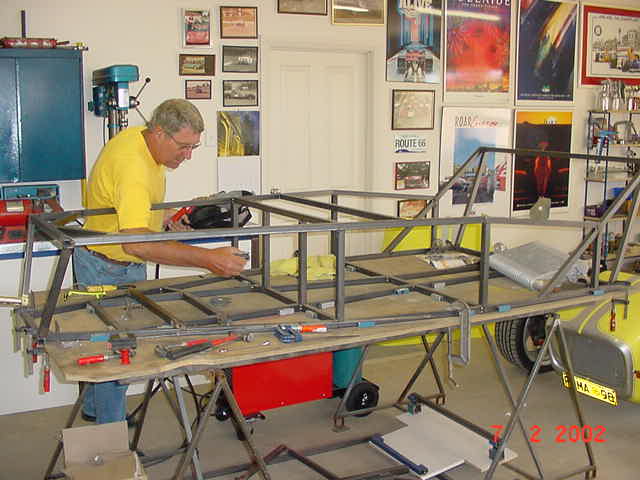
My build started in December 2001. The welding is now complete and the Engineer has performed the first chassis inspection. After several years of being in storage, Puma #4 is now progressing.
Back to Top|
Donor Parts |
Cortina TC steering column Cortina TC front uprights and brakes and lower ball joint Cortina TC handbrake assembly Cortina TC 4cyl drive shaft Cortina TC 4cyl axle/diff Cortina TC brake/clutch pedal box Cortina TC electrical loom Cortina TC indicator stalk Cortina TC/Ford windscreen mount rear view mirror Cortina TD steering lock assembly Escort Mk II steering rack and tie rod Escort Mk II steering knuckle Escort Mk II steering column Escort Mk II brake fail sensor Escort Mk II brake master cylinder (and front brake T-piece if required) Escort Mk II engine mounts Nissan Pintara crown wheel and pinion RX7 Series III Intercooler Honda Civic headrests Nissan SR20DET engine and 5 Speed manual gearbox Nissan SR20DET accelerator cable and pedal |
|
Engine & Gearbox |
Nissan SR20-DET 2.0l Turbo-charged 4 Cylinder 5 Speed Manual |
|
Suspension Front |
Locost unequal length wishbones (Nolathane bushes) Cortina TC upright Nissan upper ball joint Cortina TC lower ball joint Spax coil-over shock absorbers (G-400-AS) |
|
Suspension Rear |
Locost 5 link live rear axle Cortina TC 4 cylinder axle Links include a Nolathane bush and Rose joint pair Spax coil-over shock absorbers (G-400-AS) |
|
Driveline |
Cortina TC drive shaft Nissan front U-joint (Bluebird?) Borg Warner 78 Series differential (25 Spline) 4.11:1 final drive (ex Nissan Pintara) Cone LSD with 2 Pinion |
|
Brakes |
Escort Mk II master cylinder Cortina TC front disks Cortina TC rear drums |
|
Steering |
TC Cortina column Momo steering wheel & hub (Momo Part # 4509) TD Cortina ignition lock (Note TC unavailable) Mk II Escort rack with 43mm spacers added to arms |
|
Engine Cooling |
Mitsubishi Colt (automatic) radiator Remote reservoir |
|
Instruments |
VDO Cockpit Vision |
|
Lights |
ADR compliant 5 ¾" H4 with chrome plated shells (www.eurospares.com) |
|
Mirrors |
Centre - Cortina TC (Glass mounted) Side Haigh |
The author accepts no responsibility for the accuracy of the information presented in these web pages. The information contained in these web pages is not intended for reproduction or distribution.
Back to TopEmail to: [email protected]