- Home Page
- My project...
a Ritchey-Chretien,
diameter 450mm focal 3600 - Mechanical structure
- Links
- Info
Optical system

At first I worked manually, but then I projected and made a device that has helped me in making and finishing mirrors. I've also developed a gauging system and a correction system that makes me able to reach corrections of 1/20λ (1/40 of the wave front).
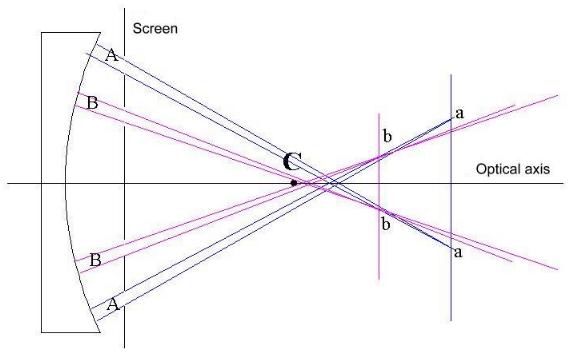
The gauge of the mirror is based on the caustic test ( the caustic is the line which joins the foci of the various zones of the mirror when this is lit by a luminous pinhole which is in the centre of curvature of the mirror itself). This topic is taught in the book Amateur Telescope Making by Albert G. Ingalls. This system can gauge the distance between 2 foci of each zone of the mirror: this value can be compared with the theorical value which is obtained with some mathematical formulas. In this way you can understand how much correct your mirror is. You can improve the level of correction if you want to reach a better approximation (or if you have the patience of a saint).
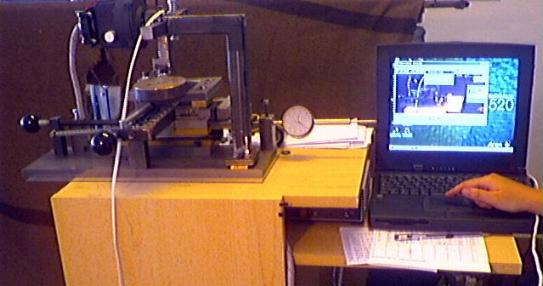
My gauging system is made of 2 right-angled slides: the first one runs parallel to the line of the optical axis of the mirror; the second slide is situated on the first one and runs perpendicularly to it. There is a micrometer 2 inches thread (a bit too expensive, unfortunately) on the first slide. On the other slide there is a CCD which is connected to a notebook. So I can gauge the distance between 2 foci of the reflected zones with a precision of 1/50l. The luminous pinhole is situated in front of the CCD. The mirror is in front of this device: its distance from it is equal to R (radius of curvature). You have to put a screen with small holes on it along the horizontal diameter of the mirror, with a distance rA , rB , rC ,etc from the centre of the mirror ,if you want to do the caustic test of the various zones of the mirror itself
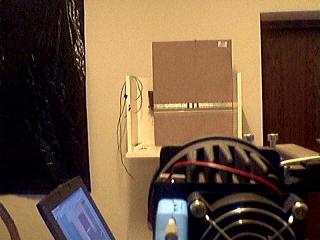
You'll obtain more accuracy in measurement if the holes are very small and numerous. The best correction that you can reach is given by the formula
k is the ratio between the width of the holes of the screen and 4R (R = radius of curvature); e is the smallest value that can be read by the gauging system. For example, using my CCD I can gauge distances with the precision of 1 pixel; in my case, 1 pixel = 0.0127mm, the width of a hole is 10mm and R is 2000m, therefore:
Dividing it by the value of λ in μm (wave length of light - λ=0.55μm) I obtain more or less 1/33λ. I've created an Excel sheet that gives me all the necessary parameters to make and gauge the optical system of a Newton, a RC or each other kind of reflecting telescope. For example, this sheet calculates the distance of the 2 foci reflected of the 2 holes. These holes form a zone of the mirror. Then it establishes the distance between the centre of curvature and the position of the 2 foci. These are essential values that permit the measurement and the correction of the mirror. With the caustic test you obtain from 3 to 5 times more accuracy in measurement than using the Foucault test. If we have a parabolic mirror with
- r= the distance between the 2 holes of a zone of the mirror,
- R= the radius of curvature of the mirror,
- x= the distance between the 2 foci of each semizone,
- y= the distance between the optical axis and the foci of each zone,
x= 4r3/R2