



Gladiator 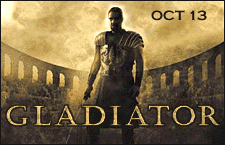
 Nominated
for: Best
Picture
Nominated
for: Best
Picture
Won:
Best Actor: Russell Crowe
Best Picture
Best Costume Design
Sound
Visual Effects
Director(s):
Ridley Scott
Cast:
Russell Crowe - Maximus
Joaquin Phoenix - Commodus
Oliver Reed - Proximo
Connie Nielsen - Lucilla
Derek Jacobi - Gracchus
Djimon Hounsou - Juba
Richard Harris - Marcus Aurelius
David Schofield - Falco
John Shrapnel - Gaius
Tomas Arana - Quintus
Ralf Moeller - Hagen
Spencer Treat Clark - Lucius
Overview:
Ridley Scott (Blade Runner) transports Hollywood to second-century Rome in this rousing historical epic that proudly harkens back to such films as Ben-Hur and Spartacus. Russell Crowe plays Maximus, a Roman general who leads the troops in conquering Germania for the empire. When an aging Marcus Aurelius (Richard Harris) tells Maximus that he'd like him to rule Rome once he's gone, a classic confrontation ensues between the brave and charming soldier--who wants to return home to his wife, son, and farm--and the jealous and conniving Commodus (Joaquin Phoenix), the emperor's only son, who is thirsty for power. Bought as a slave by the profiteering Proximo (Oliver Reed, in his last role), Maximus must kill or be killed in the ring, battling to save not only himself but the future of the very empire that he loves and honors. The film features a terrific battle sequence (that recalls the beginning of Saving Private Ryan), huge crowd scenes of thousands of people, and even a little romance, albeit mostly taboo. The impeccably choreographed gladiator scenes are violent yet thrilling, flashing by like lightning. Gladiator is a glorious spectacle filled with heart and soul.
Review from Boston Globe:
Rating:
/4
Just
as ''Jurassic Park'' dissolved the line between movies and theme parks,
''Gladiator'' eliminates what may have been any lingering boundary between
movies and the World Wrestling Federation. It's ''Spartacus'' on steroids.
For all its lip service to the principle of restoring Rome to the people
after a twisted son kills his emperor father and takes over, ''Gladiator''
is about Russell Crowe and his good guys whacking away at the bad guys
in the Roman death pit known as the Colosseum. It's a joltfest that showers
upon us all the rolling heads, gushing blood, and shattered chariot parts
you could hope for. In short, it epitomizes the kind of high-profile bloodshed
we now expect to herald the hazy, lazy, blockbuster-fixated days of summer.
Words like ''Gladiator,'' ''Battleship,''
and ''Dinosaur'' in their titles probably tell you all you need to know
about this summer's movies, with what to some is their reassuring suggestion
of big, heavy objects dropped on one's head from a great height. ''Gladiator''
plays like a wrestler being dumped in your lap as a bonus for buying a
ringside seat. Obviously, the bread-and-circuses thing hasn't changed
that much in a couple of millennia. Crowe, director Ridley Scott, and
their legions throw themselves at the spectacle thing with gusto and a
generous budget, filling the screen with countless togaed extras screaming
their heads off, too busy tracking the carnage to be bothered with boring
details like government.
"Gladiator'' is more pumped up
than ''Spartacus,'' but less earnest. There was idealism in ''Spartacus,''
whereas the only passion in ''Gladiator'' has to do with registering on
the Richter scale. Which, to give the film its due, it does, despite a
second-half drop-off in energy level. I suppose it would be too much to
expect one of these sword-and-sandal epics to feel anything like a human
experience. Still, it's going to be huge despite its old-style Hollywood
solemnity between fights. The bouts are frequent enough and brutal enough
to keep violence-minded audiences in a thumbs-up mode, right from the
start, when Crowe's general and his army wipe out a Germanic tribe. While
Kirk Douglas's Spartacus starts at the bottom and works his way up, Crowe's
general starts at the top and works his way down.
Crowe's character is named Maximus.
(What else would they call him? Minimus?) His demotion is sudden. He promises
the old emperor - Richard Harris cannily milking a juicy cameo - that
he'll reestablish a Roman Republic. But the king's bratty son, Commodus,
who's jealous of Maximus because he knows his father considers Maxiumus
the son he wishes he could have fathered, murders the old emperor and
gets rid of Maximus when the latter refuses to go along with the coup.
''Gladiator'' also makes a halfhearted effort to get a little incest going
between Joaquin Phoenix's Commodus and his sister, Connie Nielsen's Lucilla.
These scenes - in fact, all the noncombat scenes - are bathed in such
gloom that they'd sink like stones if not for Phoenix's smirk.
One thing he's smirking about
is the slaying by torture of Maximus's family. Like Spartacus, Maximus
would have preferred to live the life of a simple farmer. As it is, he's
motivated by revenge after being sold into slavery and transformed into
a gladiator. Crowe isn't asked to do much beyond staying focused and looking
vengeful. This he does as he efficiently works his way up the food chain
to the big time - Rome. The late Oliver Reed - ''Gladiator'' was his swan
song - would have stolen the movie if his slave dealer and gladiator vendor
weren't so noble. Better he should have been given some comic relief to
play, as Peter Ustinov did in such unctuous fashion in ''Spartacus,''
playing a similar role, greeting his fighters on the eve of their deadly
games by saying, ''Good luck ... to most of you.'' As it is, the film
must settle for such faint ironies as casting Derek Jacobi, of ''I, Claudius''
fame, as a potentially honorable senator.
Phoenix comes off relatively
unscathed in a role that's all but self-immolating, requiring him to speak
such lines as ''I'm terribly vexed,'' as he throws a hissy fit. ''Gladiator''
doesn't so much represent a reinvention of ''Spartacus'' as a revisiting
and italicizing of its tabloid side. Character is scanted or perfunctory,
although Crowe fills the film's big canvas with commanding presence. Still,
there's no getting around the fact that ''Gladiator'' can't drape dignity
and righteousness over the slaughter that's its reason for being.
'Gladiator'' is red-blooded,
but only in a titillating way. Predictably, with its conspicuous display
of prefascist trappings, it says more about our time than about Rome.
Its message, insofar as it has one, is that the only thing bigger than
a corrupt ruler is a celebrity gladiator.
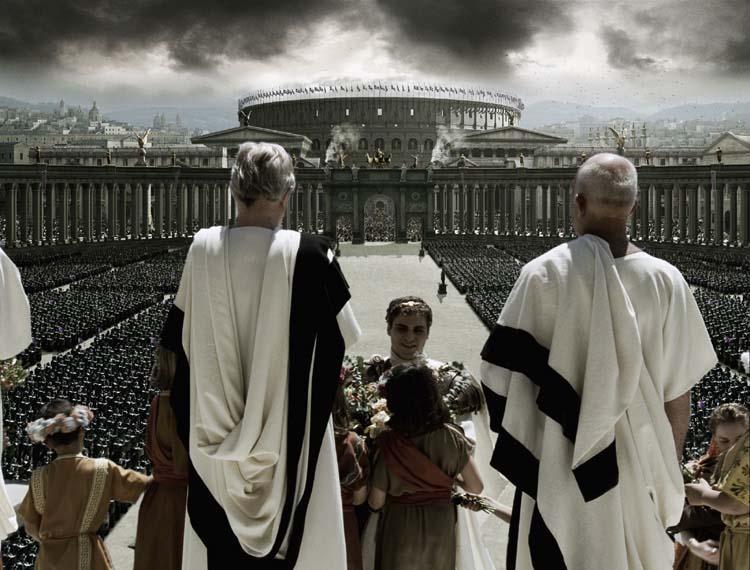
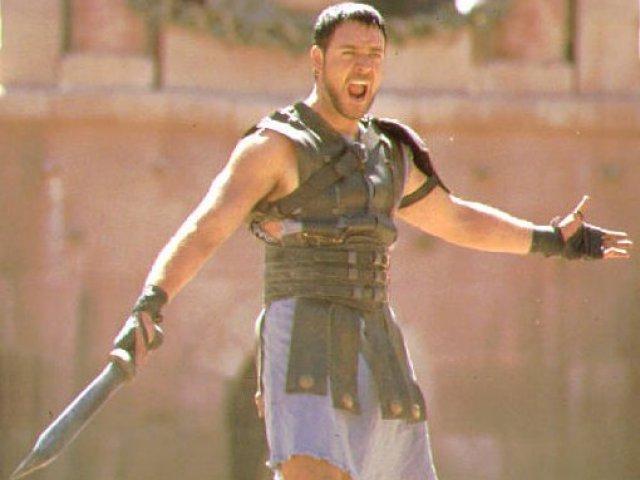
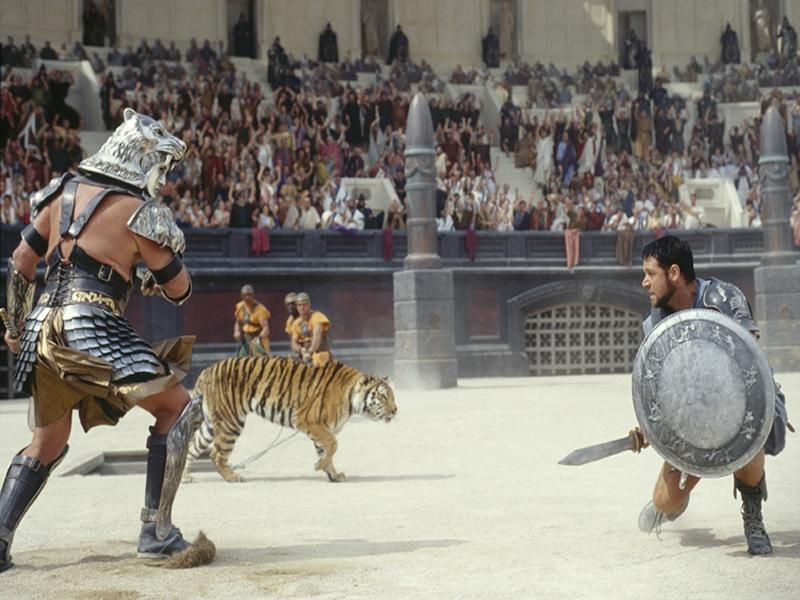
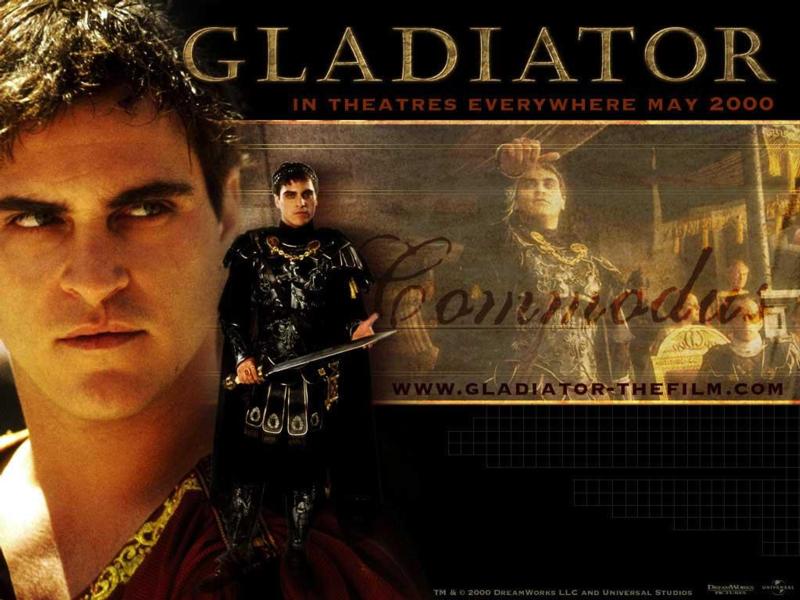
A few pictures from "Gladiator":
|
I like villains because there's something so attractive about a committed person — they have a plan, an ideology, no matter how twisted. They're motivated. -Russell Crowe- |
