



 Edgar
Degas(1834-1917)
Edgar
Degas(1834-1917)
Edgar Degas Biography:
Nowadays Degas is world-wide known as the great master of figures in movement, being a superb designer and a great innovator in the art of portrait. His works are currently celebrated for its composition originallity and his unrivalled technique. Although some critics of his time had early recognized the artistic qualities of that ‘bizarre’ young man, he only attained real success in the last years of his life, but the true acclaim came only after his death. This was mainly due to the fact that Degas, keeping aloof as he used, rarely showed his works. His only one-man exhibition was held in 1893, when he was almost 60, and where he presented about thirty landscapes in pastel.
Between 1865 and 1870 he exhibited a couple of works each year at Salon and also partecipated in seven from the eight exhibitions held by the impressionist group. Degas’s artistic production was intense, although many of his works weren’t finished, and there were a number of drawings, drafts and sketches, live pictures for a later definite version, to be completed at his studio. Since young, visiting Louvre and the big museums, mainly the Italian ones, Degas was attracted by the works of Poussin, Velasquez, Goya, David, Ingres, and the Italian quattrocentist, Ingres being the object of his fervent admiration.
Although called an impressionist, Degas cannot actually be taken as one of them, since he takes a completely different path. What he had in common with the group was his wish to move the artistic expression towards modernism. Contrary to the other impressionist, Degas had never really wanted to be completely detached from the past, and his artistic challenge was always to build a linkage between the ‘old’ and the ‘new’. On this subject, there is his famous ditto: ‘Ah! Giotto! Let me see Paris! And you, Paris! Let me see Giotto!’ Degas took pleasure in defining himself as a ‘realist’, proof of that is that, by the time of the Eighth Impressionist exhibition, held in 1886, he wanted it to be presented as an "Exhibition of a group of independent, realist and impressionist artists’.
Let’s follow Degas’s artistic path through his evolution. At 19 he is a pupil of Barrias’s and often visits Louvre and Cabinet des Estampes at the National Library, where he copies the works of the great masters of the past. Nevertheless, his presence at Barrias’s studio does not last long, and he becomes one of Louis Lamothe’s pupil, who had, on his turn, been a pupil of Ingres’s. And it was through Lamothe himself that Degas met Ingres, therefore becoming Ingres’s fervent admirer. Due to the influence that Ingres, even if indirectly, exerted upon him, Degas was always a steady backer to the thesis that the drawing, by means of ‘wide and continuing’ lines, should be the basis for all artistic composition. But the fascination exerted upon him, either by Ingres or other great masters of the past, did not prevent him from searching a new path with stubborn zeal.
The world flows, renovates itself, and Degas is attracted by this new reality. Since his first portraits, one can feel in them the presence of a relationship between ‘past’ and ‘present’, which will accompany him through all his future activity. Differently from the Impressionists, Degas did not like to work "en plein air", definitely preferring the artificial light of indoors, that give him more freedom and the chance of manipulating the subjects and modifying the pose at his will - in which nothing, as he used to say, should be left to chance. Even the outdoor subjects, such as race horses, the jockeys, the hunting scenes, as well as landscapes, although studied to their minimal details "in loco", by means of drafts and sketches, were to be later remade in his studio.
We have said that Degas thought himself a ‘realist’, but this contact of his with the reality is quite cold, analysed and thought upon. While Manet loved to work instinctively, ‘reproducing everything he had seen’, as he himself used to say, Degas, on the contrary, permanently taking his work into discussion, always said, "I know nothing about inspiration, spontaneity, temper; what I do is the result of reflecting upon and studying the great masters’. It sounds strange that he who hadn’t had any important relationship with a woman through all his life, had chosen women as one of the main subjects of his works.
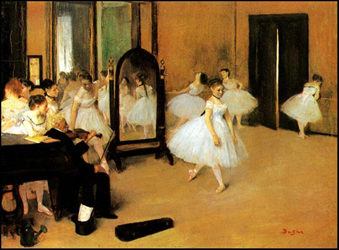
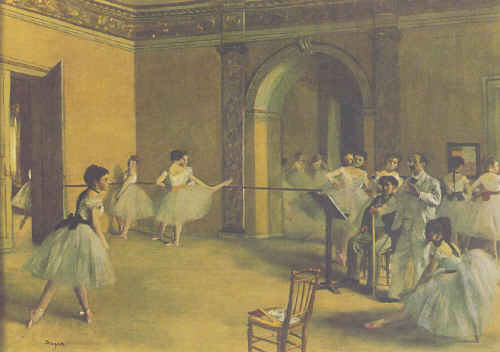
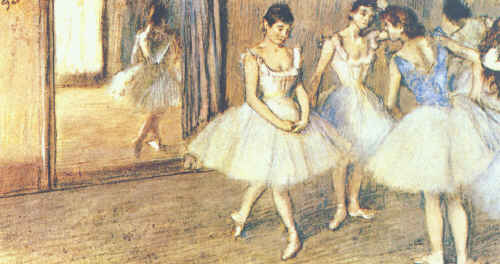
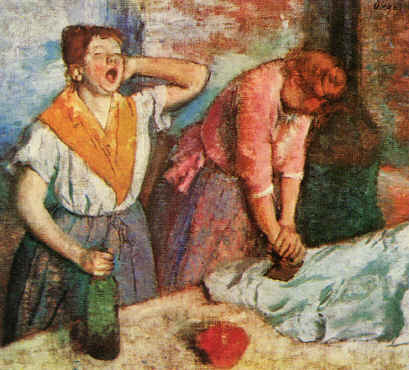
But the ‘women’ as seen by Degas, his dancers, his bathing, ironing and washer women are not delirious, not even a little romantic figures - they are anything but the object of a meticulous, quite obsessed study of their working movements, or of their more intimate daily activities. The ballet dancers and the bathing women look like a sequence in a movie, all of the same fascinating for their totally innovating cuts, for the decentralized pagination, for the unusual angularity: in this sense, it is evident the influence from the orientalism, highly fashionable at his time, and from Japanese prints, of which Degas was a fond collector.
But Degas oustands also for the delicate lines of his drawings, as well as for his exemplary interpretation of light. Nevetherless Degas does not aim to surprise us: his is a plotless narrative. The situation he shows us, be it the ballet dancers’s evolutions or the ironing women’s gestures when pressing the iron upon the cloth, is, on its own, and simply, the aesthetic moment fixed on the canvas, its very harmonious representation. How much work, how many tests though to represent that which looks like a simple gesture imprisoned by one thriving instantaneous vision! On this Degas noted, "It is necessary to remake the same subject ten, one hundred times.Nothing in art should look casual, even less movement’. Before we go through the most important chronological data in Degas’s life and work, I herewith finish these notes about artist Degas transcribing some critic opinions from his contemporaries. "Up to this moment, he is the person whom I have seen to better represent, in modern life translation, this life soul"(E. de Goncourt, Journal, Feb 13, 1874).
In 1876, Edmond Duranty, on the occasion of the Second Impressionist exhibition, wrote about Degas: "So this series of new ideas was mainly formed in the mind of a designer, one of ours, one of those showing now in these rooms, a man gifted with the most rare talent and the most rare intelligence. Several people made use of his conceptions and his artistic unselfishness, and it is about time justice be made and the world be aware of the source from which many painters profited and who never conceded to reveal it. I wish this artist keeps on exercising his prodigious ability as a philanthrope, not as a businessman like many others. G. Rivière, in 1877, on the occasion of the Third Impressionist exhibition, so writes about Degas: "He does not try to make us believe a naivité he does not own; on the contrary, his prodigious knowledge commands whatever it be; his ability, so attractive and peculiar, displays the characters in the most unforeseeable and pleasant way, nevertheless remaining always true and natural".
And still referring to Degas, he goes on: "He is an observer, he never goes for exaggeration, the effect coming always through reality itself, without being ever forced. That makes him into the most precious among the scenes he presents". Referring to Degas’s nudes, in 1889, K. Haysmans wrote: "... It is not the cold and even flesh anymore, the always nude flesh of godesses, ... but it is true flesh naked, real, alive...". Among Degas’s own notes on his works, we recall just some of his most precious ones: "Happy am I, who never found my style, something that would enrage me much. Painting is not so difficult when one does not know it... but once one has got the cognition... oh! Then... it is all about something else." On his feminine nudes, Degas wrote: "... the animal man that takes care of himself, a cat that licks itself. Up to this moment, the nude has been presented in poses that had a public in mind; my women, on the other had, are simple, honest people who bother with nothing but the very caring of their bodies". Finally, about Art, Degas wrote: "Art is a vice: one does not marry it legally, but rapes it ".
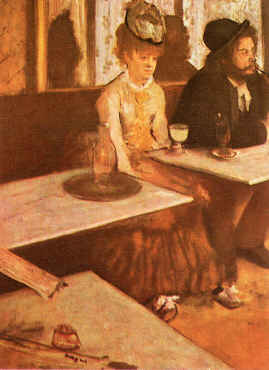
A very small portion of Degas' work:
 |
"It is necessary to remake the same subject ten, one hundred times.Nothing in art should look casual, even less movement"
- Edgar Degas-