Ananta
Kumar Giri
Associate Professor
Madras Institute of Development Studies
79, Second Main Road, Gandhinagar,
Adyar, Chennai - 600 020
Tamil Nadu, INDIA.
E-mail: [email protected]
a[email protected]
About Ananta K Giri
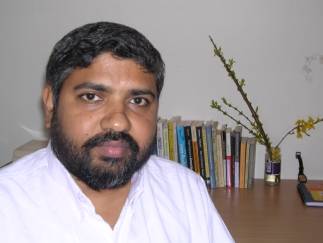
Ananta Kumar Giri is currently on the faculty of the Madras Institute of Development Studies, Chennai, India. Giri had his education at Ravenshaw College, Orissa (B.A., 1984); Delhi School of Economics, University of Delhi (MA in Sociology, 1986); and Johns Hopkins University, Baltimore, USA (PhD, Anthropology, 1994). Prior to joining the Madras Institute of Development Studies, Gin had taught and done research at National Institute of Science, Technology and Development Studies, New Delhi; Jamia Millia Islarnia, New Delhi; G.B. Pant Social Science Institute, Allahabad and Indian Institute of Management, Ahmedabad. Giri has an abiding interest in transformative social action, alternative movements of ideas, socio-cultural movements and spiritual mobilizations. The origin of this interest of his goes back to his study of the Chipko movement in the Himalayas in the mid-1980s. This interest also draws on his earlier studies on the transnational socio-religious movement of Habitat for Humanity (the subject of his PhD thesis and the subsequent publication, Building in the Margins of Shacks: The Vision and Projects of Habitat for Humanity, Orient Longman, New Delhi, 2002) and the People's Science Movement of India (the subject of his essay, "The Portrait of a Discursive Formation: Science as Social Activism in Contemporary India,' which forms part of Global Transformations: Postmodernity and Beyond (Jaipur & Delhi: Rawat Publications, 1998). Giri has subsequently carried on fieldwork on the vision and project of the self-study movement of Swadhyaya in India and England, and is currently finalizing a book on it provisionally entitled, Self-Development and Social Transformations? The Vision and Experiments of the Socio-Spiritual Mobilization of Swadhyaya. Giri has also been recently interested in the vision and experiments of integral education, having carried out preliminary fieldwork on it in Orissa. This has made him interested in the wider issue of child-centered education. Giri has also been looking at the work of the Danish folk high school movement and is currently translating the biography of Kristen Kold, the pioneer of Danish folk high school, from Oriya to English. Through his study of Swadhyaya and integral education, he has sought to bring the neglected theme of self-development to development studies. Giri�s most recent work, Reflections and Mobilizations: Dialogues with Movements and Voluntary Organizations (New Delhi: Sage Publications, 2004), carries this critical interrogation of the discourse and practice of development forward by pleading for transformative dialogues between scholars and activists.
Giri's work with social movements has made him interested in the issue of social criticism and cultural creativity, He co-ordinated an international seminar on "Social Criticism, Cultural Creativity and the Contemporary Dialectics of Transformations" in December 1996 at the Madras Institute of Development Studies. His opening address at the seminar has been published in Dialectical Anthropology (September 1998) and a volume from the seminar entitled, Rethinking Social Transformation: Social Criticism and Cultural Creativity at the Turn of the Millennium has come out from Rawat Publications in 2001.
Giri
also continues his interest in rethinking theories and methods. He co-ordinated
a national seminar on "Creative Social Research: Rethinking Theories
and Methods" at
Values
and ethics have been another interest of Giri. He has just published Conversations
and Transformations: Towards a New Ethics of Self and Society (Lanham,
USA: Lexington Books, 2002). While
being at Indian Institute of Management, Ahmedabad in 1993-94, he had
carried out an ethnographic study on the ethical discourse of managers and
management educators. His book, Values,
Ethics and Business: Challenges for Education and Management (Jaipur
& New Delhi: Rawat Publications, 1998) grows out of this. In
recent years, he has extended this interest of his into theoretical domains
having carried out a dialogue with Jurgen Haberrnas and Emmanuel Levinas.
His papers, "Moral Consciousness and Communicative Action: From
Discourse Ethics to Spiritual Transformations" (History of the Human
Sciences, Aug. 1998) and "The Calling of an Ethics of Servanthood"
(Journal of Indian Council of Philosophical Research, 1998) carry out
this dialogue. He has also been
interested in the calling of development ethics and has recently co-edited
with Philip Quarles van Ufford of Free University, Amsterdam, A
Moral Critique of Development: In Search of Global Responsibility
(London: Routledge, 2003). This book has also been translated into Bhasa
In
his just published book, Reflections
and Mobilizations: Dialogues with Movements and Voluntary Organizations,
Giri explores pathways of being scholar-activists in our contemporary times.
Giri's recent work on global responsibility has taken him in both
ethnographic and philosophical directions, pleading for a greater
interpenetration between philosophy and anthropology. He has been carrying
out fieldwork on global justice movements such as Attac (Association for the
Taxation of Financial Transactions for the Aid of Citizens) in
Giri
writes in both Oriya and English. He has published six books in Oriya such
as Patha Prantara Nrutattwa
(Anthrpology of Street Corner), Mu Jadi Dhumaketu Hoithanti (If 1
were a Comet), and Koinonia
Diary. His essays on criticism, Sameekhya, Parampara 0 Purdorusti
(Criticism: Tradition and the Calling of Future) has formed part of the
postgraduate syllabus in the Department of Oriya,