| Druid Society |
| � Sencha; historian, analyst � Brithem; judge, arbitrator, ambassador � Scelaige; keeper of myths and epics � Cainte; master of magical chants, blessings, curses, invocations, execrations, banishments � Liaig; doctor who uses plants, magic and surgery � Cruitre; harpist who uses music as magic, master of the "Three Noble Strains" of music: music that invokes laughter, tears, and sleep. � Deoghbaire; cup bearer who knows the properties of intoxicating and hallucinogenic substances � Faith; diviner � Bard; popular poet and singer � Fili; sacred poet and diviner |
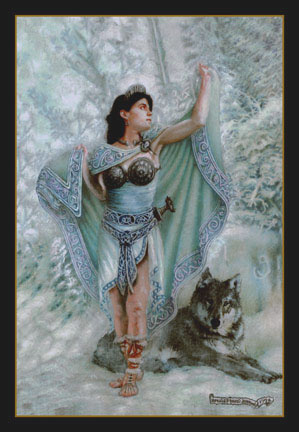
| Other classes in the old Celtic social order included the warrior-aristocracy, out-caste Fianna warriors; Bards, brehons (lawyers), historians and other more specialized professionals; land-holders (landlords); freeborn laborers; and non-freeborn laborers. Celtic law included ways for anyone, including non-freeborn laborers, to move up or down the social hierarchy; what rights and responsibilities were due to each of them, and what kind of punishment could be given to criminals according to their status (for more was expected from those who had more). An old Celtic proverb goes: "A man is better than his birth". Bards and Fili were the primary keepers of the histories, genealogies, laws, poetry, music and stories of the Celtic people. Their training was similar to the Druid's training, and their rank in society was second only to the King. A bard was expected to be able to perform what were called the "three noble strains", which were music to inspire laughter, tears, or sleep. They were guaranteed to receive special hospitality wherever they went, and be free from insult, among other rights; a breach of this would allow the bard to compose a satire-poem that would tarnish the offender's reputation for generations to come. The Celtic noble class held the political and economic power of the tribe. Kingship was passed from a king to his son, or (as in the case of the Picts) from a king to the son of the previous queen. Many Celtic tribes actually elected their king for a lifelong term, from among eligible men whose ancestors were kings. Of interest to those who study Druidism is the concept of the sacred king, in which the king was ritually married to the Goddess of the land. Sometimes a Druidess (or, as in one recorded case from Donegal, Ireland, a horse) would temporarily represent the Goddess to whom the king was married. He had to rule justly and honorably in order to satisfy his immortal spouse, for if he did not the land would become barren and infertile, and the tribe's prosperity would decline, an event which occurs reasonably frequently in mythology. The king had to be in full health and without physical blemish as well to please her, and this is why the god Nuada had to abdicate the throne when he lost his hand in battle. This ritual is evidence for a Druidic doctrine of the unity of humans and nature. A sacred king would also be bound by a Geas as an additional condition for his prosperous rule. The mythologies record that many Druids were women; in fact Celtic women enjoyed more freedom and rights than women in any other culture of that time, including the rights to enter battle, own and inherit property, trace her kinship matrilinially (through her mother's family line), and choose and divorce her husband. The Irish hero Cu Chullain was trained by a land-owning warrior queen named Scathach, for whom the Scottish island of Skye is named. In the Welsh myths, there are the powerful sorceresses and goddesses like Cerridwen, and Arianrhod who ruled Caer Arianrhod. In Briton, Boudicca was a female chieftain of the Iceni tribe, powerful enough to lead a revolt of united Celtic tribes against the Romans in 61 BCE. Her patron was the goddess Andrasta, a goddess of battle whose totems included the raven and the hare. Mogh Roith, who was one of the greatest Irish Druids, was taught by a female Druid named Banbhuana, the daughter of Deargdhualach. Similarly, Irish women have a heroine in Queen Maeve of Cruachan, who led an army against the province of Ulster, all to establish her equality in her marriage. Queen Maeve employed the services of a Druidess named Fedelm, who had a gift for prophesy and who was asked by Maeve to predict the outcome of the war she was launching against Ulster. Fedelm predicted (correctly, as it turned out) that Maeve would be defeated. Because she did not like this prediction, Maeve ordered Fedelm�s immediate execution. Women were also permitted to become Fianna, outlaw-warriors. Fionn MacCumhall, from the Irish Fenian myths, was trained in poetry and magic by a Druidess. A woman named Asa (Irish for "Gentle") became Fianna and took the name Ni-Asa ("Not Gentle"), which eventually became "Nessa", at the time she became mother to King Conchobar. Her influence was such that her son kept her name instead of his father's name, thus: "Conchobar Mac Nessa", or "Conor, son of Nessa". Celtic law identified up to nine different types of marriages, some differentiated on the basis of how much property was brought into the marriage by each partner, and some differentiated by the circumstances of the conception of children. The latter type is apparently designed to protect the rights of the children. Here is a list of nine marriage types from Irish law: � "union of joint property" in which the man and woman contribute the same amount of property. � "union of woman on man's property", in which the woman brings little or nothing into the marriage. � "union of man on woman's property", in which the man brings little or nothing into the marriage. � A less formal partnership in which the man visits the woman who still lives with her own kin. � a union in which the wife's kin does not consent to the marriage. � an abduction, in which the wife willingly elopes but her kin do not permit her to go. � a partnership of secrecy, � a one night's stand or "soldier's marriage"; apparently this is to protect the rights of children who might issue from a rape, and finally � the marriage of two insane persons. As you can see by this, there are several classes and society's in Druidism. They have laws, they have their own town structures, and they all work together to achieve balance. |
 |