Welcome to CXC Help online!!
Section A- Principles of Chemistry
States of Matter 1.1
Evidence of the particulate(meaning made up of particles) nature of matter is derived from phenomena such as Diffusion and Osmosis. The definition for the two terms are as follows:
- Osmosis- The movement of water particles from a region of high concentration to a region of low concentration across a semi-permeable membrane.
- Diffusion- The movement of particles from a region of high concentration to a region of low concentration along a diffusion gradient.
Actual evidence of these two phenomena will or should be observed during lab sessions.
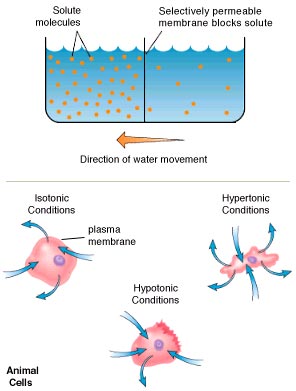 Picture was obtained from the following website www.bergen.edu/faculty/rdill/Biology_I/Bio_I_lab_Images/bio_i_lab_images
States of Matter 1.2
The following table explains the difference between the three states of matter liquid, solid and gas.
| State of Matter |
Arrangement of Particles |
Energy |
Motion |
| Solid |
Arranged in a regular pattern which is repeated over and over.Particles are closely packed together |
Little or no energy |
Particles are fixed in position and can only vibrate |
| Liquid |
Particles are further apart than they are in solids but close in comparison to gases because intermolecular forces are still present |
Moderate energy |
Particles can move freely in comparison to solid |
| Gases |
Particles are far apart because little or no intermolecular forces exist between particles |
High energy |
Rapid, vigorous motion particles quickly take up the space they are in |
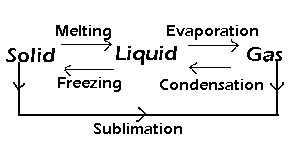
Depending upon the energy supplied or withdrawn changes of state occur. Consider the diagram below.
Atoms and the Periodic Table 1.1
The first objective in this section is to know how to describe with diagrams the structure of the first 20 elements. All of them won't be displayed here but here are a few and I will explain how the rest are drawn.
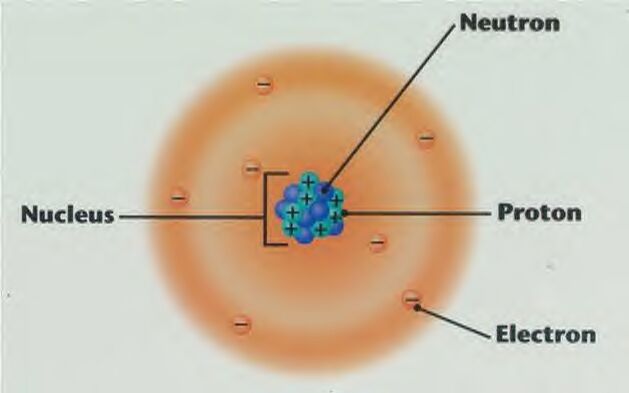 This is something like how a real atom looks(Picture obtained from www.medfriendly.com
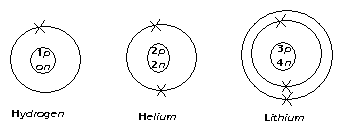 After Helium the drawning of the next 17 atoms follows a general pattern:
- First draw the nucleus and put in the proton and neutron number of the atom.(proton and neutron numbers will be explained shortly)
- The number of protons are the same as the number of electrons which will be place in shells, however this is done in a certain order.
- The first shell can only hold 2 electons after that the remaining electrons will go on a second shell which can hold up to 8 electrons after this electrons are placed on a third shell which can hold 8 electrons after this electrons are placed on a fourth shell which can hold 18 electrons but since we are only doing the first 20 atoms the fourth shell be used to hold more than 2.
| Particle |
Relative Mass |
Relative Charge |
| Proton |
1 |
+1 |
| Electron |
0 |
-1 |
| Neutron |
1 |
No Charge |
Your probably wondering about now what an atom is well the definition is a follows:
An atom is the smallest part of an element which gives the element its properties.
Section 2.3
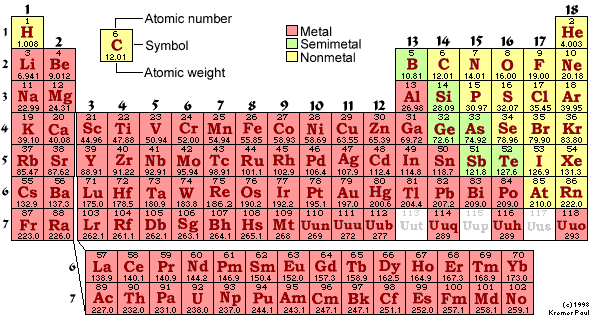
Atomic Number/Proton Number- This states the number of protons and in the nucleus . It also indicates the number of electrons in the shells (proton and electon # in a neutral atom is the same) and the position of the element on the periodic table.
Atomic Mass/Mass number- This is the sum of protons and electrons in a given atom. It the relative atom mass of the element
Relative atomic mass- The mass of an element in comparison to a carbon-12 atom whose mass is 12.00g exactly. (Section 2.4)
Section 2.5
This part requires you to interpret the symbol seen below:
 X -represents the symbol of the element
a -represents the mass number
b -represents atomic number
c -represents charge/oxidation number(a later topic)
d -represents number of items in the entity(ususally a chemical formula
Section 2.6
The definition of isotopy is as follows:
Isotopes are atoms of the same element with the same proton number but different neutron number.
Example consider carbon. Sometimes it is chemically altered to have a mass number of 14(so its called Carbon-14)because two extra nuetrons are added. So both of them compared look like this:
146C 126C
Section 2.7
Although some isotopes are natural some are manufactured and they don't just do this for fun. Some uses of isotopes are as follows: