











|
|
|
|
|
|
|
|
|
|
|
|
|
|
|
|
||||||||||||
|
|
|
|
|
|
|
|
|
|
|
|
|
|
|
|
|
|
|
|
|
|
||||||
| introduction:: Examples of Infectious Disease | ||
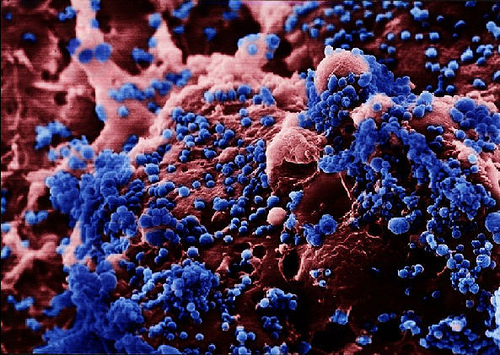
AIDS ( Acquired Immunodeficiency Syndrome ) is most commonly defined as a severe immunological disorder caused by the retrovirus HIV, resulting in a defect in cell-mediated immune response that is manifested by increased susceptibility to opportunistic infections and to certain rare cancers, especially Kaposi's sarcoma. There are many ways in which HIV is transmitted however the primary way is by contaminated body fluids, especially blood and semen.
|
||
There are basically three classes of drugs used in fighting HIV infection. They are always used in combination, never alone. Some drugs bind to the virus DNA strand while it tries to replicate, inhibiting its replication, and slowing down the advancement of disease. |
||
Once the HIV virus has infected a person, there would not be immediate manifestation of AIDS. The virus would colonize in the human (CD-4) T-cell, a type of lymphocyte in to our immune system. Without proper functioning of the (CD-4) T-cell, the body loses an extremely effective body defense mechanism that could make our body extremely vulnerable to bacteria that otherwise would pose no harm to us. The HIV virus does not just colonize on CD4-T cell. They penetrate into the T-cell and 'overtake' the T-cell totally, just like what a virus typically does. However, one special feature in HIV infection is that the HIV virus would remain dormant inside the T-cells, i.e. it just goes intracellular and ceases all activities. No clinical symptoms can be seen in this stage of infection, which can stretch up to few decades. Only an HIV screening test at this stage can detect HIV infection at this stage. |
||
Avian Influenza is defined as an often-fatal flu virus of birds , especially poultry that is transmissible from them to humans, in whom it may also prove fatal. Several avian flu strains were known to have "jumped the species barrier" and infected humans, first in Hong Kong. The human cases of the disease in Vietnam and Thailand were acquired through either direct or indirect contact with infected poultry. Though humans are beginning to be affected by the disease there is no proof that the disease is being transferred from person to person at the moment. However there is fear that the genes of the disease may undergo mutation, and become transmissible from person to person. |
||
Symptoms of bird flu in humans range from typical flu-like symptoms (fever, cough, sore throat and muscle aches) to eye infections, pneumonia, severe respiratory diseases (such as acute respiratory distress), and other severe and life-threatening complications. The symptoms of bird flu depend on which virus strain causes the infection. Studies done in laboratories suggest that the prescription medicines approved for human flu viruses should work in preventing bird flu infection in humans. However, flu viruses can become resistant to these drugs, so these medications may not always work. Additional studies are needed to prove the effectiveness of these medicines. The H5N1 virus currently infecting birds in Asia that has caused human illness and death is resistant to amantadine and rimantadine, two antiviral medications commonly used for influenza. Two other antiviral medications, oseltamavir and zanamavir, would probably work to treat flu caused by the H5N1 virus, but additional studies still need to be done to prove their effectiveness. There currently is no commercially available vaccine to protect humans against the H5N1 virus that is being seen in Asia and Europe. However, vaccine development is taking place. Research studies to test a vaccine to protect humans against H5N1 virus began in April 2005, and a series of clinical trials is underway. |
||
next page:: Global View and Current Situation |
||
|
|
|
|
|
|
|
|
|
 |
|
|||||||
 |
 |
 |
 |
 |
 |
 |
 |
|
 |
 |
 |
 |
|
||||