For nearly sixty years, Theodor Seuss Geisel has delighted millions worldwide with his fanciful and often times surreal worlds in which moral and social tales unfold with the ease and excitement of a perpetual child. His unbridled creativity and his ability to touch the hearts of children, parents and grandparents alike goes unmatched within the 20th century art world. Just as the great illustrator Norman Rockwell utilized the cover of the Saturday Evening Post to reach an audience beyond the scope of most artists, so too did Dr. Seuss with his over 48 books for children. With books such as Green Eggs and Ham, the 3rd largest selling book in the English language, Seuss found a showcase for his work which yielded a following larger than any other artist in history.
A brief biography of Dr. Seuss
Theodor Seuss Geisel was born 2 March 1904 in Springfield, MA. He graduated Dartmouth College in 1925, and proceeded on to Oxford University with the intent of acquiring a doctorate in literature. At Oxford he met Helen Palmer, who he wed in 1927. He returned from Europe in 1927, and began working for a magazine called Judge, the leading humor magazine in America at the time, submitting both cartoons and humorous articles for them. Additionally, he was submitting cartoons to Life, Vanity Fair and Liberty. In some of his works, he'd made reference to an insecticide called Flit. These references gained notice, and led to a contract to draw comic ads for Flit. This association lasted 17 years, gained him national exposure, and coined the catchphrase "Quick, Henry, the Flit!"
In 1936 on the way to a vaction in Europe, listening to the rhythm of the ship's engines, he came up with And to Think That I Saw It on Mulberry Street, which was then promptly rejected by the first 43 publishers he showed it to. Eventually in 1937 a friend published the book for him, and it went on to at least moderate success.
During WW II, Geisel joined the army and was sent to Hollywood. Captain Geisel would write for Frank Capra's Signal Corps Unit (for which he won the Legion of Merit) and do documentaries (he won Oscar's for Hitler Lives and Design for Death). He also created a cartoon called Gerald McBoing-Boing which also won him an Oscar.
In May of 1954, Life published a report concerning illiteracy among school children. The report said, among other things, that children were having trouble to read because their books were boring. This inspired Geisel's publisher, and prompted him to send Geisel a list of 400 words he felt were important, asked him to cut the list to 250 words (the publishers idea of how many words at one time a first grader could absorb), and write a book. Nine months later, Geisel, using 220 of the words given to him published The Cat in the Hat, which went on to instant success.
In 1960 Bennett Cerf bet Geisel $50 that he couldn't write an entire book using only fifty words. The result was Green Eggs and Ham. Cerf never paid the $50, btw...
Helen Palmer Geisel died in 1967. Theodor Geisel married Audrey Stone Diamond in 1968. Theodor Seuss Geisel died 24 September 1991.
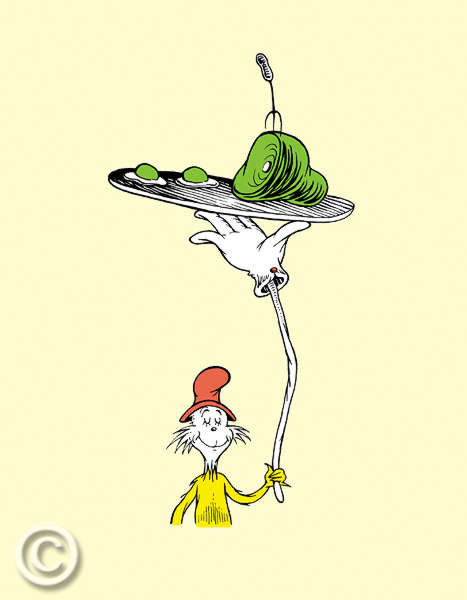
Green Eggs and Ham (1960), has been heralded as one of the most significant children's books ever written. This drawing appears on the inside cover of the book, and marks the introduction of the beloved character, Sam. This book was written using just 48 words after Seuss's publisher bet him that a children's book could not be written using less than 50 words.
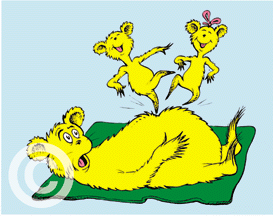
Hop on Pop! We like to hop on top of Pop!
"Dr. Seuss reached four generations of fathers and children with his over 48 books, and at the same time exposed families to art, literacy and the fun of learning together. It is rare that a work of art captures family relationships in such a poignant yet whimsical way. Hop on Pop! is the first in a series of larger format lithographs printed in an edition size of only 1500."
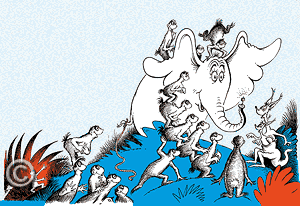
Horton Hears a Who! 1954.
They've proved they are persons, no matter how
small
"On June 1st, 2002 the world watched as politicians,
celebrities and thousands of Seuss fans gathered in Springfield,
Mass. to witness the unveiling of the Dr. Seuss Memorial
Sculpture Garden and its 14' high bronze Horton centerpiece.
As this giant sculpture was unveiled, Ted Kennedy told the crowd
that Horton had always captured his heart because, as the
youngest child in a family of powerful voices, he continually
found hiself struggling to be heard."
Send eMail to - Joseph Lynn Oliver
Gibson County TN

Try searching the WWW useing any of the folowing search engines.

Thanks to our host, Yahoo - Geocities.