RUGBY
This site was built useing Macintosh OS X software.
Final results, Rugby 2003 Worldcup. Nov. 22 2003
Go to Rugby Football Union Site.
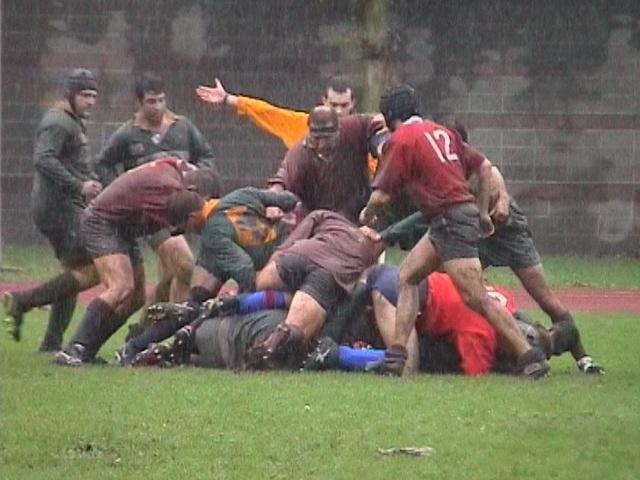

Semi - final score, ENGLAND 24 - FRANCE 7
Wilkinson boots England into Final
16/11/03
France disappoint in RWC semi-final
Newcastle star Jonny Wilkinson booted England into the 2003 Rugby World Cup Final, the pivot kicking five penalties and three drop-goals, two of which were on his right foot, as his country earned a 24-7 win over a disappointing French side in Sydney on Sunday. The game will not win any beauty pageants, but England demonstrated the versatility that has put them at the top of the Zurich World Rankings by reacting to the adverse weather conditions to eke out a controlled 10-man victory. Their style of play may not win them any admirers in the purist camp, but it was exactly what was needed in this game, and it was France's inability to adapted to the conditions that washed away their World Cup dreams. With the greasy conditions putting pay to any free-flowing hopes, the contest was reduced to a head-to-head between the two kickers; Wilkinson and Frediric Michalak. In the end it as the English 'veteran' who saw off the French prodigy by kicking all 24 of his team's kicks, including 3 snap drop-goals. Michalak, who came into the game with over 100 points in this tournament, was tipped by many to oust Wilkinson from his exalted plain - but the 21-year-old clearly missed the dry balland could not tune in his weather satellite. He was duly replaced with 20 minutes to go after adding only one score - a conversion to flanker Serge Betsen's try.
Given th huge stakes of this game, both sides looking nervous in the opening exchanges. France were clearly not enjoying the rain, and if it was England's plan to unsettle themin the tight it worked, and the early stages werepeppered with some bad-tempered exchanges. For all their inspirational back play it was France's scrum that destroyed Scotland and Ireland, but England were up to the challenge and had the upper-hand. Their domination in the tight hurt France and had a knock-on effect through the spine of their team - for once in this tournament they looked far from cool and collected
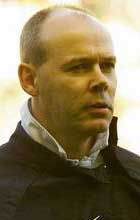
Coach Clive Woodward
As the English pressure grew, so did French mistakes, and a deep kick drew an awful knock-on fromFrance wing Aurelien Rougerie. The scrum put Wilkinson in a decent position for a drop-goal andEngland's fans erupted in joy as he opened the scoring with less 10 minutes played. But France replied immediately after Betsen collected a loose ball from the back of a line-out and crashed over the England line. A late dive by ever-presentRichard Hill looked like it prevented the try but the video ref was of a different opinion and France had the lead. Michalak stepped up and scored a wonderful conversion form the touch-line, but it was to be his first and last entry in the day's score book.
Betsen's try focused France and they looked sharp as their industrious back row hassled England's midfield out of space and time. But England got off the hook as Michalak missed two penalty attempts, and the game descended into a slug-fest marooned between the two 10-metre lines as the sides tried to make sense of the conditions that were getting worse by the minute. With the swirling winds and greasy ball reducing both team's line-out to a lottery, it was becoming clear this would be game that came down to kicks. But even the surgical Wilkinson was having trouble with the conditions and he missed a penalty awarded to England after wing Christophe Dominici brought down Jason Robinson with a blatant trip. The electric French wing could have a difference to this game, but he was shown a yellow card for his efforts.To make matters worse, he had injured himself in the process offouling Robinson and never returned the game. As the rain grew heavier England's control grew stronger, and soon the bullocking forwards had their fly-half in a position to kick an easy penalty which he soon followed up with another drop-goal to snatch back the lead. England had found their water-wings, and Wilkinson put over another penalty from the limit of his range at the stroke of half-time to give England hope for the second half. England began the second period in the same limited but hugely effective style-but when a Wilkinson penalty was blown off course, France sensed it was time to get out of jail. Les Bleus looked to inject a little free-running into the proceeding and were immediately awarded a penalty. When Michalak misses again one could sense France didn't no where to turn and a series of uncharacteristic errors crept into their game - including a poor knock-on from the normally unflappable Olivier Magne. Magne's outstanding partner Betsen was soon shown a yellow card for a late tackle on Wilkinson, but the England fly-half responded to the heavy challenge by getting to his feet and slotting the penalty to put daylight between the sides. Those three points hurt France, and England took full advantage of their extra forward and went about crushing up through the fringes. France defending stoutly and at no time did England look like finding a gap for the try, but with centimetres of space to work in Wilkinson coiled his boot around the ball from the back of a ruck to score his third drop-goal to put England even further ahead. When Wilkinson slotted yet another penalty after another Michalak attempt fell short, French coach Bernard Laporte pronounced the battle of the fly-halves officially dead by bringing on Gerald Merceron as theFrench fly-half's replacement. Merceron hada briefto add some urgency to the French game and managed to get the gears going in the backs, but their intentions didn't suit the conditions and the game was up when Wilkinson stepped up to put away another penalty. France spent the last 15 minutes of the game pinned - nailed, rather - in their own 22 as England looked to score a try that would silence any residual doubters. The try still hadn't come by the time referee Paddy O'Brien finally put France out of their misery by blowing for full-time, but England had shown what the are capable of -even when reduced to scraps.
The scorers: For England: Pens: Wilkinson 5 DGs: Wilkinson 3
For France: Try: Betsen Con: Michalak
Man of the Match: Jonny Wilkinson had the boot, but it was the tireless work of his half-back partner Matt Dawson that kept England on the front-foot with some fine sniping and good distribution. The fact that Dawson had such a fine platform to work off had a lot to do withthe return of Richard Hill who added theinvisible touches that England had so sorely missed. Moment of the Match: He may have shuffled on for a minute early in the gameas a blood replacement, but it wasn't until he came on for real in the 76th minute that Jason Leonard received the applause he deserved for becoming the most capped rugby player ever - 112 not out.A fantastic achievement from a terrific competitor. Villain of the Match: Betsen may have knocked off a few years from Clive Woodward's life after he took out Wilkinson with a late tackle, but it is Christophe Dominici who limps away with the award after his blatant trip on Jason Robinson. The England wing had beaten the Frenchman on the inside and there was little the little wing could do to save his pride save to stick out his leg. Poor form!
The teams:
England: 15 Josh Lewsey, 14 Jason Robinson, 13 Will Greenwood, 12 Mike Catt (Mike Tindall, 68),11 Ben Cohen, 10 Jonny Wilkinson, 9 Matt Dawson (Kyran Bracken, 40-41; 69),8 Lawrence Dallaglio, 7 Neil Back, 6 Richard Hill (Lewis Moody, 73),5 Ben Kay, 4 Martin Johnson, 3 Phil Vickery (Jason Leonard, 3-5), 2 Steve Thompson (Dorian West, 76),1 Trevor Woodman (Jason Leonard, 76). Not used: 18 Martin Corry,22 Iain Balshaw.
France: 15 Nicolas Brusque, 14 Aur�lien Rougerie, 13 Tony Marsh, 12 Yannick Jauzion, 11 Christophe Dominici (Cl�ment Poitrenaud, 33),10 Fr�d�ric Michalak (G�rald Merceron, 64),9 Fabien Galthi� (captain), 8 Imanol Harinordoquy, 7 Olivier Magne, 6 Serge Betsen (Christian Labit, 70),5 J�r�me Thion, 4 Fabien Pelous, 3 Sylvain Marconnet, 2 Raphael Ibanez, 1 Jean-Jacques Crenca (Olivier Milloud, 61). Not used: 16 Yannick Bru,18 David Auradou,21 Damien Traille. Yellow cards: Christophe Dominici 23, Serge Betsen 52.
By Andy Jackson
Semi - final score, AUSTRALIA 22 - NEW ZEALAND 10
Wallabies give Kiwis the wobbles
15/11/03
Home side through to 2003 RWC Final George Gregan's Wallabies promised the world that they had a few aces up their sleeve for Saturday's 2003 Rugby World Cup semi-final. And, they certainly showed at Sydney's Telstra Stadium that they are not just all talk - stunning pre-tournament favourites, the All Blacks, 22-10 to advance to next week's RWC Final.
This result, apart from surprising virtually every rugby pundit across the globe, also produced a number of firsts, with the Wallabies becoming the first defending champions to advance past the semi-finals and also the first-ever team to play in three World Cup Finals. For the All Blacks it was yet another RWC gone wrong, having won the inaugural tournament in 1987, they have now lost in the play-off stages in every tournament since - the semi-finals in 1991, the Final in '95, the semis in '99 and the semis, again, in 2003. But more importantly, the Wallabies turned all the pre-match predictions on their head in Sydney on Saturday with a world-class performance of structured attacking rugby and rock-solid defence. They lifted the intensity of their game and limited their mistakes. Where the Kiwis fumbled their way through 80 minutes, the Australians were focussed and lifted their game to a new high. They appeared to be the hungrier team and never wavered, even when the Kiwis threatened to get back into the game.
From the opening minutes, Gregan's team took control of the ball and never gave the Kiwis a sniff of the possession. In fact, it took the All Blacks a full five minutes before they touched the ball, other than to re-start play. The Wallabies hit the rucks with ferocious vigour, ensuring a steady stream of quick ball going back to halfbacks Gregan and Stephen Larkham. But they also kept the All Blacks under pressure in the set-pieces. And with such quality possession it was easy for the Wallabies to stick to their gameplan. Here Larkham played a pivotal role. At the outset he often took the ball wide, and with the Wallabies quicker to the point of breakdown, the Kiwis were forced into a defensive role. In the first five minutes, the Kiwis had to make 28 tackles. While it did not show on the scoreboard immediately, it did have a major influence in the latter stages of the game ... with the Wallabies finishing the stronger of the two teams.
And as the game wore on, Larkham varied his play brilliantly and made 'King' Carlos (Spencer) look more like a Joker than a King. On several occasions he slipped past the inside in the No.10 channel, with Spencer nowhere to be found. The Spencer magic that was so prevalent all year, was suddenly gone! It would be easy to give all the plaudits to the outstanding Australian backs, but much of the credit must go to the Wallaby pack, who certainly outplayed their more-fancied Kiwi rivals on the day. In the line-outs, Justin Harrison was a tower of strength, while Bill Young did a lot more than just scrum. And without the ball, the Kiwis' dangerous runners were not a factor. Not only did Spencer look lost for most of the game, but wings Doug Howlett and Joe Rokocoko also never saw enough of the ball to have made any inroads into any defensive lines. Mils Muliaina tried bravely at fullback, but he, too, was never a factor. And when the Kiwis eventually did get their hands on some ball, the Australians made sure that their defensive lines remained structured and solid. In this department, flanker George Smith deserves credit for all the work he did in snuffing out any potentially dangerous moves. Another standout aspect of this game was the way in which the Wallabies made the All Blacks pay for their mistakes. Not only did they make the Kiwis' normally impressive defence look rather ordinary, but the pounced on every loose ball as if their very lives depended on it. There will be some concern for Australia, with prop Ben Darwin having been stretchered off after a collapsed scrum in the 49th minute. It is uncertain what the full extent of the injury is at this stage. For now, however, they will enjoy the moment. They are into a World Cup Final. Their opponents will determined on Sunday, and they will then shift their focus to next week's game at this very same venue. Man of the match: For New Zealand, openside flanker Richie McCaw fought a lone battle in the face of the ferocious Wallaby onslaught. For Australia, there were many stars. Stirling Mortlock was a star in the midfield, causing all sorts of problems for the defence, while forwards like George Smith and David Giffin also went that extra yard. But, in the end, our vote goes to fly-half Stephen Larkham , who on the day made all the right calls and played the role that was expected of him. He even managed to turn ball over at the breakdown. Moment of the match: With two tries only, one would be tempted to go for a turnover or tackle somewhere, but the crucial play came in the ninth minute when Stirling Mortlock intercepted Carlos Spencer's floating pass and sprinted 90 metres to score . From that moment on you knew the Kiwis would play catch-up rugby and they never quite managed to do so. Villain of the match: Brilliant, clean, hard rugby. No villains .
The scorers:
For Australia: Try: Mortlock Con: Flatley Pens: Flatley 5
For New Zealand: Try: Thorne Con: MacDonald Pen: MacDonald
The teams:
Australia: 15 Mat Rogers (Joe Roff, 29-35), 14 Wendell Sailor, 13 Stirling Mortlock (Roff, 72), 12 Elton Flatley (vice-captain, Nathan Grey, 64-67), 11 Lote Tuqiri, 10 Stephen Larkham, 9 George Gregan (captain), 8 David Lyons, 7 Phil Waugh (vice-captain), 6 George Smith (Matt Cockbain, 72), 5 Nathan Sharpe (David Giffin, 23-30, 39), 4 Justin Harrison, 3 Ben Darwin (Alastair Baxter, 49), 2 Brendan Cannon (Jeremy Paul, 49), 1 Bill Young. Unused replacement: 20 Chris Whitaker.
New Zealand: 15 Mils Muliaina, 14 Doug Howlett, 13 Leon MacDonald, 12 Aaron Mauger, 11 Joe Rokocoko, 10 Carlos Spencer (vice-captain), 9 Justin Marshall (Byron Kelleher, 48), 8 Jerry Collins (Marty Holah, 73), 7 Richie McCaw, 6 Reuben Thorne (captain), 5 Ali Williams (Brad Thorn, 58), 4 Chris Jack, 3 Greg Somerville, 2 Keven Mealamu, 1 Dave Hewett (Kees Meeuws, 48-69, Hewett). Unused replacements: 16 Mark Hammett, 21 Daniel Carter, 22 Caleb Ralph.
By Jan de Koning
Saturday, November 8: 2003
New Zealand v South Africa Telstra Dome, Melbourne
Score, New Zealand - 29, South Africa - 9
Three tries without reply for New Zealand
The All Blacks toyed with and embarrassed the Springboks in their Rugby World Cup quarter-final fixture at Melbourne's Telstra Dome on Saturday, as the advanced to the semi-finals in Sydney next week on the back of a convincing 29-9 win.
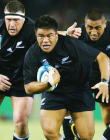
Forward effort: Try-scorer Mealamu leads the Kiwi charge
Seldom have two teams produced more contrasting displays at this level of the game. Everything the All Blacks were, the Springboks were not - determined, focussed and hungry.
And when the experts look at this match in days to come, and analyse every minute in the most absolute manner, they will realise that the All Blacks could so easily have beaten this bunch of pitiful Springboks by 50 points again ... as they did a couple of months ago in Pretoria. Yes, it is true. This All Black team, as easy as they made this victory look, played well below the standards we have come to expect from them. But on the day they did more than enough to beat a team that will come under a huge amount of criticism back home for their lack of passion, their sub-standard skills on attack and their disorganised defensive showing. Even more concerning for South Africans would be that this is the first time they have not advanced to the semi-finals of the RWC and it is also the first time they have lost at the RWC against the All Blacks - to go with the many other 'records' they have set under the tutelage of Rudolf Straeuli.
But all credit must go to the Kiwis for doing what they needed to do, without really exerting themselves at the Telstra Dome. They easily accounted for the Springboks' much-vaunted tight five, which never looked like dominating anything other than the mistakes column. The Kiwis dominated the possession stakes from the opening stages and for long periods the Boks never saw anything of the ball. In fact, in the first 15 minutes the Kiwis had more than 80 percent of the ball and enjoyed well over 70 percent in territorial advantage. That stat seldom dipped below 70 percent in the first half. While the Boks saw a bit more of the ball in the second period, with the possession stakes ending at about 62-38 in favour of the Kiwis, the South Africans could not use any of the opportunities presented to them. The All Blacks, however, showed how badly they wanted to win this game, showing greater determination in the set-pieces and at the breakdowns, turning ball over at regular intervals.
While the Kiwi forwards hunted as a unit, arriving at the breakdowns in far greater numbers, the Bok forwards seemed more eager to hang out wide and let the backs do their jobs. Then there were the scrums where the Kiwis also embarrassed their opponents at times, and on at least one occasion turning over ball and scoring from it by shoving the South Africans off their own put-in. Behind this dominant pack the New Zealand backline was brilliantly marshaled by their halfbacks, Justin Marshall and Carlos Spencer. And the backs enjoyed the space and time afforded to them, often breaching the Boks' shockingly disorganised defensive lines - especially their first-time tackles. The irony of it all was that while the Boks were so focussed on shutting down the All Blacks' dangerous runners out wide, they simply forgot to tackle around the fringes and in the midfield. In the 10, 12, 13 channel the Boks slipped more first-time tackles on Saturday than some international teams do in an entire season. And while we can go on at length about the lack of ball the Boks had, the few times when they did get the ball in hand their option-taking was either very ordinary or they simply could not control the possession, simply handing the ball back to the Kiwis on a platter. And against a team of New Zealand's calibre, even when they are not firing on all cylinders, they will make you pay - as indeed they did with the Springboks. At the end of the game the Kiwis showed an almost disdainful contempt for the Boks, as they threw the ball around and ran the Boks ragged. And it was only some desperate one-off tackles by a couple of Springboks that prevented the Kiwis from scoring more tries.
Few players in the South African side will be able to walk away from this mess with their heads held high, but among them will be youngsters like Schalk Burger, a second-half replacement, winger Ashwin Willemse and lock Bakkies Botha. For the Kiwis it was a game on which they can reflect how much they can still improve, having walked away with an easy win against one of their traditional rivals. Man of the match: Many of the All Blacks put their hands up, with flanker Richard McCaw, first five-eighth Carlos Spencer, centre Leon MacDonald and captain Reuben Thorne all doing their bit. But our vote goes to the Kiwis' outstanding hooker Keven Mealamu , who time and again showed up the Boks' close-in tackling and was eventually rewarded for his high work-rate with one of his team's three tries. Moment of the match: This one goes to the 72nd-minute try scored by winger Joe Rokocoko , which epitomised the entire game. From a scrum deep inside the Boks' 22, with the South Africans putting the ball in, the Kiwis simply shoved them off the ball, turned it over and then it was quickly passed to Carlos Spencer. He, in turn, flicked it back brilliantly through his legs, to Rokocoko, who went over in the corner for the try. Villain of the match: We are tempted to nominate most of the Springboks for their lack of passion, but the vote goes to Springbok captain Corn Krige , who early in the match showed exactly the lack of discipline the Boks have been criticised for in the past year or two. At a ruck, and after having already been awarded a penalty within striking distance, Krige attempted to stand on an opponent's leg when the ball was nowhere near. The result was that the penalty was turned over and the Boks lost an opportunity to put a much-needed score on the board. This moment almost epitomised the Boks mind set throughout the game ... a beaten and frustrated side.
The scorers:
For South Africa: Pens: Hougaard 3
For New Zealand: Tries: MacDonald, Mealamu, Rokocoko Con: MacDonald Pens: MacDonald 3 DG: Mauger
The teams:
South Africa: 15 Jaco van der Westhuyzen, 14 Ashwin Willemse, 13 Jorrie Muller, 12 De Wet Barry, 11 Thinus Delport (Jaque Fourie, 40), 10 Derick Hougaard (Louis Koen, 74), 9 Joost van der Westhuizen (Neil de Kock, 77), 8 Juan Smith, 7 Danie Rossouw (Schalk Burger, 62), 6 Corn� Krige (captain), 5 Victor Matfield (Selborne Boome, 77), 4 Bakkies Botha, 3 Faan Rautenbach (Richard Bands, 60), 2 John Smit (Danie Coetzee, 74), 1 Christo Bezuidenhout.
New Zealand: 15 Malili Muliaina, 14 Doug Howlett, 13 Leon MacDonald, 12 Aaron Mauger (Daniel Carter, 77), 11 Joe Rokocoko (Caleb Ralph, 77), 10 Carlos Spencer (vice-captain), 9 Justin Marshall (Steve Devine, 77), 8 Jerry Collins, 7 Richard McCaw (Marty Holah, 60-64, 74), 6 Reuben Thorne (captain), 5 Ali Williams, 4 Chris Jack (Brad Thorn, 74), 3 Greg Somerville, 2 Keven Mealamu (Mark Hammett, 74), 1 Dave Hewett (Kees Meeuws, 49).
By Jan de Koning
Saturday, November 8: 2003
Australia v Scotland Suncorp Stadium, Brisbane
Score, Australia - 33 , Scotland - 16
Quiet first-half showing from Wallabies
Australia marched on to the Rugby World Cup semi-finals with a 33-16 victory over a brave Scottish team at Suncorp Stadium in Brisbane on Saturday. After a quiet first half, the Wallabies stretched their legs into a comfortable lead, but the Scots got the last try at the death, a fitting reward for lots of serious effort.
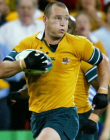
Try time: Mortlock looks around en route to the tryline
Chris Paterson the Scottish fly-half, nearly did not play. In a kick about before the match he was struck on the head by a flying ball and felled. He was helped off the field looking groggy, but was there to start the match and score 11 points for his side. The first half was level, partly because the Scots did well on Australia's line-outs, partly because the Wallabies squandered possession. But the Scots were resolute and creative and actually enjoyed territorial superiority in the half. The first half was an all-kick affair as far as the scoring went, but it was not a stodgy affair as the Wallabies sought to run free and the resolute Scots not only stood firm but did some raiding into Wallaby territory of their own. The Wallabies started playing to the wings. The Scots started getting in behind the tackle and making the best of scraps. Their best took Kenny Logan close on the left-wing but his chip dribbled into in-goal where Wendell Sailor killed it. The handling by both sides was mostly excellent, then crucially poor. Lote Tuqiri came off his left-wing to cut through, only for Mat Rogers to knock on the easiest of passes.
Rogers later cut through brilliantly but the Wallabies were brought back for obstruction by Bill Young who conceded three penalties in the half. The Wallabies used a penalty to force a five-metre line-out but again the Scots stood firm till they conceded a penalty. Off-side gave the Wallabies a four-minute lead, but Chris Paterson levelled the score when Stephen Larkham was penalised at a tackle. When Glenn Metcalfe went off-side in front of his posts the Wallabies took the three points - 6-3 after 22 minutes. Paterson punished Young's obstruction to make it 6-all after 33 minutes. The Wallabies ran, Andrew Henderson tackled Stirling Mortlock early and Flatley made it 9-6 after 36 minutes. Then came the moment of the half when Paterson dropped a goal from slap in front, but 49 metres out. The ball sailed high and drew and crossed the crossbar with good room to spare. The Wallabies made a significant change at half-time. Off went George Smith and on came lanky Matt Cockbain, giving them a third line-out option. The change worked as after this the Scots suffered more in the line-outs than the Wallabies did. The Australians scored early in the second half. Gregor Townsend broke sharply for Scotland but Phil Waugh won a turnover, gave to Flatley, who gave to Harrison who passed high to his left. Stirling Mortlock tipped the ball, caught it and raced 60 metres to score under the posts with an extravagant dive. That made it 16-9 after 45 minutes. Larkham had a wobbly drop at goal which hit the crossbar and then Nathan Sharpe cracked through a gap and gave to Flatley who was hauled down from behind. A penalty made it 19-9. Waugh, who had set up the first try, set up the second. He latched onto a Scottish slap-back at the line-out and raced downfield on the Australian right. The ball sped to Tuqiri on the left-wing. He crabbed half the width of the field. The Wallabies were close and won the ball. George Gregan side-footed a dab of a kick over the line and dived on it to score. The semi-final berth was assured at 26-9 with 22 minutes left. The Wallabies used a penalty to make a five-metre line-out. This became a five-metre scrum to the left of the posts as they looked at them. From the scrum David Lyons, who had a strong-driving match throughout, picked up and drove at the line for a try with three Scots hanging on him - 33-9 after 64 minutes. This became the season for substitutions and the game was played out with the best efforts coming from the Scots.
The Wallabies conceded three penalties within five metres from their goal line. The third became a line-out which splintered and Rob Russell, the replacement hooker, drove swiftly over with Cameron Mather in behind him. Paterson converted and the match ended. Man of the match: For Scotland, Nathan Hines was strong and Cameron Mather lively, and then there was noble Simon Taylor, one of the most skilled and most effective No.8s at the Rugby World Cup. For Australia, David Lyons did many battering things into the Scottish ranks, George Gregan ran the show, Matt Cockbain made a big difference and Brendan Cannon did all hooking things well and found time to be a startling loose forward. But our Man of the match is Phil Waugh whose alert, turnover efforts made two tries.
Moment of the match: The sweetness of Chris Paterson's soaring drop , a magic moment. Villain of the match: None whatsoever . Wendell Sailor's petulant slap was too feeble to count.
The scorers:
For Australia: Tries: Mortlock, Gregan, Lyons Cons: Flatley 3 Pens: Flatley 4
For Scotland: Try: Russell Con: Paterson Pens: Paterson 2 DG: Paterson
The teams:
Australia: 15 Mat Rogers (Joe Roff, 59), 14 Wendell Sailor, 13 Stirling Mortlock, 12 Elton Flatley, 11 Lote Tuqiri, 10 Stephen Larkham (Matt Giteau, 53, Daniel Vickerman, 73), 9 George Gregan (captain, Chris Whitaker, 65), 8 David Lyons, 7 Phil Waugh (Brendan Cannon, 75-76), 6 George Smith (Matt Cockbain, 40), 5 Nathan Sharpe, 4 Justin Harrison, 3 Ben Darwin (Al Baxter, 64), 2 Brendan Cannon (Jeremy Paul, 61), 1 Bill Young.
Scotland: 15 Glenn Metcalfe (Ben Hinshelwood, 46), 14 Simon Danielli, 13 Gregor Townsend (James McLaren, 75), 12 Andrew Henderson, 11 Kenny Logan, 10 Chris Paterson, 9 Bryan Redpath (captain), 8 Simon Taylor, 7 Cameron Mather, 6 Jason White (Jon Petrie, 64), 5 Stuart Grimes (Scott Murray, 61), 4 Nathan Hines, 3 Bruce Douglas (Gordon McIlwham, 68), 2 Gordon Bulloch (Rob Russell, 75), 1 Tom Smith. Unused replacement: 20 Michael Blair.
By Paul Dobson
Score , England - 28 , Wales - 17.
Nov. 9, 2003
Wilkinson kicks England past Wales
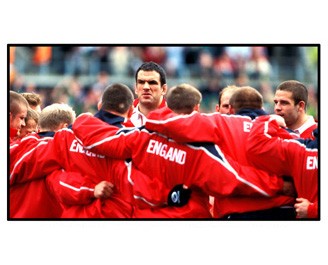
Wales give them an almighty scare
England were made to work all the way for their 28-17 quarter-final win over Wales, their opponents outscoring them by three tries to one, but a 23-point haul from golden-boy Jonny Wilkinson setting up a semi-final meeting with France next Sunday.
The English were left needing a second-half flash of pure inspiration from fullback Jason Robinson to finally subdue a fantastic Welsh challenge that left England looking distinctly ordinary for much of the match. Wales dominated every facet of play during the first half, and went into the break with a 10-3 lead. England - who started the game as Rugby World Cup favourites - only managed to climb above the inspired Welsh in the second half. A magical dash by Robinson led to a Will Greenwood try before fly-half Wilkinson recovered his composure to add five second-half penalties and a late drop-goal. Fly-half Stephen Jones and flankers Colin Charvis and Martyn Williams managed to cross the line for Wales, and they outscored England by three tries to one. The difference between the teams - as so often is the case for England - was Wilkinson's points-haul.
Indeed, if comparisons are needed - it was Wales who were the more dangerous outfit on display, they put on a display of running rugby that many detractors believed to be beyond their capability. Even through England had the lions share of possession, Wales ability to counter-attack at pace made a re-enactment of Wales defeat of England in the quarter-final of RWC '87 a distinct possibility. England - like New Zealand before them - had few answers to the kind of fluidity that Wales applied to their attack; a fluidity that appears to have sprung from nowhere. The side that took to the field for England had 704 caps between them - never before had such an experienced side ever trotted on to a rugby pitch. But Wales exploded into the game and made them look like amateurs. Clive Woodward's side has six 'captains' within it - one for each particular area of play - but the team looked leaderless as wrong decision followed wrong decision. Indeed, it was only the introduction of the wise head of Mike Catt at half-time that reversed the result in England's favour. Wilkinson, winning his 50th cap today, looked positively green in the opening exchanges. With Wales breathing down his neck he made a series for poor choices. Not that it was entirely his fault - with England's backs looking shapeless he was forced to find other avenues of attack, and his tactical kicking from hand let him down badly. England must have bunked off their video session this week because they looked shocked when Wales started picking at them with the same intensity as they showed against the All Blacks last week. The English defence was left perplexed as an early Welsh raid saw Robert Sidoli surge over the England line, but the big lock lost control of the ball as he stretched for the touch-down. England tried all they could to find first gear in the first half - with Jason Robinson putting in the dance moves in an attempt to rouse his team-mates - but it was to no avail. Wilkinson hit the post with a relatively easy penalty and missed a drop-kick in the opening quarter. His forwards lost two line-out balls, and gave away a rash of penalties in the same period. The England fly-half opened the scoring with a penalty kick that wobbled through the upright, and England began to feel their way back into the game by putting together some decent phases. But Wales were as resolute in defence as they were in attack, and a huge hit by centre Mark Taylor on Will Greenwood put pay to any English hopes of a try and buoyed the Welsh fans. As the strains of 'Bread of Heaven' echoed around Suncorp Stadium, the outstanding Shane Williams picked up a poor cross-field kick meant for Ben Cohen, and the Welsh backs sliced through England allowing fly-half Stephen Jones to finish off the lightening counter-attack by scoring. England soon conceded a kickable penalty and Welsh skipper Colin Charvis had the sheer audacity to go for the line-out. From the maul, Wales bludgeoning their way through the much-vaunted England forwards and Charvis was on the end to flop over the line for the try. It was a carbon-copy of the skipper's try against the All Blacks - down to Charvis' little buff of his own bouffant - and showed just the extent of Wales' newly-found confidence. Where they found it, however, remains an absolutely mystery. Jones missed again with the conversion - a crucial miss. Wales let 10 points go begging during the match; England only three. With England distinctly rattled, Wales attempted to press home their advantage with some scintillating breaks. England's panic was exemplified by wing Dan Luger who slicing a rushed clearance kick 10 yards backwards - if it had been a tee-shot, he might have holed the green he had just walked away from.
Luger mouthed a curse, England heads hung low, and Woodard looked furious. Meanwhile, Wales' confidence grew and they took to the break seven points clear. Desperate times call for desperate measures -and Woodward called off Luger, switched Mike Tindall to the wing and brought veteran back Mike Catt into the centre to add a little solidity to the midfield. It proved to be a masterstroke. With Catt taking charge of midfield distribution and tactical kicking, Wilkinson was free to focus on his own game rather the team's. England had finally found their shape and - as if to celebrate the fact - Jason Robinson unleashed a moment of pure inspiration. Having received a quick throw-in on the edge of his own 22, the fullback looked bereft of options. Suddenly he eyed a gap in the Wales midfield, pinned his ears back, and disappeared down the middle. His acute change of pace left the Welsh floundering and Robinson completed his 60-yard sprint by unloading to Will Greenwood who went over in the corner for the score. The try lifted English chins and Wilkinson slotted the tricky conversion and a penalty to recapture the lead.
It was obvious Woodward had knocked some sense into his players during the break, and they began to play some wise percentage rugby that put Wilkinson in a good position to kick another easy penalty. But Wales hadn't finished - they continued to run at England with some lurid running rugby, but a few wrong decisions far out - and a tighter looking English defensive line - meant that all their hard work came to nought. Wilkinson looked content to leave Catt in charge of leading the attack and began to focus on his place kicking -and duly added two more penalties from difficult angles with traditional nonchalance. Catt added an extra dimension to the English attack and his runners began to find holes, Wales were forced to concede another penalty as they back-pedalled and were punished with yet another Wilkinson score. But while England dug in behind that famous left boot, Wales still had gas to burn, and they continued to put on a terrific handling performance. After beating the English back, Iestyn Harris put in a cross-field kick and flanker Lawrence Dallaglio - under pressure - could only knock it back and watch as replacement flanker Martyn Williams scampered over to touch down. Iestyn Harris - taking over the kicking duties from the misfiring Jones - stepped up to narrow the gap to eight points.
England composure started to sag again, and some back-chat directed at referee Alain Rolland after a penalty decision moved Harris 10 metres up the field and within kicking range. Woodward was visible annoyed at his players lack of discipline, but his team were let off the hook as Harris' attempt sailed well wide. It was Wilkinson, naturally, who had the last word by slotting a drop-goal with the last kick of the game.
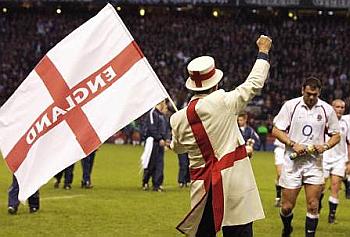
So, a huge Welsh effort, but a win for England. The England players trudged off the field forlornly - they are no longer favourites for the cup, and one can't help to thing how much lower they'll feel once they have taken in France's game against Ireland. Man of the match: For all England's experience, it was left to replacement Mike Catt to put some brain behind English brawn. The Bath man - who two months ago feared his international career was over - turned the game around by relieved the pressure on Wilkinson, and sparked a few unsettling runs of his own. Expect the number on his back to be in the teens next time you see him. Moment of the match: Wales played like men possessed and showed some fine passages of play, but it was Jason Robinson's flash of sheer inspiration that caught the eye. The fullback made a try out of absolutely nothing, his sheer accelerations was a joy to behold and punctured the Welsh balloon that looked as if it was about to carry them through to the semi-finals. Villain of the match: I'm not going to tarnish such a classy performance with nit-picking - yes, Brent Cockbain swung his handbag early on, but there was no harm done. So, no award this time - too many heroes everywhere!
The scorers:
For England: Try: Greenwood Con: Wilkinson Pens: Wilkinson 6 DG: Wilkinson
For Wales: Tries: S Jones, Charvis, M Williams Con: Harris
The teams:
England: 15 Jason Robinson, 14 Dan Luger (Mike Catt, 40), 13 Will Greenwood (Stuart Abbott, 55), 12 Mike Tindall, 11 Ben Cohen, 10 Jonny Wilkinson, 9 Matt Dawson (Kyran Bracken, 67), 8 Lawrence Dallaglio, 7 Neil Back, 6 Lewis Moody, 5 Ben Kay, 4 Martin Johnson, 3 Phil Vickery, 2 Steve Thompson, 1 Jason Leonard (Trevor Woodman, 49). Unused replacements: 16 Dorian West, 18 Simon Shaw, 19 Joe Worsley.
Wales: 15 Gareth Thomas, 14 Mark Jones, 13 Mark Taylor, 12 Iestyn Harris, 11 Shane Williams, 10 Stephen Jones (Ceri Sweeney, 58-63), 9 Gareth Cooper (Dwayne Peel, 64), 8 Jonathan Thomas (Martyn Williams, 58), 7 Colin Charvis (captain), 6 Dafydd Jones, 5 Robert Sidoli, 4 Brent Cockbain (Gareth Llewellyn, 46), 3 Adam Jones (Gethin Jenkins, 29), 2 Robin McBryde (Mefin Davies, 64), 1 Iestyn Thomas. Unused replacement: 22 Kevin Morgan.
By Andy Jackson
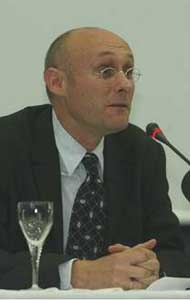
Bernard Laporte
Score, France - 43, Ireland - 21.
Nov. 9, 2003
Classy French silence Ireland's call
Les Bleus show full array of skills
France marched into the Rugby World Cup semi-finals with an emphatic 43-21 win over Six Nations rivals Ireland, Les Bleus dazzling the Telstra Dome crowd on Sunday with four high-quality tries. The French signalled their intentions from the very beginning as they sent the ball out wide from the word go and fly-half Fr�d�ric Michalak was quite simply magnificent every time touched the ball. The Toulouse No.10, who is quickly challenging England's Jonny Wilkinson as the best in the game, stamped his authority early in the game when he chipped the ball out to the right-wing for powerful No.8 Imanol Harinordoquy to gather, pop it off to centre Tony Marsh, who in turn passed on to flanker Olivier Magne to charge over for the first try. The French made it all look so easy and it was a sure sign of things to come ... France dominated all phases of the game and the loose trio of Magne, Serge Betsen and Harinordoquy were sublime as they marauded Ireland's ball like a pack of rabid dogs and provided their exciting backline with copious amounts of quality ball. The angles of running employed by the French were a joy to watch as they glided through gaps at will, with some desperate defence by Ireland's inspirational skipper Keith Wood and some French errors, mainly down to over-eagerness, allowing the Irish to keep their opponents at bay.
Ireland matched the French side's silky running with pure grit and determination as they began to find their feet midway through the half and bashed away at the defence with strong runs through midfield, but France were just as awesome on defence as they were on attack as they swamped the Ireland players in a sea of blue - with that man Betsen leading the way. It took a chip over the defence by Irish star centre Brian O'Driscoll to beat the defence and Christophe Dominici was forced to hack the ball into touch, setting up Ireland with their first real opportunity of the game. But the resulting move was broken down due to some phenomenal defence by France and when an Irish pass went awry, Les Bleus pounced. Betsen was again involved as he linked up with Dominici, putting the little winger into space for the try. Michalak continued to make it look all too easy as he slotted his second conversion - keeping his 100 percent record intact. France stretched the lead to 27-0 at the break after the loose trio again turned ball over close to the Irish line for Harinordoquy to dot down. Ireland were immediately under pressure following the re-start as fly-half Ronan O'Gara knocked on to hand possession back to the French and after prop Reggie Corrigan gave away a penalty in the resulting scrum, Michalak kept his team rolling on with the penalty goal.
The 20-year-old fly-half continued to dictate proceedings as he danced through the defence not long afterwards to set up play five metres from the Irish tryline as hooker Raphael Iba�ez bashed his way through. Michalak was then on hand to send the ball out to Magne, who linked up with prop Jean-Jacques Crenca for a simple run-in. That after Crenca had handled in the early stages of the move. Ireland coach Eddie O'Sullivan then opted to replace O'Gara with veteran No.10 David Humphreys and the move proved to be the better option for the Irish as the French took their foot off the gas slightly, allowing Ireland back into the game and when centre Kevin Maggs blasted through the gap there was nobody at home to stop the try. Humphreys made no mistake with the conversion. The try sparked the Ireland side into action as they looked to close the gap, but the pressure proved too much as Humphreys knocked on when the line was in sight. France then made sure the revival was short-lived as they again began to pile on the pressure. Another Michalak penalty reasserted the French authority before the game began to break down. Both teams began to send on the replacements and then Iba�ez was sent to the sin bin as he continued to infringe at the breakdown - something the entire French team was guilty of doing.
Ireland took advantage of the extra man and in the next movement Humphreys stabbed it through for O'Driscoll to chase over and score. Humphreys converted and O'Driscoll picked up a second not long after, but it all came too late for Ireland with the French well in front and already on the way to the Telstra Stadium in Sydney for a semi-final clash against one of England or Wales. Man of the match: For Ireland, skipper Keith Wood can take a bow with another big game in front and around the park, while O'Driscoll did what he could with limited ball, but it was the French loose trio of Olivier Magne, Imanol Harinordoquy and Serge Betsen who ruled the day - with Betsen just pipping his two partners for the award with a tireless display on attack and defence. Moment of the match: There were plenty of brilliant moments during the match, but it was Ireland captain Keith Wood's tearful post-match interview that highlighted the passion of the Irish, bringing an end to a remarkable World Cup career for Wood and presenting an example of true sportsmanship to many others who have little. Villain of the match: There was the occasional bit of niggle, but nothing serious, so French hooker Raphael Iba�ez collects this award for his continuous negative play at the breakdown earning him 10 minutes in the sin bin.
The scorers:
For France: Tries: Magne, Dominici, Harinordoquy, Crenca Cons: Michalak 4 Pens: Michalak 5
For Ireland: Tries: Maggs, O'Driscoll 2 Cons: Humphreys 3
The teams:
France: 15 Nicolas Brusque, 14 Aur�lien Rougerie, 13 Tony Marsh, 12 Yannick Jauzion (Brian Liebenberg, 48), 11 Christophe Dominici, 10 Fr�d�ric Michalak, 9 Fabien Galthi� (captain), 8 Imanol Harinordoquy (Patrick Tabacco, 74), 7 Olivier Magne (Yannick Bru, 63-73), 6 Serge Betsen, 5 Jerome Thion (Olivier Brouzet, 63, Pepito Elhorga, 77), 4 Fabien Pelous, 3 Sylvain Marconnet, 2 Raphael Iba�ez (Bru, 73), 1 Jean-Jacques Crenca (Olivier Milloud, 70). Unused replacement: 20 G�rald Merceron.
Ireland: 15 Girvan Dempsey, 14 Shane Horgan, 13 Brian O'Driscoll, 12 Kevin Maggs, 11 John Kelly, 10 Ronan O'Gara (David Humphreys, 48), 9 Peter Stringer (Guy Easterby, 73), 8 Victor Costello (Eric Miller, 68), 7 Keith Gleeson, 6 Simon Easterby, 5 Paul O'Connell, 4 Malcolm O'Kelly, 3 John Hayes, 2 Keith Wood (captain), 1 Reggie Corrigan (Marcus Horan, 48). Unused replacements: 16 Shane Byrne, 18 Donncha O'Callaghan, 22 Anthony Horgan.
Yellow card(s): Raphael Iba�ez (France, 63)
By Rob Peters