
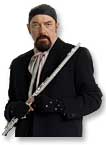
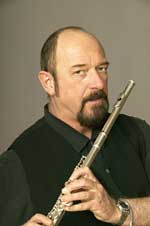
Lead singer and flautist with the rock group Jethro Tull . Born in Dunfermline UK 1947. Formed in 1968, the group achieved popularity during the 1970s, particularly in the USA, with successful albums including Aqualung (1971), Thick as a Brick (1972), Living in the Past (1972) and Warchild (1974). The band still tours and records occasionally, for example, Catfish Rising (1991). Anderson's solo albums include Walk Into Light (1985) and Divinities: Twelve Dances with God (1994).
Anderson is a landowner on the Strathaird Peninsula on the Isle of Skye. When not involved in music, he runs a company producing smoked salmon.
Calliandra Shade (The Cappuccino Song)
Ian Anderson Vocals, bamboo flute, guitars, accordion, percussion, bass guitar James Duncan Drums
Caf� society is as old as the hills. Starbucks and its imitators are the coffee face of the new man in a hurry. Throughout the Old World, the laid-back, knowing residents of towns and villages suspend time in the post-luncheon long moment. Oh, well � the coffee�s only ever as good as the water it is made with. And the froth on top is the frilly knicker on a cheap tart�s bum.
Funny old cup o� tea, coffee
lyrics
I sit in judgement on the market square. I have my favourite table and I have my chair. Natives are friendly and the sun flies high. All kinds of crazy waiters � they go drifting by.
Come, sit with me and take decaf designer coffee. Come, laugh and listen as the ragamuffin children play. Lame dog and a black cat, now, they shuffle in the shadows. You got cappuccino lip on a short skirt day.
Hours last forever in the Calliandra shade. Conversation going nowhere and yet, everywhere. Kick off those sad shoes and let the bare toes tingle. Slip off the shoulder strap: loosen the thick black hair.
Electric afternoon and shrill cellphones are mating. Lame dog is dreaming, dreaming of a better life where bed is fluffy pillows, table scraps are filet mignon flicked indiscretely by the lazy waiter�s knife.
Rupi�s Dance
Ian Anderson Vocals, flute, acoustic guitars David Goodier Stand-up bass
The sight of a dark-haired, sexy and alluring young female swaying and swishing to the sound of CNN quietly playing in the background never fails to captivate.
Rupi was, at the time of writing this song, about 14 weeks old and a bit wobbly on her tiny feet and with not much of a tail yet to balance the bodily gyrations.
Funny old girls, pussies cat
lyrics
She dances through the flower-filled room � Sea-green eyes a-sparking. Or are they blue? The message clear: Seduce the master, winking.
Dainty feet circles inscribe Upon the frozen parquet. Arabesque in compound time: Stately Pavane or Bour�e.
Sultry smile, come hither gaze � Black hair softly shining. Calls me up to half-lit bed. Sweet cloud with golden lining.
Oh, so young with ageless smile � Born of ungodly maker Draws me: moth to candle bright � Fiery pleasure-seeker.
She dances through the flower-filled room � Sea-green eyes a-sparking. It�s Rupi�s dance: the message clear. Her movement does the talking.

Lost In Crowds
Ian Anderson Vocals, flute, acoustic guitars Leslie Mandoki Drums and percussion Laszlo Bencker Keyboards Ossi Schaller Guitar George Kopecsni Guitar The Sturcz String Quartet
I am terrible at drinks parties. I do my best and try to chat happily and meaningfully to complete strangers but something in my conversation seems to bother them. Too intense, perhaps? Too fond of talking at people instead of listening? Too condescending and patently bored with the whole thing?
What the hell. I prefer the anonymity of being among the faceless crowds in airports, on downtown sidewalks and in the ubiquitous mall haven of tranquil and isolated suburbia.
Funny old things, crowds
lyrics
I get lost in crowds: if I can, I remain invisible to the hungry mouths. I stay unapproachable. I wear the landscape of the urban chameleon. Scarred by attention. And quietly addicted to innocence.
So, who am I? Come on: ask me, I dare you. So, who am I? Come on: question me, if you care to. And why not try to interrogate this apparition? I melt away to get lost in this quaint condition.
At starry parties where, amongst the rich and the famous I�m stuck for words: or worse, I blether with the best of them. I see their eyes glaze and they look for the drinks tray. Something in the drift of my conversation bothers them.
So, who am I? Come on: ask me, etc.
In scary airports, in concourses over-filled, I am detached in serious observation. As a passenger, I become un-tethered when I get lost in clouds: at home with my own quiet company.
Herald Tribune or USA Today. Sauvignon Blanc or oaky Chardonnay. Asleep for the movie. Awake for the dawn dancing on England and hedgerows � embossed on a carpet of green. I descend and � forgive me � I mean to get lost in crowds.
A Raft Of Penguins
Ian Anderson Vocals, flute, piccolo, wooden flute, acoustic guitars Leslie Mandoki Drums, and percussion Laszlo Bencker Keyboards The Sturcz String Quartet
Having worked, over these many years, with various orchestral forces from solo woodwind players through string quartets to the more-or-less symphony orchestra, I remain entranced at the differences and misconceptions present in the mutual understanding � or lack thereof � in such gatherings of minds and music.
Who is the more terrified in such encounters? Me or them? I play a bit out of tune, out of time and read not a not a note of those Dead Sea Scrolls written so carefully upon the stave of life. But when the wind gets up and the music stand blows over, I can busk it with the best of them. It�s all in the head, you see. And in the heart. And that improvisational adventure is a mystery to many a first fiddler and his tribe.
Here is an affectionate musing on the scary delights of fronting an orchestra in the face of a paying public.
Funny old birds, penguins
lyrics
A raft of penguins on a frozen sea. Expectant faces look down on me. Shuffle uneasy. The whistler plays. Counting eleven, they begin to pray.
Tenuous but clinging, the missing link Joins us, closer than we might think. Some half remembered coarse jungle drum � A naked heart-beat, trill and hum.
This world�s no stage for the faint at heart. Each symphony, a sum of parts. Each overture, a sweet foreplay. Let�s crash and burn some other day.
Bonded in terror or suspicion deep Tentative tiptoe or giant leap Call down the angels to guide them in A raft of penguins take to the wing.
A Week Of Moments
Ian Anderson Vocals, flute, acoustic guitars Leslie Mandoki Drums and percussion Laszlo Bencker Piano, Hammond B3 organ, Keyboards
Vacations for me are a mercifully short excuse for getting away from the rat race to find only that the stress of yet more hotels, screaming pool children and fellow guests from Hades make for a mixed and dubious week�s pleasure.
So here is my imagined idyllic, romantic holiday for two. Don�t tell Shona � she might hold me to this.
Funny old chap, holidays
lyrics
A week of moments � a clutch of days � Ten thousand minutes of a Passion Play. Medley of quavers informs the tune. It�s all too much: over all too soon.
Sweet condensation on chilling wine Traveler�s palm, flamboyant tree Fast photos ripped and lost consign A week of moments to faint memory.
A week of moments plucked from the page Found far horizons, a sunset stage. Suitcases bulge, in silence packed A chapter closed: no looking back.
The lightest touch upon my arm No fierce restraint, no call to stay. Hushed room maids glide like pawns to king With pool attendants in chess piece array.
A Hand Of Thumbs
Ian Anderson Vocals, piccolo, flute, acoustic guitars David Goodier Bass guitar and stand-up bass Leslie Mandoki Drums and percussion Laszlo Bencker Keyboards, Mellotron, Moog Ossi Schaller Electric guitar George Kopecsni Electric guitar
An imagined meeting with seductive stranger, glimpsed across yet another crowded room. Must try to practise these social skills. Must try to do better. Must try to be more confident.
Funny old business, fear of humiliating failure
lyrics
My hand of thumbs is shaking I am so glad to meet you All tongue-tied and twisted My lips stuck like glue
More than a lifetime to say, How are you? More than an ocean to cross becalmed. Less than a second to sink in silence. Yours truly, I remain disarmed.
Saw you peeping from the corner. Your eyes seemed to call hello. I�m all too easily mistaken, My feet unsteady as they go.
Was I a suave and confident trickster I would sweep you up and carry you down To raspberry meadows under diamond skies and just mess around. Just mess around.
Eurology (instrumental)
Ian Anderson Vocals, flute, acoustic guitars David Goodier Bass guitar John O�Hara Accordion Leslie Mandoki Percussion
Power-walking down London�s Baker Street in rush-hour some months ago, I found myself humming this tune, bestowed upon me by the Euro-Gods � or, at least, their angels-in-waiting.
Having popped in to the nearest Sony Centre to purchase a digital �dictaphone� of the cheapest variety, I repaired to the local Indian restaurant and furtively muttered into the new device the melodic bones of this eclectic and varied piece, between munches of poppadom and vindaloo. Well, you could forget it by the time you got home, couldn�t you? Bet you wish I had.
I was trying to explain this piece to a journalist as being a pun on the study of the urinary tract and its diseases when he asked me if it was difficult to play. �No, it�s a piece of piss, actually�, I offered.
Funny old things, Euro-tunes
Old Black Cat
Ian Anderson Vocals, bamboo flute, acoustic guitars David Goodier Stand-up bass
For twelve years I enjoyed the good company of a pretty average, unexceptional old moggy by the name of Mauser. He was so-called after the German armament company of the same name but Deutsche-slang suggests his name might also liberally translate as �Shagger� � quite inappropriate since he was de-balled and disarrayed as a young sir. However, he may have long considered eunuch meanderings of the third kind. Who knows?
He died of liver cancer quickly and painlessly just before Christmas and I wrote the song in the hours after the go-to-sleep-now needle went in.
Funny old thing, sentimentality
lyrics
My old black cat passed away this morning He never knew what a hard day was. Woke up late and danced on tin roofs. If questioned �Why?� � answered, �Just because.�
He never spoke much, preferring silence: eight lost lives was all he had. Occasionally sneaked some Sunday dinner. He wasn�t good and he wasn�t bad.
My old black cat wasn�t much of a looker. You could pass him by � just a quiet shadow. Got pushed around by all the other little guys. Didn�t seem to mind much � just the way life goes.
Padded about in furry slippers. Didn�t make any special friends. He played it cool with wide-eyed innocence, Receiving gladly what the good Lord sends.
Forgot to give his Christmas present. Black cat collar, nice and new. Thought he�d make it through to New Year. I guess this song will have to do.
My old black cat Old black cat
Photo Shop
Ian Anderson Vocals, flute, piccolo, mandolin, percussion, accordion, acoustic bass guitar
Just across the street from London�s Paddington Station, is a small photo shop where I have occasionally taken in some film for developing. The voyeuristic delights (and horrors) of processing the customers� holiday snaps must be a poor substitute for the chance to leave cold and rainy old Paddington for the balmier climes of foreign parts.
And some of those foreign parts, in all their gynaecological detail, doubtless show up in the work load from time to time. Oh, well: brightens up a drab day doesn�t it? And most of the snaps get stuck in a bottom drawer and forgotten; better remembered, perhaps, by the photo processor than the picture-taker. Think about it when next you drop off the roll of film with the bared buttocks of Auntie Maude by the swimming pool.
Funny old waste of trees, most holiday photos
lyrics
A Morris Minor, a caf noir � Banana smoothie, snails in a jar. Three dodgy sailors, a girl on skates � A little too muscled from doing weights.
A family wedding, a sushi bar � Sand in the Seychelles, karaoke star. Lads on the razzle get lost in love. Paddington station, rain clouds above.
The crumpled sheets of a long hot summer. Stored images like an acorn, drop. Squirreled away, but still remembered by the man in the photo shop.
Rush hour on Praed Street: behind the glass � a picture process, in one hour fast. Intimate portraits of topless wives � flashed indiscretions: snap-happy lives.
Pigeon Flying Over Berlin Zoo
Ian Anderson Vocals, flute, acoustic guitar David Goodier Bass guitar James Duncan Drums Leslie Mandoki Udu Laszlo Bencker Piano, Hammond Organ Andrew Giddings keyboards The Sturcz String Quartet
While I was going morning walk-about during a few hours off mid-German tour, I dropped in, as I usually do, to the calm and orderly Berlin Zoo to check out my little pals in the Cat Kingdom for the medium to small.
On my way to the cat enclosure, I noticed a pigeon flying lazily over the other animals locked behind wires in their enclosures and thought, �Oh, to be free like that pigeon�..�
But then, would the antelope, the elephant and the flamingo really want the get-out-of-jail card after all? I wrote the song in my head � words and music, top to tail and went for a curry. Put in on mini-disc back at the hotel.
Funny old things, zoos
lyrics
I�m thinking free - like the bird flying over, over the animals in the zoo. How do you do? What�s it like to be in there? Think about it.
You�re locked behind wires. Safe and warm - under house arrest protection from the wild, wild storm and tempest raging here on the outside. Think about it.
Pigeon I. Pigeon toed. I�m pigeon-friendly as pigeons go. Pigeon lonely. Pigeon English. What�s it like to be in there? Think about it.
Harsh spaces. Empty freedom. Scary concept. Wrong side of the window. Which one of us will wake imprisoned come tomorrow? Think about it.
Give it due consideration. Weigh it up. Kiss me quickly. Pigeon friendly. Let me in there to be with you. Mull it over. (Think about it.)
Griminelli�s Lament (instrumental)
Ian Anderson Vocals, flute, acoustic guitars David Goodier Bass guitar John O�Hara Keyboard
Andrea Griminelli is a famous Italian flautist who possesses good looks, Latin charm, worldliness, exceptional musicality and, temporarily, no girlfriend following a parting of ways.
That is why I wrote for him this piece of music which we played together on some concerts with orchestras in Italy in 2002. It combines Celtic and Baroque influences to symbolise our separate musical and cultural backgrounds. Didn�t do a lot to cheer him up, really. I play both flute parts on this recording, as Andrea and James Galway both would have liked to perform the second flute part on the piece and I didn�t want to upset either of them. Now, I�ve probably upset both.
Funny old lip-smackers, flute-players
Not Ralitsa Vassileva
Ian Anderson Vocals, flute, acoustic guitars John O�Hara Accordion James Duncan Drums Leslie Mandoki Percussion Laszlo Bencker Piano Andrew Giddings Bass, keyboard
As an inveterate watcher of CNN after each Tull show, I clamber, naked as a baby, on to the hotel bed to be with the young, and not-so-young ladies and gentlemen of Cable News Network as they fill me in on the daily events of this wicked world. Of course, Ralitsa (Bulgarian-born and educated journalist of the most professional and responsible sort) is a CNN International gal and therefore not viewable in the United States, but we see her over here in the UK in the rest of the world.
The chattering classes love to pontificate on the ways and wiles of the world and I am no exception. This song is based on the memory of a temporary and slightly tipsy female dinner table companion who regaled me with the day�s news stories as if she was the author of all-that-was-great-and-happened-today. As if she could be the slick, tutored and elegant Ralitsa! Oh, Ralitsa of the careless dimple.
Funny old things, CNN gals
lyrics
Dinner table chattering classes � tell all we need to know. Like it. Lump it. Dig it. Dump it � on your late, late show.
And do you think you�re Ralitsa Vassileva? You�re just hand-me-down news in a cookie jar. It�s a long way from here to CNN in America and a red-eyed opinion too far.
Dish the dirt or dish the gravy. Spill the beans to me. Sinking fast in terminal boredom � Feigned interest flying free.
And do you think you�re Ralitsa Vassileva etc.
Talking monkey, breaking news junkie, tragedies to reveal. Light and breezy, up-beat squeezy, close in to touchy-feel.
Pass the Merlot, dance the three-step Cut to a better chase. Align yourself with no proposition and simpler thoughts embrace.
Let�s talk about me. Let�s talk about you. In a world of private rooms. Hide awhile from dark stormbringers � sad messengers of doom.
Sadly, you can�t be Ralitsa Vassileva etc.
And do you think you�re Ralitsa Vassileva etc.
Two Short Planks
Ian Anderson Vocals, flute, acoustic guitars, percussion David Goodier Bass guitar
When I was a short-trousered pre-teen schoolboy, I had an easy ride at primary school in Scotland. But, aged twelve, and having relocated to a more competitive environment at the North of England�s Blackpool Grammar School, the full horror of the regular examination process had me in a tizzy. Some subjects caused me great anguish and difficulty: Algebra, Trigonometry, Chemistry and some aspects of Physics brought on the jitters due to fear of loosened sphincter, hot flushes and migraine attacks.
I decided that I was not academically blessed and took refuge in the strangely comforting notion that I must be naturally a bit stupid (as thick as two short planks). Of course, sufficiently relaxed and resigned to a distant and soon-to-be-forgotten acquaintance with academia, I quickly went on to rise to the top of the lead class and take all my exams successfully a year early!
Funny old thing, school
lyrics
Find some way to square the circle. Feet slipping, sliding on the level. Connect to reason, is there anybody there? Drum it in to me now if you dare.
Triangles by Isosceles. Principles by Archimedes. Amo, amas; even amat make for one less way to skin the cat.
Two short planks � Try my luck on another day Must be thick as two short planks � That�s about all that I have to say.
Two short planks � Pop the question: I sit the test Must be thick as two short planks � Spin me round till I come to rest.
They say truth comes flooding if you let it. But what happens if I just don�t get it? I�m blissful in my sweet ignorance and delight in my incompetence. Two short planks � Try my luck on another day Must be thick as two short planks � That�s about all that I have to say. Two short planks � Pop the question: I sit the test Must be thick as two short planks � Spin me round till I come to rest.
Birthday Card At Christmas
(Bonus track from The Jethro Tull Christmas Album)
Ian Anderson Vocals, flute, acoustic guitars Martin Barre Electric guitar Andrew Giddings Keyboards and bass Doane Perry Drums
My daughter Gael, like millions of other unfortunates, celebrates her birthday within a gnat�s whisker of Christmas. Overshadowed by the Great Occasion, such birthdays can be flat, perfunctory and fleetingly token in their uneventful passing.
The daunting party and festive celebration of the Christian calendar overshadows too, some might argue, the humble birthday of one Mr. J. Christ.
Funny old 25ths, Decembers
lyrics
Got a birthday card at Christmas: it made me think of Jesus Christ. It said, �I love you� in small letters. I simply had to read it twice. Wood smoke curled from blackened chimneys. The smell of frost was in the air. Pole star hovered in the blackness. I looked again: it wasn�t there.
People have showered me with presents. While their minds were fixed on other things. Sleigh bells, bearded red suit uncles. Pointy trees and angel wings. I am the shadow in your Christmas. I am the corner of your smile. Perfunctory in celebration. You offer content but no style.
That little baby Jesus. He got a birthday card or three. Gold trinkets and cheap frankincense. Some penny baubles for his tree. Have some time off for good behaviour. Forty days, give or take a few. Hey there, sweet baby Jesus: Let�s share a birthday card with you.
We are delighted to be able to share with you some of the humor, the charm, the insight, and the love for felines of Ian Anderson, flute player for the famous rock band, Jethro Tull. Ian is a devoted Bengal owner, and was kind enough to grant us this exclusive interview. What an honor for us to be able to talk "cats" with this fascinating and passionate man!!
HDW: I an, thank you for taking the time to tell us about yourself, your cats, and some of your thoughts about cat-keeping and the Bengal breed in particular!! First of all, could you tell us a little about your background?
I.A.: F or almost (a cat's whisker away) thirty years I have been the flute player, singer and occasional guitarist in the rock band Jethro Tull. We have played over two thousand concerts in most of the countries of the world where electricity is available, and sold (so EMI Records tell me) over forty million albums.
My musical and touring commitments over all these years have left me little time to follow the usual range of manly hobbies and so my private recreational time is usually spent at home in the company of my wife Shona, our two children James and Gael, and the four or five cats which, at any one time, we have enjoyed the company of in our English home surrounded by our farming estate and woodlands.
Ian Anderson, known throughout the world of rock music as the flute and voice behind the legendary Jethro Tull, celebrated his 39th year as a recording and concert musician in 2002. Ian was born in 1947 in Dunfermline, Fife, Scotland. After attending primary school in Edinburgh, his family relocated to Blackpool in the north of England in 1959. Following a traditional Grammar school education, he moved on to Art college to study fine art before deciding on an attempt at a musical career.
Tull formed in 1968 out of the amalgamation of the John Evan Band and McGregor's Engine, two blues-based local UK groups. Still enjoying a lengthy and ongoing career, Jethro Tull has released 30 albums, selling more than 60 million copies since the band first performed at London's famous Marquee club. After undertaking more than 2500 concerts in 40 countries throughout three decades, Tull plays typically 100 concerts each year to longstanding, as well as new fans worldwide.
Widely recognized as the man who introduced the flute to rock music, Ian Anderson remains the crowned exponent of the popular and rock genres of flute playing. So far, no pretender to the throne has stepped forward. Ian also plays ethnic flutes and whistles together with acoustic guitar and the mandolin family of instruments, providing the acoustic textures which are an integral part of most of the Tull repertoire. Anderson has recorded three diverse solo albums in his career: 1983's eclectic-electric "Walk Into Light"; the flute instrumental "Divinities" album for EMI's Classical Music Division in 1995 which reached number one in the relevant Billboard chart, and the more recently recorded acoustic collection of songs, "The Secret Language of Birds", released in 2000.
New solo recordings are scheduled after the live Tull classic "Living With The Past" CD and DVD released in May 2002. In addition to Tull concert tours, further Ian Anderson solo concerts with orchestra and other acoustic shows are planned for 2002 - 2004. Ian Anderson lives on a farm in the southwest of England where he has a recording studio and office. He has been married for 25 years to Shona who is also an active director of the companies. They have two children - James and Gael - who work in the music and television industries respectively.
His hobbies include the growing of many varieties of hot chile peppers, the study and conservation of the 26 species of small wildcats of the world and collecting and using vintage Leica and other cameras. He reluctantly admits to owning digital cameras and scanners for his work on the photographic promotional images related to Tull as well as his solo career. Ian owns no fast car, never having taken a driving test, and has a wardrobe of singularly uninspiring and drab leisurewear. He still keeps a couple of off-road competition motorcycles, a few sporting guns and a saxophone which he promises never to play again. He declares a lifelong commitment to music as a profession, being far too young to hang up his hat or his flute, although the tights and codpiece have long since been consigned to some forgotten bottom drawer.
April 23, 2002
Who inspired the most famous flutist in rock and pop music to take up the flute in the first place? "Eric Clapton," said Ian Anderson. "Eric Clapton is not known for being a flute player, and that was the reason I took up the flute. I figured I was never going to be as good a guitar player as he was, so I better learn to do something he couldn't do." Rock music in the 1970s would have been much less interesting had Anderson not made that decision. He and his band, Jethro Tull, lit up the record charts in the early-to-mid '70s with a string of top-ten albums--- Aqualung, Thick as a Brick, Passion Play, War Child and Songs From the Wood . The band's hit singles "Living in the Past" and "Bungle in the Jungle," and album cuts like "Teacher" and "Locomotive Breath" continue to be staples of Classic Rock radio.
"I didn't want to be just another third-rate guitar player who sounded like a bunch of other third-rate guitar players," the Pied Piper of Rock said in an interview last week. "I wanted to do something that was a bit more idiosyncratic, hence the switch to another instrument." His flute playing has come a long way from very humble beginnings. "When Jethro Tull began, I think I'd been playing the flute for about two weeks. It was a quick learning curve�literally every night I walked onstage was a flute lesson." Learning to play the flute while making music in the context of a rock band led him to create a distinctive personal style. "Actually, the first period of trying to play was very unproductive for me. When I tried to blow it, I hardly got anything from it. Eventually I managed to get a noise out of it by using that technique which I later heard Roland Kirk using, which was singing the note at the same time as you play it.
"I guess if I'd ever had flute lessons, I would have given up," he laughed. "If I'd been a proper flute player, then I would have found it so difficult to make the instrument integrate into a rock band." Anderson's trademark stance, playing the flute while standing on one leg, "evolved when I was playing harmonica, hanging on to the microphone stand. It was easy to lift one leg in the air and kind of wiggle about. Then it became noticed by the people who wrote the very first reviews of Jethro Tull back in 1968: 'This guy plays the flute, and he stands on one leg.' They kind of put the thing together. It wasn't that I stood on one leg playing the flute to begin with, it was the harmonica. So I then started to stand on one leg playing the flute, just because that's what people thought that I did, even though I don't think that I did. The press kind of invented it for me, putting one and one together and getting three."
Anderson, though, notes that the stance is really a natural one for a flutist: "Playing the flute is an unbalanced thing to do. Playing a side-blow instrument like that, your body is somewhat contorted and off-balance. If you stand on one leg, it forces you to make sure that your body is correctly postured to hold the instrument and to breathe while you're doing it. "Strangely, as I found out many years down the line, it is the pose of the Indian god Krishna who plays the flute to win the affections of the young female goat herders. It is the posture of at least two Indian gods in Central and South America, and many depictions of the god Pan show one foot being raised." Anderson cites Stand Up as a particular favorite of his among the many Jethro Tull albums of the last 34 years. "It's the first album of original music that I wrote. It has elements that were the forerunners of things that showed up more obviously in later albums---classical music, blues, jazz, folk music, eastern music, Mediterranean music."
The band has a new CD and DVD coming out at the end of this month, both entitled Living with the Past . Both feature live concert performances recorded in London last November, and include additional music, conversation, and a three-song reunion of the original quartet. Anderson and the band have a full schedule far into the future. Besides preparing for the sixty dates on this American tour, he has been "doing some orchestrations for work I'm doing with symphony orchestras this year in Europe and maybe next year in the U.S.A." He also has solo concerts scheduled for this fall and next spring, plus recording dates. "For me musically, the next 19-20 months are mapped out." But now, it's time to rock across America. Saturday night's performance at the Norva is the fourth date on their current tour.
"As always, our concerts are a mixture of old and new songs," he says of the setlist. "We try and be fairly indicative of the different musical styles of the different eras that Jethro Tull has played through." And once again, fifty-four year old Ian Anderson will prance around the stage, "wiggle about" on one leg, sing out the songs we all know by heart, and prove, as he sang prophetically twenty five years ago, "you're never too old to rock and roll�if you're too young to die."
April 23, 2002
Can one musical recording change a person's life? Hard as it may be to conceive of now, there was a time when many of us believed music could change the world for the better and have a positive effect on individual lives. There were particular recordings that had significant influence on each of us. In December, 1969, I was a 17-year old senior at Suffolk High School. My friend Whitney Saunders came home from Woodberry Forest for the holidays toting a stash of new albums he'd acquired during the fall term. Whenever he came home, he turned me on to music I hadn't yet discovered---He went to a boarding school near the university town of Charlottesville; I lived in a musically insulated small town on the outskirts of what we then called "Tidewater." Among this batch of records was something he thought I'd really like---an album called Stand Up by a band named Jethro Tull. Jethro wasn't a member of the band, just the name of the band (and an 18th century farmer/inventor). What made this British group stand out from all the others was the flute playing of the leader, Ian Anderson. Whitney was certain I'd enjoy this one.
Stand Up was cool---even the album cover was cool. The cover photo was a woodcarving of the band, the back showed a woodcut of the quartet walking away. When you opened the cover, the four band members actually stood up, just like a pop-up children's book. Hearing the music was even cooler. I'd never heard anything like it. The ten songs roamed over a wide stylistic range---blues on the opener, "A New Day Yesterday;" folkie balalaika on "Fat Man" and "Jeffrey Goes to Leicester Square;" a jazzy spin through the classical "Bouree" (Bach, though I didn't realize it at the time); the jazz/rock fusion of "Nothing Is Easy." There were the pretty ballads, "Look Into the Sun" and "Reasons For Waiting," and dynamically diverse hard rockers, "Back to the Family," "We Used to Know" and "For a Thousand Mothers." The lyrics appeared to make sense, mostly, and I could relate to them.
What would have the biggest impact on my life, though, was the aggressive fluting of Ian Anderson. Up to that moment, I'd thought of the flute as an instrument for girls. There were no male flutists in the high school band. The flute produced a light, airy, high-pitched tone. And there wasn't much flute in rock or pop music. There was the occasional flute solo in a song by the Association or Mamas and Papas, and there'd been some nice flutework on Blood, Sweat & Tears' landmark second album earlier that year. Still, the flute was hardly an essential element in a rock band. Ian Anderson, however, produced a different sound. He overblew, grunted, inhaled noisily and often hummed along with himself. This was new to me, though I'd later learn he picked up his style from the records of jazzman Rahsaan Roland Kirk. The day after Christmas, I went down to the Band Box and bought my own copy of Stand Up . I played it over and over, dissected it, reviewed it for our high school newspaper, The Peanut Picker . I began whistling the flute parts, imagining myself as a flutist.
Shortly thereafter, I heard Herbie Mann's Memphis Underground on the new "underground" FM station, WOWI. A different, fuller, brighter tone, but just as assertive, intoxicating, amazing. That was it. I was hooked. I had to learn to play the flute! I bought a flute from a former girlfriend in the high school band, Angel Ellis, for $25.00. She also gave me her fingering chart showing which keys to push to make different notes. I began teaching myself to play. At first, I nearly passed out, hyperventilating as I tried to get an approximation of the sounds I'd heard. But I was determined to sound like my new idols, Ian Anderson and Herbie Mann. I discovered an earlier, jazzier Tull album, This Was , which included a version of Kirk's "Serenade to a Cuckoo." Then in April, 1970, a new Jethro Tull album appeared. Entitled Benefit , it featured a picture of Ian Anderson playing the flute while standing on one leg like a kilted flamingo, eyes bugged out at the microphone. A loud blast of heavy rock, Benefit blended the blazing electric guitars of Martin Lancelot Barre with Anderson's acoustic guitar and flute to create a unique sound. The record buying public began to take notice.
I spent the summer of 1970 practicing, practicing, practicing. In September, I entered Virginia Tech. My friend Hugh Spain called me from Randolph-Macon to tell me Jethro Tull was coming to Richmond on the first of November. The concert was scheduled for a Sunday night at the Mosque, and he had gotten some tickets for the front row of the balcony. My hitchhiking buddy, Jimmy Coppola, and I thumbed from Blacksburg to Richmond on Friday night, October 30, 1970. We got as far as an all-night drugstore on the southside of Richmond, about an hour from Ashland where Hugh was awaiting our call. It was after midnight, and the only folks in the drugstore were a few members of the local late-night intelligentsia. They took one look at our long hair, and started the stereotypical comments of the time: "Hey baby." "Man, those are some ugly girls." Etc. Facing an hour or more with these gentlemen of south Richmond, Jimmy and I immediately slipped into our best approximation of redneckia, and proceeded to have an enlightening conversation with our new-found friends. By the time Hugh arrived to pick us up, the local guys were inviting us to come back any time. Whew!
That Sunday night is a night I'll always remember. I'd been to a few concerts, even seen Led Zeppelin (they were terrible), but THIS was JETHRO TULL!! I was not disappointed. Ian Anderson was quite the showman, as the rest of the world would soon learn, and had already perfected many of the personalized rockstar moves for which he'd become known. He stood on one foot a la the Benefit album cover, danced like a crazed marionette, and directed the proceedings like some wild-eyed maestro in a thrift-store bathrobe. The flutework was intense, the band was hot. I was inspired. After the concert, we hitchhiked through the night back across the state, catching a ride most of the way with a bunch of fellow Tull fans in a VW microbus. I had now seen Ian Anderson in person, and I now had a role model for my own performing moves. I paradiddled my way through the dorm, flaunted my flauting, and got the look and the moves down pat.
After Aqualung came out in the spring of 1971, Jethro Tull never looked back. I didn't think Aqualung was as good as the band's earlier work, but it certainly vaulted them into the superstar strata. I continued working on my flute playing, practicing, listening to any flutist I could find. I played my flute in several bands in college, at anti-war demonstrations and panty raids, and pied-pipered my way through Virginia Tech. A note-for-note rendition of "Bouree" was always sure to get a "Wow, man, you're great" response. Even today, playing jazz around Hampton Roads, I am often asked, "Do you play any Tull, man?" Sure. What would you like to hear?
Send eMail to - Joseph Lynn Oliver