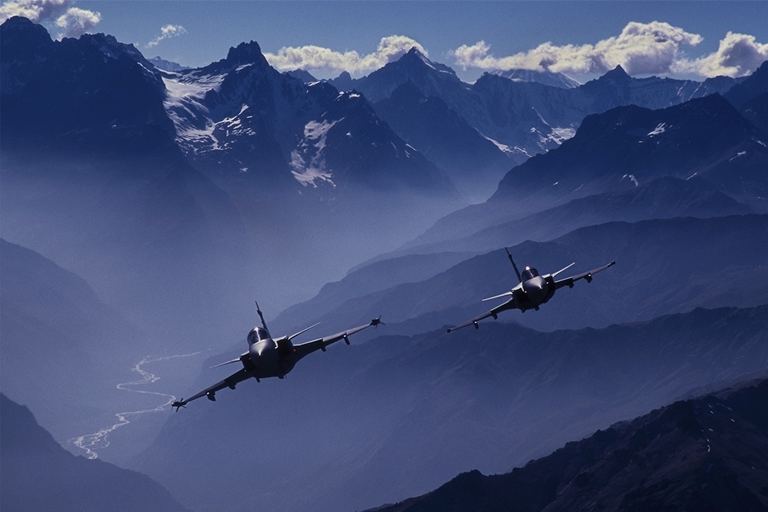
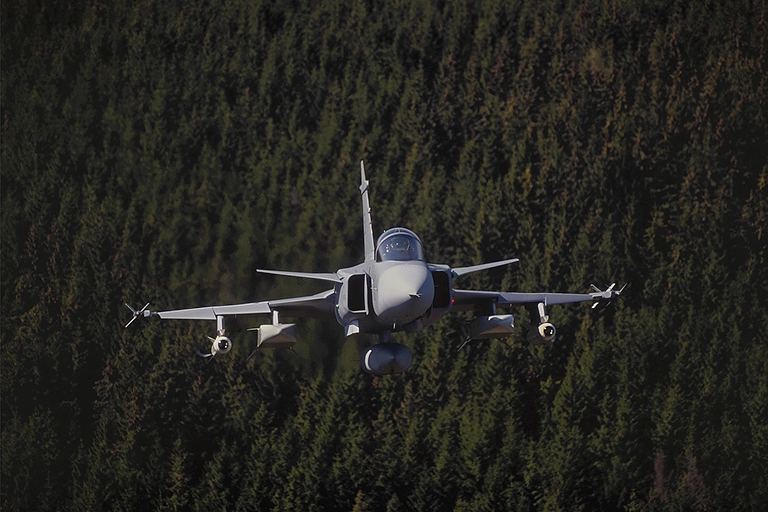
"Gripen" means "the Griffin" in English, which is a mythical and heraldic animal with the head of an eagle and the body of a lion.
Gripen is the world's best light weight multi role combat aircraft in production. It is now fully operational with the Swedish air force with more than 115 (as of Jan 2002) delivered. As of January 2002 more than 25 000 missions have been flown resulting in more than 20 000 flying hours. This document will give a brief overview of the technical and operational aspects of the aircraft and programme so far.
Deliveries of series aircraft to the Swedish air force are in progress. 204 aircraft, including 28 two seaters, are on order.
By June 2002, more than 120 have been delivered. Two squadrons at F 7 are equipped and two at F 10, and they're being introduced at F 21 and F 17.
The Gripens were ordered in three production batches, of 30, 110 and 64 aircraft each, the last two with 14 two-seaters each. In the first two batches the single seaters are designated JAS 39A and the two seaters JAS 39B, in the third batch the single seater is JAS 39C and the two seater JAS 39D.
It can be noted that the 20 last aircraft in batch 2 will be to batch 3 standard, starting with the 107:th production single seater, c/n 39207, which will be delivered by mid-2002. In the long term, Gripens in Swedish service will either be to batch 2 or batch 3 standard.
Batch two is being delivered now, batch three will be delivered in 2003-06. The Swedish air force will repaint all required batch one Gripens to match the colour demarcations of later ones.
All aircraft from the three batches are to be operational by 2007.
One unit, SWAFRAP JAS 39, will be ready for international missions from 2004 onwards when it it will take over after SWAFRAP AJS 37 when the last Viggens are retired, and as like them it will primarily be tasked with photo reconnaissance.
In September 1998 the Vinten Vicon 70 Series 72c day and night, low and medium altitude reconnaissance pod, which is suitable for high performance aircraft, was chosen for Gripen.
But for budgetary reasons, it wasn't purchased.
Sensor fit would have comprised high resolution optronic daylight and IR sensors, able to work in conjunction with the aircraft's radar. Imagery will to be recorded on video and be available to the pilot during the mission.
First delivery for the Swedish air force was planned for 2002, and this would have allowed for the retirement of AJSF 37 Viggen in 2003.
In 2002 an optronic pod to be developed by Saab Avionics was selected. The fit will be similar to the above mentioned pod, but in addition two of them will be fitted with low altitude SKA 34 film cameras as the optronics fit will be optimized for medium altitudes.
The pod itself will be built by Terma, several of the sensors by Recon/Optical and L-3 Communications will make the digital recorders.
They'll be able to be carried by JAS 39C/D and possibly by JAS 39A/Bs as well.
IOC is set for 2006, when the AJSF 37 Viggens will be retired.
Integration of Rb 99 AMRAAM including test firings which started in 1998, is as of mid-2000 soon completed.
Sidewinder was fully integrated at the time Gripen entered squadron service.
Captive RB 98 IRIS-T trials started in 1999.
All ground attack weapons were cleared for use by 1997 or earlier.
All ordered stand off bomblet dispensers BK 90, Mj�lner, have been delivered by 1999.
Future ground attack weapons include laser guided bombs, a stand off precision missile and anti-radiation missiles. (These kinds of weapons weren't included in the initial planning as a priority, but the uses Gripen will be put to has changed a bit with the changing world situation, so it's a good thing it's a flexible and adaptable platform.)
The first JAS 39 Gripen squadron was declared fully operational with the wing F 7 in S�ten�s starting on Oct 1:st 1997, the second was in 1998. Both replaced AJS 37 Viggen squadrons.
S�ten�s hosts the new "Gripen centre" with training for all categories of personell.
The next wing to get Gripen was F 10 at �ngelholm with two squadrons, in 1999-2000, where they replaced first J 35J Draken (retired in 1999) and then AJS 37 Viggen. The first two were delivered on Oct 30:th 1999.
As of 2000, it was decided that the future peace time organization of the Swedish air force will have four fighter wings with eight squadrons of Gripen. At first plans were that these squadrons would be larger, to allow for a longer service life of the aircraft, but present plans are that some of the batch one will be declared surplus and become available for the government to sell or lease to another operator.
By the end of 2004, there will be two Gripen
squadrons at each of:
F 21, Lule�,
F 4, �stersund,
F 7, S�ten�s and
F 17, Kallinge.
The JAS 39A/Bs were planned to be upgraded as follows, but as the new, smaller, organization does not need all ordered Gripens, the older ones will not be upgraded.
The JAS 39C/Ds will in addition to this
The last 20 batch 2 aircraft will get the Ericsson Saab Avionics EP-17 Mk3 colour displays, EP-17 Mk4 with a digital mass memory (replacing analog video recorder) and other improvements which will be fitted to batch 3 and export Gripens.
As internationalisation measures, Swedish Gripens (at least some) will
There are tentative designations for future upgrades, JAS 39E/F would be for an upgrade where an AESA radar is the major new piece of hardware. JAS 39G/H would be a possible future upgrade (after 2020?) where it's still unclear exactly what could be included.
Initial funding for a phased array radar has been approved.
FMV, the Swedish Defence Materials administration and the formal customer on behalf of the air force, will fund the conversion of one of the prototypes into a flying technology demonstrator. It will be ready in 2000-2002 and be used to study new weapons, avionics and propulsion.
Regarding propulsion, a more powerful engine (F414 or EJ200) may be fitted and it will fly with thrust vectoring, which would allow for a future tailless version.
As for radar, Ericsson Microwave Systems is planning on flying demonstrator of its AESA radar, on its own or with partners. It's planned to scan +-60 deg electronically and 60 deg mechanically in azimut, permitting scanning over a 240 deg arc and electronically +-60 deg up and downwards.
The Swedish air force is planning on having precision guided munition capability such as laser guided bombs operational on Gripen by 2003. This is a result of studies regarding what capabilities are required for international peace keeping missions.
The export version, being marketed jointly by BAE Systems and Saab, will not be identical to the Swedish air force version. Exactly how it will be configured of course depends on customers' needs, but it can be assumed it's close to JAS 39C in configuration.
As with all major weapon systems, there does not exist a "dollars per airframe" price tag. It's much more complicated than that, possibly with payment in a basket of currencies, to different schedules and with different offset deals included.
A NATO-compatible prototype has been readied. Apart from making it NATO-compatible in general, with connectors and so on, it has got a retractible aerial refuelling probe, which could be fitted without removing any other system. As missions can last much longer, this version also has an on board oxygen generating system.
In March 1998, Ericsson Saab Avionics was selected as the supplier of the export Gripen integrated countermeasures system, EWS 39, including warning, jamming and expendable countermeasures systems.
In May 1999, Denel Aviation was chosen to supply the NATO compatible stores pylons for all export Gripens.
On 1998 Nov 18 the South African government announced its selection of Gripen as the preferred fighter, together with Hawk.
On 1999 Sep 15 South Africa decided to order nine two seat multi-role Gripen fighters and take out an option for nineteen single seat Gripens, which be exercised by 2004.
The two seaters will be delivered in 2006-08 and if the option for the single seaters is exercised, they will be delivered in 2009-11.
On 1999 Dec 03 South Africa signed a contract for 24 Hawks and 28 Gripens. The Hawks will be delivered in 2005-2006, Gripen deliveries will begin in 2007 with nine two seaters and be concluded in 2012 with the last of the nineteen single seaters.
Contract value is 15.7 billion Rand, including VAT and other costs. The contract has sort of an "reverse option", providing for cancellation before 2004.
Separation test with all air to ground, anti ship weapons and Sidewinders have been concluded successfully.
During 1996, about 100 test flights were flown. Their part of the flight test programme concentrated on high alpha and beta flight as well as stall and spin recovery. The aim is to push the envelope in order to decide exactly where the limits should be put, so as to not compromise safety while affording combat pilots maximum performance with ease of handling.
Tests up to an alpha of 28 degrees were concluded with the standard flight control software release which has a preliminary alpha limit of 20 degrees, above which it returns the aircraft to 20 degrees or less.
The second phase with flights up to 55 degrees alpha were conducted with a software release without any alpha limit. The third phase went beyond that, to 110 degrees alpha, while retaining controllability.
It's expected that the final alpha limit will be in the region of 50 degrees.
The Manoeuver Load Limiter will let the pilots give full stick and rudder commands at all times, but by taking into account the present weight, what kinds of external loads are carried, speed, altitude and other data in order to obtain maximum performance enabling the pilots to concentrate on the tactical situation.
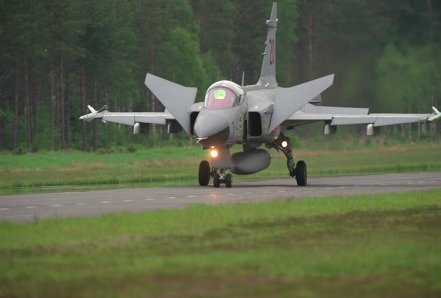
Gripen is designed for the high demands put on flying performance, flexibility, effectiveness, survivability and availability the future air combat environment will put. The designation JAS stands for Jakt (Fighter), Attack (Attack) and Spaning (Reconnaissance) and means every Gripen can fullfill all three mission types.
Flying properties and performance are optimised for fighter missions with high demands on speed, acceleration and turning performance. The combination of delta wing and canards gives the JAS 39 Gripen very good take off and landing performance and superb flying characteristics.
The totally integrated avionics makes it a "programmable" aircraft. With the built in flexibility and development potential the whole JAS 39 Gripen system will retain and enhance its effectiveness and potential well into the 21:st century.
Gripen affords far more flexibility than earlier generations
of combat aircraft, and it's operating costs will only be about
two thirds of those for Viggen, in spite of it being able to
in all areas perform at least as well or slightly better, and
in some cases much better. This while not
being an expensive aircraft to purchase either.
The specification for this aircraft says that must be able to operate from 800 m runways, so actual take off and landing distance is significantly less, and since early on in the programme, all flights from Saab's facility in Link�ping are flown from within a 9 m x 800 m outline painted on the runway.
Stopping distance is reduced by extending the relatively large airbrakes; using the control surfaces to push the aircraft down enabling the brakes to be used harder; tilting the canards forwards, making them into large airbrakes and also pushing the nose gear - which also has brakes - down.
So even without thrust reversing, which would have made the aircraft heavier and less affordable, the stopping distance does not exceed that of Viggen.
Gripen uses Ericsson processors programmed in Pascal-D80 and Ada and has five duplicated databuses, assigned to different tasks, all with several levels of backup operating modes.
The main instruments are three MFDs and the wide angle HUD. Control is by a short centrally mounted stick and a side mounted system hand controller/throttle.
Should the main generator fail, there's an APU which is also used to provide power on the ground, and batteries.
Gripen is fitted with Martin-Baker 10LS seats which permits safe ejections at speeds up to 1150 km/h at sea level, at zero altitude and speed and down to 100 m altitude inverted flight.
To begin with, the two-seat variant was said to be considered unnecessary, as simulators are very good today.
But two seater aircraft aren't useful just for teaching pilots to fly the aircraft. In Swedish use, it will not be much used for conversion training, as Gripen is considered easy to fly, but mostly for tactical training and have a significant tactical role. It will be fully combat capable, apart from having no gun and less fuel.
Gripen is a lightweight fighter, with an empty weight of about six tons, a normal take off weight of less than nine tons and a max take off weight of in the current version less than 13 tons. It's a bit over 14 m long.
It's supersonic at all altitudes.
Gripen is able to carry a very wide range of armaments on its eight hardpoints.
In 1982 decided to build a small, true multi-role aircraft, made possible by advances in several fields.
The first prototype flew 9:th Dec 1988.
Several layouts were studied, in the end an unstable canard layout was adopted, as it would give the greatest benefits to performance, as it gives a high onset of pitch rate and low drag enabling the aircraft to be faster, have longer range and carry a larger useful payload.
Gripen is made by the consortium IG JAS, which consists of Saab Military Aircraft, BAE Systems, Saab-BAe Gripen AB, Ericsson Saab Avionics, Ericsson Microwave Systems, Celsius Aerotech and Volvo Aero Corporation.
It is adapted for, marketed and supported on the international marked of the joint company Saab-BAe Gripen AB.
Apart from the above companies, the international content of Gripen is high, with 60% coming from NATO countries and 70% from EU nations, so close to 30% of the content is from USA.
Send eMail to - Joseph Lynn Oliver