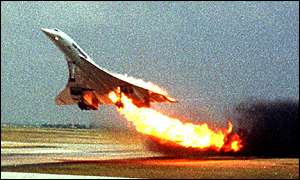
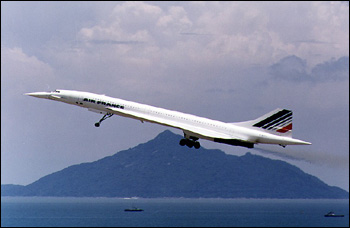
July 26, 2000, 113 dead in Concorde flight AF4590 Crash.
����GONESSE, France -- The Concorde that crashed and killed 113 people during takeoff had been delayed for last-minute maintenance on one of its engines, Air France said Wednesday as its fleet of supersonic jets was indefinitely grounded.
���� In a statement, Air France said it had taken a replacement part from a backup Concorde to repair one of the doomed plane's engines before Tuesday's crash. Investigators, meanwhile, said the pilot reported engine trouble seconds after takeoff and tried to find a spot to land before the plane plummeted to the ground in flames.
����That information was released Wednesday as French forensic experts examined the charred bodies to determine their identities and as relatives of the victims, mainly German tourists, began arriving in Paris.
����"Today Germany is shaken," Chancellor Gerhard Schroeder said at a service for the victims at a chapel in Hanover, Germany, on the grounds of the World's Fair. Pope John Paul II sent condolences. In France, President Jacques Chirac said "everything" would be done to determine the causes of the accident. Air France said the crash of Flight AF4590 appeared to have been caused by a fire in one of the engines at the moment of takeoff. Possible causes of the fire ranged from birds flying into the air intake to mechanical failure, experts said. ����Prosecutor Elisabeth Senot, who is in charge of the judicial investigation, said the control tower alerted the pilot that the back of the plane was on fire 56 seconds after takeoff. The pilot replied that he had engine trouble, at which point the flames were rapidly growing, France 2 televsion quoted Senot as saying.
����The pilot responded that he could not stop the flight and was trying to reach Le Bourget, a nearby airport. "It is during this looping maneuver that the aircraft crashed on the hotel in Gonesse," France 2 quoted Senot as saying.
����In a statement, the airline said the "engine reverse thruster" of engine 2 of the doomed plane was inoperative on its return from New York on July 24. Such thrusters are used to slow the plane upon landing.
����Although the required piece was not available, Flight AF4590 was cleared for departure because of a technical level of tolerance allowed by the manufacturer, Air France said. However, the pilot, taking into account that the plane was full, ordered the replacement of the inoperative part, the statement said. ����The statement did not indicate whether the last-minute repair could have been related to the catastrophe. ����French Transport Minister Jean-Claude Gayssot on Wednesday ordered the indefinite suspension of all Air France Concorde flights. He said he wanted more checks, with an emphasis on the recovered black boxes -- the flight recorders and cockpit voice recorder.
���� "When we know a sufficient amount about them, and when we're in touch with our British colleagues, we will be able to consider the decision to resume," he said. However, he said the future of the Concorde was "not in question."
���� �The Ministry of Transportation said the two recorders were damaged but had been found. ���� Air France already had grounded all Concorde flights Wednesday. British Airways canceled its two Tuesday night flights, but resumed Concorde service Wednesday between New York and London after completing safety checks. ����French media speculated on whether this marked the end of the swooping "white bird," a source of French pride. The daily Le Figaro wrote, "The Concorde without a doubt died yesterday." ���� Until Tuesday, the Concorde had a perfect safety record during 31 years of service.
����At least one of the two left-side engines was on fire as the plane took off at 4:44 p.m. from Charles de Gaulle airport carrying 100 passengers and 9 crew members, witnesses said. As the jet struggled to gain height, witnesses saw a plume of flame trailing 60 yards behind it.
���� All those aboard perished, along with four people on the ground. Twelve people were rushed out of Hotelissimo, the hotel that was hit. One was seriously injured, police said early Wednesday. A neighboring hotel was damaged.
���� But the toll on the ground could have been much worse: 45 Polish tourists who were staying at Hotelissimo had left earlier to go sightseeing. They returned after the crash to find an inferno where their hotel once stood.
���� Ninety-six of the passengers on board the Concorde were from Germany -- 13 from the town of Moenchengladbach, on the border with the Netherlands. There were also two Danes, one Austrian and one American. The American was a retired Air France employee, but the company did not release a name.
���� �The victims on the ground included two Polish hotel employees, the Polish Consulate in Paris confirmed. Television reports said the other two were a British tourist and a French woman. Authorities said 81 bodies had been taken away for autopsies by Wednesday morning. ���� The Concorde passengers were headed for New York, then on to a luxury voyage through the Caribbean. But the dream vacation ended in a nightmare of flame and black smoke at Gonesse, a small town near Charles de Gaulle airport about nine miles northeast of the French capital.
���� "We saw flames shoot up 40 meters (120 feet) and there was a huge boom," said Samir Hossein, a 15-year-old student from Gonesse who was playing tennis. "The pilot tried to yank it up, but it was too late." ���� �The crash did not appear to be linked to cracks found recently in both British Airways and Air France Concordes. "There were no hairline cracks in this Concorde," Air France said.
���� �The plane, full of fuel on takeoff for the Atlantic run, had been in service since 1980 and had flown 12,000 hours. It had its last mandatory regulatory checkup July 21. ���� Twelve of the needle-nosed supersonic jetliners are still operated by Air France and British Airways. ���� �The Concorde, which first flew in 1969, has been considered among the world's safest planes. Air France officials had said in the past that their current fleet is fit to fly safely until 2007.
���� �The plane, which crosses the Atlantic at 1,350 mph, is popular with celebrities, world-class athletes and the rich. It flies above turbulence at nearly 60,000 feet, crossing the Atlantic in about 3? hours.
Concorde Crash Report
Following is a transcript of the voice recorder box of Concorde flight AF4590, released by the French Accident and Inquiry office:
FLIGHT CLEARED for takeoff at 4:42.17 p.m.
Controller: "Air France 4590, runway 26 right, wind zero 90 knots, authorized takeoff."
Co-pilot: "4590 taking off 26 right" (sound of switch).
Pilot: "Is everyone ready?"
Co-pilot: "Yes."
Mechanic: "Yes."
Pilot: "Up to 100, 150" (followed by unclear words, sound of switch). "Top" (noise similar to engines increasing power).
Unidentified voice on radio channel: "Go on, Christian."
Mechanic: "We have four heated up" (sound of switch).
Co-pilot: "100 knots."
Pilot: "Confirmed."
Mechanic: "Four green."
Co-pilot: "V one" (Low-frequency noise).
Pilot: (unclear)
Co-pilot: "Watch out."
Controller: "Concorde zero ... 4590, you have flames (unclear) you have flames behind you."
Unidentified voice (simultaneously on radio) "Right" (background noise changes, sound of switch).
Mechanic: "Stop (unclear)."
Co-pilot: "Well received."
Mechanic: "Breakdown, eng, breakdown engine two" (two sounds of switches, followed by fire alarm).
Unidentified voice on radio: "It�s burning badly, huh" (Gong)
Mechanic: "Cut engine two."
Pilot: "Engine fire procedure" (sound of switch, end of ringing).
Co-pilot: "Warning, the airspeed indicator, the airspeed indicator, the airspeed indicator" (sound of switch, gong).
Person in control tower: "It�s burning badly and I�m not sure it�s coming from the engine" (Switch sound similar to fire extinguisher handle being activated).
Pilot: "Gear on the way up."
Controller: "4590, you have strong flames behind you."
Mechanic: "The gear" (alarm, similar to toilet smoke alert).
Controller: "Beginning reception of a Middle Marker."
Co-pilot: "Yes, well received."
Mechanic: "The gear, no" (Gong).
Controller: "So, at your convenience, you have priority to land."
Mechanic: "Gear."
Co-pilot: "No" (two switch noises).
Pilot: "Gear (unclear), coming up."
Co-pilot: "Well received" (fire alarm, gong, three switch sounds).
Co-pilot: "I�m trying (unclear)."
Mechanic: "I�m hitting."
Pilot: "Are (unclear) you cutting engine two" (end of smoke alarm).
Mechanic: "I�ve cut it."
Controller: "End reception Middle Marker."
Co-pilot: "The airspeed indicator" (sound of switch, end of ringing).
Co-pilot: "The gear won�t come up" (fire alarm rings).
Aircraft instrument: "Whoop whoop pull up" (GPWS alarm, gong).
Aircraft instrument: "Whoop whoop pull up" (GPWS alarm).
Co-pilot: "The airspeed indicator."
Aircraft instrument: "Whoop whoop pull up" (GPWS alarm).
Fire service leader: "De Gaulle tower from fire service leader."
Controller: "Fire service leader, uh ... the Concorde, I don�t know its intentions, get yourself in position near the south doublet" (sound of switch).
Pilot: (unclear).
Fire service leader: "De Gaulle tower from fire service leader authorization to enter 26 right."
Co-pilot: "Le Bourget, Le Bourget, Le Bourget."
Pilot: "Too late (unclear)."
Controller: "Fire service leader, correction, the Concorde is returning to runway zero nine in the opposite direction."
Pilot: "No time, no (unclear)."
Co-pilot: "Negative, we�re trying Le Bourget" (four switching sounds).
Co-pilot: "No (unclear)."
Fire service leader: "De Gaulle tower from fire service leader, can you give me the situation of the Concorde" (two gongs and sound of switch, followed by another switch and sounds likened to objects being moved).
Pilot: (unclear, sounds like exertion).
Pilot: (unclear, sounds like exertion).
Pilot: (unclear, sounds like exertion).
Last sound noted on transcript at 4:44.30.18 p.m. Recording ends at 4:44.31.16 p.m.
Visit my other pages, click here to view links.
Send eMail to - Joseph Lynn Oliver