Clan Oliver
The name is likely to have come from the French Olivier,
maker or seller of olive oil, and it became widespread
through the influence of the Norse name Olaf. It is first
recorded in Scotland in the 12th century. Olivers were a powerful
family in the Borders.
OLIVER: The name is found throughout the British Isles and France, where it came from Olivier,
"French", with origins in Normandy, Northern France. Genealogical
or geographical evidence would be required to establish a
Scottish ancestry. The Old Norse name Oleifr is also
given as a source, particularly in Shetland. The earliest mention
in the Scottish records is of Walter Olifer, a witness to William
I's gift of a serf to the Bishop of Glasgow about 1180.
Tradition asserts a common ancestry, or early link, with the
Frasers, also of Norman origin, who, though formerly a Border
family, are now more associated with the Highlands. Oliver, son
of Gilbert de Fraser, built their early seat of Oliver Castle in
Tweedale about 1230, but whether this Oliver was the same man, or
a kinsman of Oliver, Abbot of Dryburgh in the 1260s cannot be
ascertained. The Castle was held in 1266 by Sir Simon Fraser
whose son, in 1314, fought for Bruce at Bannockburn. There no
evidence of the Olivers moving north when many Frasers went
thence, and only on the basis of long past association can they
be said to have any affiliation with that clan. Similarities in
name, origin, and the vagaries of spelling in early documents
have confused many Olivers with Oliphants, and thus, many records
of one may in fact refer to the other, particularly in areas
outwith the Borderland, notably Perthshire, where many Oliphants
settled. The name Knowles, often equated with Knox in
Aberdeenshire, is elsewhere promoted as a form of Oliver, and
though no association is here advanced it is interesting to note
that the Frasers of Philorth have similar territorial association
from an early date. In the 16th century, continuing raids and
counter raids across the borders left many families, including
the Olivers, little choice but to survive by plunder, and in
1527, the Earl of Angus, then in 'control' of his
step-son, the young King James V, used the Scots Army to curb the
adventurers, thereby appeasing his wife, the Dowager Queen
Margaret Tudor and her countrymen over the English Border.
First found in Roxburghshire where they were seated from early
times and their first records appeared on the census rolls taken
by the ancient Kings of Scotland to the rate of taxation of their subjects.
Some of the first settlers of this name or some of its
variants were: Evan Oliver who settled in Delaware with his wife
Jean and seven children in 1682; Mary Oliver settled in Virginia
in 1651; Nicholas Oliver settled in Virginia in 1638.
Oliver, sept of the Clan Fraser

The Clan Fraser Arms: Fraser - Azure, 3 fraises or cinquefoils
argent; Fraser of Lovat - Quarterly, 1st and 4th azure, 3 fraises
or cinquefoils argent, 2nd and 3rd argent, 3 antique crowns gules
Crest Badge: Fraser - On a mount a flourish of strawberries,
leaved and fructed proper; Fraser of Lovat - A buck's head
erased proper Mottos: Fraser - All my hope is in God; Fraser of
Lovat - Je suis prest (I am ready) Tartan: Fraser ;dress ;hunting
Gaelic Name: Friseal Slogans:(ancient)A 'Mhor-fhaiche (The
Great Field); (modern)Caisteal Dhuni (Castle Downie) Plant Badge:
Yew Septs: Abernethy, Bissett,Brewster, Cowie, Frizell, Frew,
Macgruer, Mackim, Mackimmie, Macsimon,Mactavish, Oliver, Sim,
Simon, Simpson, Sims, Syme, Twaddle, Tweedie (andspelling
variations thereof).
There are many stories about the origin of the name Fraser.
According to Clan Fraser: A history celebrating over 800 years of
the Family in Scotland [1997] by Flora Marjory Fraser, 20th Lady
Saltoun: The truth of these stories is unknown but it is
generally believed that the name Fraser traces its origins to the
French provinces of Anjou and Normandy. The French word
strawberry is fraise and growers are called fraisiers. The Fraser
arms are silver strawberry flowers on a field of blue. Only the
Chief is entitled to use these arms plain and undifferenced.
ha-ha-ha, he-he-he, I'm the laughing Gnome and you
can't catch me, .........said the Laughing Gnome.
The Frasers first appear in Scotland around 1160 when Simon
Fraser made a gift of a church at Keith in East Lothian, to the
monks at Kelso Abbey. The Frasers moved into Tweeddale in the
12th and 13th centuries and from there into the counties of
Stirling, Angus, Inverness and Aberdeen.
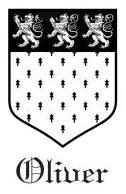
Family Crest, Coat of Arms
About five generations later, Sir Simon Fraser [the Patriot]
was captured fighting for Robert the Bruce, and executed with
great cruelty by Edward I in 1306. The patriots line
ended with two co-heiresses. Sir Andrew Fraser of Touch-Fraser,
cousin of the patriot, was the father of Sir Alexander Fraser of
Cowie [ancestor of the Frasers of Philorth], Sir Simon Fraser
[ancestor of the Frasers of Lovat], Sir Andrew Fraser and Sir
James Fraser of Frendraught.
Frasers of Philorth [Lords Saltoun]
The senior line is descended from Sir Alexander Fraser, who
married Robert the Bruces widowed sister, Lady Mary, who had
been imprisoned in a cage by Edward I.
His grandson, Sir Alexander Fraser of Cowie, acquired the
Castle (now Cairnbulg) and lands of Philorth by marriage with
Lady Joanna, younger daughter and co-heiress of the Earl of Ross
in 1375. Eight generations later, Sir Alexander Fraser, 8th laird
of Philorth, founded Fraser's Burgh by royal charters
obtained in 1592, and also built Fraserburgh Castle, now Kinnaird
Head Lighthouse Museum. His son, the 9th laird, married the
heiress of the Abernethies, Lords Saltoun, and in 1669 their son,
Alexander Fraser, became the 10th Lord Saltoun. The present Chief
of the Name of Fraser is Flora Marjory Fraser, 20th Lady Saltoun,
who is an active member of the House of Lords. The family seat is
Fraserburgh, Aberdeenshire.
Frasers of Lovat [Lords Lovat]
The Frasers of Lovat descend from Sir Simon Fraser [brother of
Sir Alexander Fraser, the Chamberlain], who married Lady Margaret
Sinclair, daughter of the Earl of Caithness. Documents, dated
12th September 1367, connect a Fraser with the lands of Lovat and
the Aird. Among the lands acquired by the Lovat Frasers, the
prominent ones were in Stratherrick, which was very dear to the
hearts of the Lovat chiefs, the church lands of Beauly Priory in
Inverness-shire, part of the south shore of Beauly Firth, and the
whole of Strathfarrar. Beauly was founded in about 1320 by John
Bisset, who also built Lovat Castle. About 1460 Hugh Fraser, 6th
laird of Lovat, became the 1st Lord Lovat. The 11th Lord Lovat
was beheaded on Tower Hill in London in 1747, following which the
Lovat title was attained and the estates were forfeited to the
Crown.
The estates eventually passed to the nearest collateral
heir-male, Thomas Alexander Fraser, 10th laird of Strichen,
Aberdeenshire, who in 1837 was created Baron Lovat in the Peerage
of the U.K., and the attainder of the Scottish title was reversed
in 1857, when he became 14th Lord Lovat. With the death of the
17th Lord Lovat in 1995, aged 83, his eldest son and his youngest
son having died the previous year, his grandson, Simon Fraser,
born in 1977, became the 18th Lord Lovat and 25th MacShimi, the
Chief of Clan Fraser of Lovat. Castle Dounie was home of the
chiefs of Lovat from 1511 until it was burned following Culloden.
The current Beaufort Castle, built in the 1880s, was sold in
1995. The Lovat family seat is Beauly, Inverness-shire.
Frasers of Muchalls [Lords Fraser] In 1366 Thomas Fraser, a
descendant of Sir Alexander Fraser of Cornton [brother of Sir
Richard Fraser of Touch-Fraser], exchanged the lands in
Petyndreich, Stirlingshire for those of Kinmundy, Aberdeenshire.
His grandson Thomas exchanged the estate of Cornton for Stonywood
and Muchalls in Aberdeenshire. His descendant, Andrew Fraser, who
was created Lord Fraser in 1633, completed Castle Fraser in 1636.
Following the premature death in 1716 of Charles, 4th Lord
Fraser, the estates passed to the heirs of his wifeÕs
first marriage, the Frasers of Inverallochy, later assuming the
name of Mackenzie-Fraser. Castle Fraser was sold at auction to
the 1st Viscount Cowdray in 1921 and given to the National Trust
for Scotland in 1976.
Surnames:
ABERNETHY (1) BISSET (1) BREWSTER COWIE (1) FRASER FRAZER
FRESER FREZEL FRISELL FRIZELLE GILRUTH GREWAR (2) GRUAR (2) GRUER
(2) MACGREWAR (2) MACGRUER (1) DRUMMOND MACGRUER (2) MACILLRICK
(1) MACILRIACH (1) MACIMMEY MACKIM MACKIMMIE MACSIMON MACSYMON
OLIVER SIM SIME SIMON SIMONS SIMPSON SIMS SIMSON SYM SYME SYMON
SYMONS TWADDLE TWEEDDALE TWEEDIE
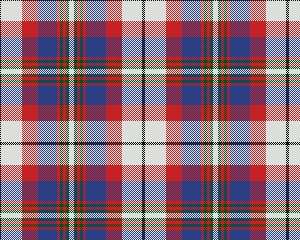
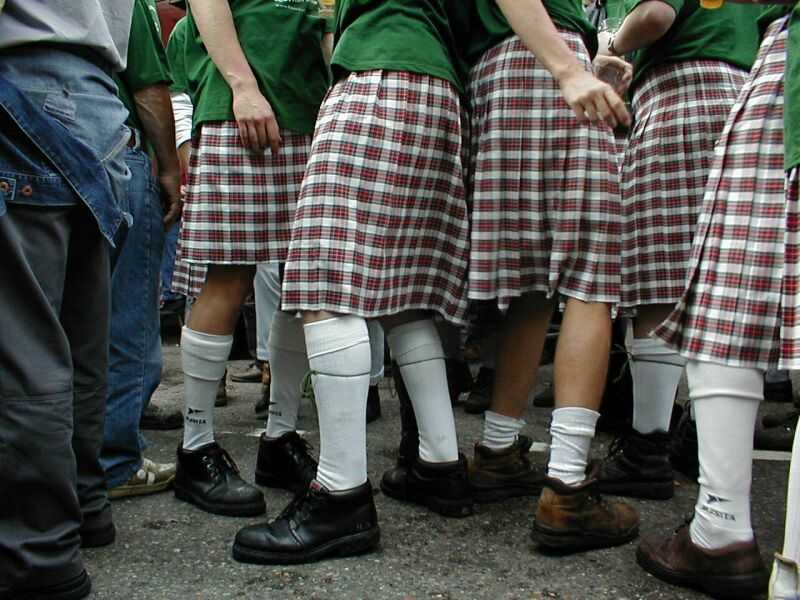
Oliver kilt pattern.
Highland Dress has become the distinctive costume of the whole
of Scotland, despite its suppression as a symbol of Scottish
independence. Its components were drawn from elements in daily
use within the Highlands, but these have become rationalised for
use in modern life and tailored fashions.
It was the Victorian age that transformed costume and Scottish
symbols in general, but there would have been little
sentimentality for early Highland dress as it was a practical
matter and a fact of life. With this in mind, it is good to
visualise the practical and economic realities that the earlier
forms represent.
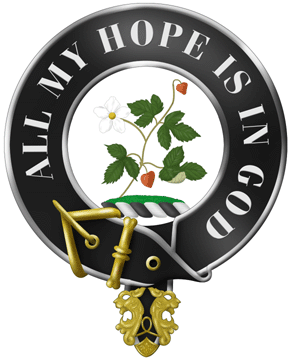
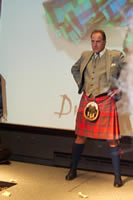
Badge worn by Oliver clan
The Scottish regiments continued to use Highland dress since
they were government forces, and their forms of dress influenced
the creation of the modern form, practical for military tailoring
and evening dress. The lowland forces, for instance, adapted
trews into a military uniform employing tartan.
The wealthy classes, apart from their own military
connections, often had a Highland background or property. It was
then Queen Victorias royal patronage that resolved the
developing elements into a regular form for use in society.
When people think of the tartan now, most think of the
very colourful pattern of the cloth of the Scottish Highlands.
But originally the word "tartan" described the way the
thread was woven to make the cloth: each thread passed over two
threads then under two threads, and so on.... (Indeed, the
original "tartan" was a very light, woollen material
which couldn't really keep the wearer warm).
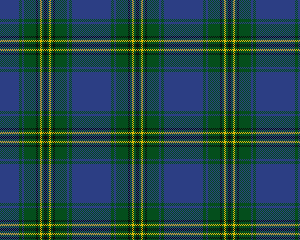
The Oliver family hunting kilt pattern.
The oldest known piece of tartan is one that was found buried
in the ground near Falkirk. It was found in a pot filled with
over 1900 silver Roman coins and is thought to be about 1700
years old. It is quite different from many of the colourful
tartans that we all know today. Its believed that it was made
from the undyed wool - dark brown and light browny/green - of the
Soay sheep which once inhabited Scotland and which still can be
found on the island of St. Kilda.
What is the difference between a tartan and a check?
Its catching on.
If you think of tartan as the pattern, then consider the
Grand-Prix chequered flag - the check is printed in pure white
and pure black squares. But in a tartan there is always a square
where the two colours of thread cross, which is a speckled blend
of the two colours
Tartans have become synonymous with Scotland and Scottish
clans and families in particular. However, tartans were
originally a style of cloth intended to be decorative. They had
patterns that were popular within certain districts of
manufacture, they relied on a limited range of colour dyes and
were made of the local coarser type of wool .
This has lead to the idea of district tartans being the
original association, between the land, the community and its
cloth. Where there was a strong clan within a district, as was
often the case in the highlands, then visitors from other areas
might well have been recognised as of a clan from their tartan.
This must have been true of visitors from the Western Isles, for
instance. It is this concept of clan tartans that today
predominates, but the use of tartan is yet richer.
Few locals
When tartan was proscribed by law, the Government or Black
Watch pattern was the only legally one. This was used by the
regiments raised within Scotland, forming the basis of the
regimental tartans .
By the early 1800s, it was realised that the knowledge of
tartans before the «45 was being lost and, simultaneously,
there was a romantic movement concerning Scotlands past.
This lead to institutional and individual efforts to preserve
tartan designs. Tartans were reconstructed from portraits,
collected on pilgrimages, demanded from clan chiefs and recovered
from weavers notes.
Tartans became a backdrop. The weaving and tailoring
industries were especially boosted by the visit to Edinburgh of
George IV in 1822 and by Sir Walter Scotts statement, as the
visits manager, Let every man wear his tartan;.
Queen Victoria gave considerable encouragement thereafter, though
this encouraged both fantasy and fact in the study of tartan.
(Some royal tartans remain the preserve of the House of Windsor
or individual titles within it, just as clan chiefs sometimes
have a chiefs tartan .)
The significance of tartan as national dress, worn under
various circumstances, created clan tartans for every
"name", even those that previously had none. These were
often supplemented by hunting tartans of subdued character and
dress tartans which were brighter.
Further variety was added by fashion, fancy or trade tartans
to fill any niche, including various colours of a single pattern.
Dancing Tartans originate from the ARISAID or Dress Tartans.
There were even some mourning tartans developed.
In recent years the corporate tartans have become popular
where an institution or company adopts a tartan design for livery
and use in merchandising.
Where no clan tartan exists, families can and have developed
new Family Tartans. Generally which tartan is worn is controlled
by convention there not being a statute for its government.
Disputes as to its use and production rely on the civil law of
Copyright, Design Act and in rare cases
Patents/Trademarks.
Manufacturers often offer a given tartan design in a variety
of colour effects , called Modern, Reproduction, Ancient and the
like. An ancient and a modern tartan is often the same pattern
and should not be confused when the design is being
considered.
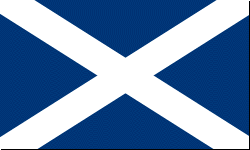
The Saint Andrew's Cross is one of the oldest national
flags of all, dating back at least to the 12th century. It is
based on the x-shaped cross on which the patron saint of Scotland
was crucified. This flag, along with the flag of Saint George the
patron saint of England formed the basis of the Union flag when
James VI of Scotland became James I of England.
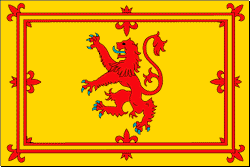
The Scottish Royal Standard consists of the arms of the King
of Scots; a red lion rampant on a yellow field within a frame
decorated with fleurs-de-lis. The lion dates from the reign of
William the Lion (1165-1214) and the frame from at least 1222.
The fleurs-de-lys are said to commemorate the long-standing
alliance between Scotland and France.
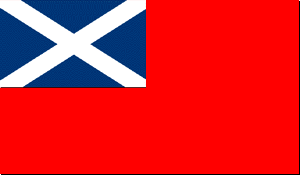
The Scottish Red Ensign was officially used as the Merchant
flag of Scotland until 1707. It is still used unofficially by
private citizens for use on water.
Send eMail to -
Joseph Lynn Oliver
Mon p�re dans le ciel me montrera la mani�re.

Yahoo -
Geocities