|
Home | Archive | Links | Join Discussion! | Send Message | About CellNEWS |
 |
|
|
Human Embryonic Stem Cells Become Spinal Motor Neurones Monday, 31 January 2005
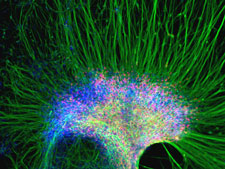
Much sooner in the future, the advance will allow researchers to create motor neuron modelling systems to screen new drugs, says study leader Su-Chun Zhang, an assistant professor of anatomy and neurology in the Stem Cell Research Program at the Waisman Center at UW-Madison. Scientists have long believed in the therapeutic promise of embryonic stem cells with their ability to replicate indefinitely and develop into any of the 220 different types of cells and tissues in the body. But researchers have struggled to convert blank-slate embryonic stem cells into motor neurones, says Zhang. The goal proved elusive even in simpler vertebrates such as mice, whose embryonic stem cells have been available to scientists for decades. One reason scientists have had difficulty making motor neurones, Zhang believes, may be that they are one of the earliest neural structures to emerge in a developing embryo. With the ticking clock of development in mind, Zhang and his team deduced that there is only a thin segment of time - roughly the third and fourth week of human development - in which stem cells could be successfully prompted to transform themselves into spinal motor neurones. In addition to the narrow time frame, it was also critical to expose the growing stem cells to an array of complex chemical cocktails. The cocktails constitute naturally secreted chemicals - a mix of growth factors and hormones - that provide the exact growing conditions needed to steer the cells down the correct developmental pathway. "You need to teach the [embryonic stem cells] to change step by step, where each step has different conditions and a strict window of time," says Zhang. "Otherwise, it just won't work." To differentiate into a functional spinal motor neuron, the stem cells advanced through a series of mini-stages, each requiring a unique growing medium and precise timing. To start, the Wisconsin team generated neural stem cells from the embryonic stem cells. They then transformed the neural cells into progenitor cells of motor neurones, which in turn developed in a lab dish into spinal motor neuron cells. The newly generated motor neurones, according to Zhang, exhibit telltale electrical activity, a sign that the neurones, which normally transmit electrical impulses, were functional.
The spinal motor neuron cells have survived in culture in the lab for more than three months, says Xuejun Li, an assistant scientist in Zhang's group, and the lead author of the study. To determine the exact recipe for motor neuron growth, Li foraged labs worldwide to obtain the growth factors and other natural chemicals needed to guide cells from one stage of motor neuron development to another. But once past a certain point, Li found that the cells kept veering off toward different cellular destinies. After hundreds of unsuccessful variations of growth factors and morphogens, Li was struck by an idea: Why not apply a chemical known to be necessary for a later stage of neuron development to a much earlier step in the process? The hunch paid off and turned out to be the final piece of the puzzle. The discovery, says Zhang, demonstrates that human stem cells do not necessarily differentiate in linear fashion, as scientists always believed. Rather, a series of complex overlapping changes may well be the developmental norm in higher vertebrates such as humans. "We cannot simply translate studies from animal to humans," says Zhang. The next step, Li says, will be to test if the newly generated neurones can communicate with other cells when transplanted into a living animal. The team will first test the neurones in chicken embryos. While the new results are promising and provide access to critical cells that may one day be used in therapy, it will likely be many years before they can be tested in humans, Zhang says. The UW-Madison work was supported by the Amyotrophic Lateral Sclerosis Association, the non-profit organisation Hope for ALS, and the Neuro-Immune Dysfunction Syndrome Research Institute of the National Institutes of Health. |
||
|
|

|
^^ Back to top | Home | Archive | Links | Join Discussion! | Send Message | About CellNEWS |
|
|
|
|
