|
Scientists
Identify Synthetic Compound that Keeps Stem Cells Young
Wednesday, 08 November 2006
A team of scientists from the Scripps Research
Institute, the Genomics Institute of the Novartis Research Foundation and
the Max Planck Institute for Molecular Biomedicine has discovered a new
synthetic compound that can support growth and self-renewal of mouse
embryonic stem cells, offering a simple alternative to current growth
conditions that may vary batch-to-batch and confuse experimental results.
The findings,
reported in this week's Proceedings of the National Academy of Sciences,
should accelerate stem cell research and offer new insights into cell
biology that could aid in the development of treatments for diseases such
as cancer and Parkinson's.
Embryonic stem cell research has been plagued by problems arising from
undefined conditions for growing and differentiating stem cells. Embryonic
stem cell culture dishes are commonly coated with inactivated fibroblast
cells known as “feeder cells”. These
feeder cells offer embryonic stem cells a suitable attachment surface and
also release largely uncharacterized nutrients into the culture medium that
support stem cell growth in the undifferentiated state. A variety of other
factors are also added to promote stem cell growth and, most importantly,
force the cells to maintain their pluripotency-their ability to become a
variety of other final, specialized types of cells.
The end result is that such conventional culture conditions often suffer
large variability, and make it extremely difficult for scientists to tease
out the impact of individual molecules on experimental results.
“Stem cell applications and studies have been hampered by using undefined
culture conditions” says Sheng
Ding, an assistant professor at Scripps Research who led the research.
Feeder cells can also introduce viral and other forms of contamination that
may lead to rejection of stem cells by the human immune system, among other
problems.
|
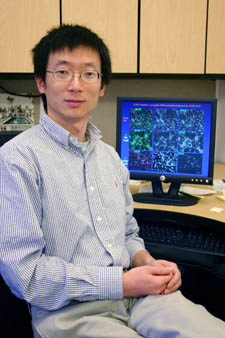
Dr.
Sheng Ding
Photo
by the courtesy of Scripps Research Institute
|
Ding and his colleagues set out to solve these culturing problems
using high-throughput screening of a Scripps Research library of tens of
thousands of synthetic small molecules in search of a compound that could
eliminate the need for feeder cells and added factors. This initial
screening led to the discovery of a class of pyrimidines that improved cell
growth. Later, the team produced a library of analogs of this class that
proved to include a single compound, dubbed “pluripotin”, which supports self-renewal of
mouse embryonic stem cells and maintains their pluripotency alone with only
the addition of standard cell culture basal medium.
The Ding group has also shown that pluripotin improves the growth of human
embryonic stem cells, although other factors are still required to maintain
their pluripotency. However, the team is already screening the Scripps
Research library to identify a synthetic compound or compounds that will
single-handedly maintain the human cells as pluripotin does for mouse
cells. Ongoing research with pluripotin has revealed that the compound
controls the stem cells via a novel mechanism. Pluripotin appears to
simultaneously block the activity of the proteins RasGAP and ERK1, both of
which have cell differentiation inducing activity.
“The mechanism of pluripotin suggests
new strategies for maintaining and propagating stem cells,” says Ding.
“Such a discovery of a single small
molecule that operates through two different classes of targets to achieve
a desired biological effect also has fundamental implications for drug
discovery.”
Work with pluripotin and compounds that may follow should dramatically
improve researchers' ability to work effectively with stem cell lines, Ding
says, and should facilitate the practical application of stem cell research
in developing therapies.
The work also offers benefits beyond improved stem cell culture.
“Pluripotin and other such molecules
are likely to provide insights into the molecular mechanisms that control
stem cell fate and ultimately may be useful for in vivo stem cell biology
and therapy studies,” says Ding.
Source: Scripps Research Institute
|
