|
|
UCI Scientist to Start Therapeutic Cloning
Hans
Keirstead lab launches effort to develop patient-specific stem cell lines
Monday,
14 May 2007
UC Irvine neurobiologist Hans Keirstead
and his research team today launched a project to develop stem cell lines
that genetically match human patients. These lines would allow scientists
to better study conditions ranging from diabetes to Parkinson’s disease,
and they would provide the basis for potential patient-specific stem cell
treatments.
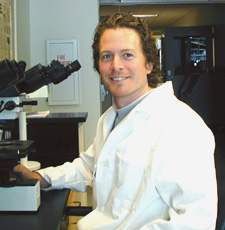
Hans Keirstead at UCI.
Photo Credit: Image courtesy of
University of California – Irvine.
|
Keirstead will use a technique called
somatic cell nuclear transfer (SCNT) in which a patient’s DNA is
transplanted into a donated unfertilized egg cell in order to generate stem
cell lines with the same genetic makeup of the patient. These lines have
tremendous therapy potential because the human immune system is less likely
to attack genetically identical cells. Only a few laboratories in the world
are attempting this technique in human stem cell research and, thus far, no
human stem cell lines have been derived using this method.
“This technique holds tremendous
promise to advance our knowledge of stem cells and their potential to cure
disease,” said Keirstead, associate professor of anatomy and
neurobiology and co-director of UCI’s Sue and Bill Gross Stem Cell Research
Center.
“I am excited to embark on this line
of research and look forward to the day when patient-specific stem cells
are utilized to treat people suffering from debilitating injuries and
health conditions.”
This project received approval May 11 from UCI’s Institutional Review
Board, which under federal regulation reviews all proposed studies
involving human tissue. The Embryonic Stem Cell Research Oversight
Committee at UCI also has reviewed the project and will ensure that
experiments involving embryonic stem cells serve important research goals
and are conducted according to the highest ethical standards.
UCI has built a cutting-edge workstation that is custom-designed for SCNT
experiments. Designed by Gabriel Nistor, a scientist in Keirstead’s
laboratory, the quarter-million dollar system housed at the Sue and Bill
Gross Stem Cell Research Center will allow scientists to dissect single
cells using lasers, manipulate cells using robotic instruments, and control
the climate in the work area. Nistor collaborated with scientists at West
Coast Fertility Centers' Embryology Laboratory to design the system. From
this Orange County medical practice, Keirstead plans to obtain donated egg
cells for his SCNT research.
Stem cells are the “master” cells
that give rise to each of the specialized cells within the human body.
During organ and tissue development, these cells transform into a
particular specialized cell, such as a heart cell or a liver cell, when
prompted by their environment or by their internal genetic programming. If
researchers can control the processes directing stem cell transformation,
they may one day be able to use these cells as a source of healthy
replacement cells for diseased or injured tissues.
Keirstead is a pioneer in the use of human embryonic stem cells in the
study of spinal cord injuries. Keirstead’s laboratory was the first in the world
to develop a method to restrict human embryonic stem cells so they generate
large amounts of only one cell type in high purity. That type of cell, an
oligodendrocyte, insulates connections in the spinal cord, allowing them to
conduct electricity.
|
|
