British Scientists Apply for Licence
to Create Hybrid Embryos
Tuesday, 09 November 2006
Stem cell scientists are seeking permission to use animal eggs in research
which aims to lead to the development of new therapies for debilitating
human conditions such as Parkinson’s disease, strokes and Alzheimer’s
disease.
|
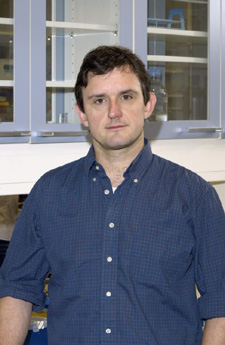
Dr.
Lyle Armstrong.
Photo
by the courtesy
of Newcastle
University
|
Dr Lyle Armstrong, who is based at
the North East England Stem Cell Institute (NESCI ) at the International
Centre for Life in Newcastle,
earlier this week submitted an application for a three-year licence from
the Human Fertilisation and Embryology Authority (HFEA) for the work.
Dr. Armstrong and his team of five scientists intend to carry out laboratory
tests which involve fusing animal eggs with human cells to try to
understand more about how cells are genetically reprogrammed.
The knowledge will take embryonic stem cell work to the next stage,
bringing the development of potential patient therapies even closer,
although these could be several decades away.
If granted, the HFEA licence would allow the scientists to create hybrid
embryos that would be approximately 0.1 per cent animal and 99.9 per cent
human, using an established technique known as nuclear transfer, or
therapeutic cloning.
Until now, work on the development of therapeutic cloning has used human
eggs from consenting IVF patients but these are in short supply. Animal
eggs are considered to be a viable alternative for tests to understand more
about how cells behave.
At first the NESCI team would be working with cow eggs. The nuclear
transfer technique would involve removing the nucleus of a cow egg - which
contains most of its genetic information - and fusing the cow egg with the
nucleus of a human cell such as a skin cell. The egg will then be
encouraged to divide until it is a cluster of cells only a few days old
called a blastocyst, or an early-stage cloned embryo.
The scientists would attempt to extract stem cells from the blastocyst
after six days. Stem cells are building blocks that can grow into any type
of tissue such as liver, heart and muscle cells.
The quality and the viability of stem cells would then be checked to see if
nuclear transfer technique has worked. The scientists would also be
observing the way that the cells are reprogrammed after fusion to see if
there are useful processes they could replicate in the laboratory.
The embryo would have to be destroyed at 14 days old in accordance with the
licence.
The eventual aim is to develop a way of creating stem cells to grow new
tissue that is genetically matched to individual patients. For example,
scientists hope to take a cell from a patient and re-programme it so that
stem cells can be extracted to grow new tissue for damaged body parts
without fear of immune rejection.
There is no possibility of allowing any of the animal hybrid cells to be
used to treat patients but this approach will protect precious resources of
human eggs at this early development stage and complement existing NESCI
research using human eggs.
Dr Armstrong said:
“We are very hopeful that the HFEA will grant us permission
for this work, which will help us to understand more about how cells behave
after the nuclear transfer process. We need this information to enable us
to take this area of stem cell research to the next stage.”.
“If we can learn from the egg cell how to
make embryonic stem cells without having to use an animal egg at all then
some day we may be able to cure diseases such as Parkinson's disease, or
better still some of the age-related diseases which are creating such a
burden on society.”
Dr Stephen Minger from King's
College London, who also will participate in this study, said to BBC:
“The current state of the technology
is such that literally hundreds of human oocytes (eggs) from young women
will be required to generate a single human embryonic stem cell line.”
“Therefore we consider it more appropriate to use non-human oocytes from
livestock as a surrogate.”
“We feel that the development of disease-specific human embryonic stem cell
lines from individuals suffering from genetic forms of neurodegenerative
disorders will stimulate both basic research and the development of new
medicines to treat these horrific brain diseases.”
Professor Robin Lovell-Badge,
head of developmental genetics, National Institute for Medical Research, concluded:
“This is a very rational step: to
learn what you can using animal eggs, which are readily obtainable, before
moving on to valuable human eggs when or if this becomes necessary.”
Source: University
of Newcastle, UK..
See also a BBC video
on this subject.
|
