|
Home | Archive | Links | Join Discussion! | Send Message | About CellNEWS |

|
|||||
|
First hESC Line Obtained by Therapeutic Cloning Thursday, 12 February 2004
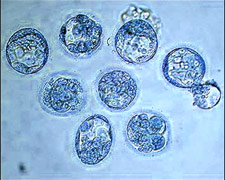
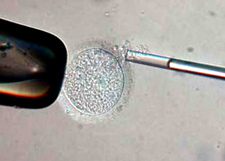
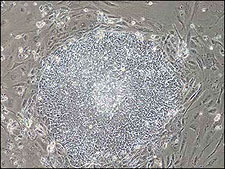
This is the first time researchers have reported the development of versatile "pluripotent" human embryonic stem cells, potentially capable of becoming any cell in the body, from a cloned human blastocyst. The stem cells were harvested from a blastocyst produced by transferring the nucleus of a non-reproductive ("somatic") cell, containing a woman's genetic blueprint, into a nucleus-free egg from the same donor. Following this transfer, factors within the host egg's exterior, or cytoplasm, reprogrammed its new nuclear contents by activating versatile embryonic genes, while silencing the more limited adult somatic cell genes. Researchers were then able to collect embryonic stem cells from the resulting cell mass inside the cloned blastocysts. The experiment, the first published report of cloned human stem cells, means so-called therapeutic cloning is now a reality.
"Because these cells carry the nuclear genome of the individual, after differentiation they could be expected to be transplanted without immune rejection for treatment of degenerative disorders," Prof. Woo-Sok Hwang at the Laboratory of Theriogenology, Veterinary Medicine Teaching Hospital of Seoul National University in Korea, who led the study, said in a statement. "These are the most advanced human embryo clones yet produced," Prof. Hwang told BBC News Online. The team says it sought approval for its work from an ethical review board and obtained informed consent from its women donors before proceeding with the work. "Our approach opens the door for the use of these specially developed cells in transplantation medicine." "We will never try to produce cloned human beings," he further said.
Working with Prof. Hwang was also researchers from four other South Korean hospitals and medical universities, and Dr. Jose Cibelli, formerly of Advanced Cell Technology and now a researcher at Michigan State University in the US. Hwang and colleagues said they created the clone using eggs and cumulus cells donated by Korean women. They cloned each woman using her own egg cell and her own cumulus cell, so the clones were 100 percent copies of each woman. Cumulus cells are found in the ovaries and in some species have been found to work especially well in cloning experiments.
Hwang and colleagues developed the stem cell line, SCNT-hES-1, after collecting 242 eggs from 16 unpaid volunteers who had signed informed-consent agreements. From these eggs, scientists then cultured 30 blastocysts to obtain 20 suitable inner cell masses. By tweaking the amount of time that elapsed between the transfer of the nucleus and the activation of the newly transplanted genetic material, the team was able to optimise their results: A two-hour delay seemed to work best, so that 20 percent of all reconstructed eggs formed blastocysts. From the inner cell mass of these blastocysts, a single human embryonic stem cell line was obtained.
Interestingly, the research team harvested eggs as well as somatic cells from the same donors. Nuclear material from the somatic cell was transferred into the nucleus-free or enucleated egg of the same woman. This unusual experimental design may be more effective than person-to-person transfers may, because it offered greater compatibility between the genetic components that were fused together. But the question then arise if the stem cells truly were derived from the transferred nucleus, or if they were the result of an accidental "parthenote" — an artificially induced blastocyst resulting from an egg that began to spontaneously divide. To support their claim that the resulting stem cells came from the transplanted nucleus, Hwang's team completed DNA fingerprinting analysis, and also checked the expression of imprinted genes. The results were consistent with stem cells resulting from transplantation.
"These results seem promising. But, it's important to remember that cell and tissue transplantation and gene therapy are still emerging technologies, and it may be years yet before embryonic stem cells can be used in transplantation medicine," he further said. The research also raises policy and ethical questions, Kennedy noted, since blastocyst-derived stem cells for tissue repair or transplantation might exacerbate pressures on egg donors in some regions. The prospect of using cloned human blastocysts to produce new embryonic stem cells lines also is likely to provoke further controversy, he added. "There is widespread consensus among all responsible, mainstream scientists — including the authors of this paper and AAAS, publisher of Science Magazine — that any attempt to clone a human being would be highly dangerous and wrong, and therefore, all reproductive cloning should be banned," Kennedy said. "But, the generation of stem cells by somatic cell nuclear transfer methods involving the same individuals may hold promise for advances in transplantation technology that could help people affected by many devastating conditions." "It is a very impressive study. It obviously represents a major medical milestone," said Dr. Robert Lanza, who has helped lead cloning experiments at Advanced Cell Technology. "I think it could help spur a medical revolution." Lanza also said it is now important that laws be passed banning reproductive cloning — using cloning to create a human baby. He noted that some researchers, notably Kentucky fertility expert Dr. Panos Zavos, have been at least trying to clone a baby. "He's got the cookbook now. It's scary. We really need to move as soon as possible," Lanza said. The results of Prof. Woo-Sok Hwang and others will be presented at a symposium titled "Stem Cell Science in the Service of Society", on Monday, 16 February, at the 2004 AAAS Annual Meeting in Seattle. Source: Press release from American Association for the Advancement of Science. |
||||||
|
|

|
^^ Back to top | Home | Archive | Links | Join Discussion! | Send Message | About CellNEWS |
|
|
|
|
