|
|
More on China:
Stem Cell Forum in China Demonstrate Cutting Edge Research
Focuses on new findings for iPS cells
Friday, 25 July 2008
Over 300 of
China's top stem cell biologists and researchers from around the globe shared
their latest results and held China's first ever symposium on advanced induced
pluripotent stem (iPS) cell research during the just concluded first annual 2008
China Stem Cell Technology Forum at the China Medical City complex in Taizhou,
China.
Read the full article here.
On this page:
China
Make Broad Progress in Stem Cell Research
Highlights
from the 'Third International Symposium of Stem Cells', Sep 15-17, 2004.
China Make Broad Progress in Stem Cell Research
Report from the
Third International Symposium of Stem Cells in Shenyang, China.
Tuesday, 21 September 2004
(Updated Tuesday, 05 October 2004)
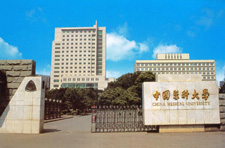
China Medical University in Shenyang.
© 2004 by CellNEWS; by the
courtesy of
Prof. Xinshan Jia.
|
While the United States discusses the existence of stem cell research,
China takes a broad perspective on the issue. Their latest results were
presented at a tree-day international stem cell symposium, the Third
International Symposium of Stem Cells, held in Shenyang in mid
September 2004, in the Northeast Chinese province of Liaoning, and
organised by the China
Medical University in Shenyang.
Specialists from China, Japan, Sweden, Switzerland and United States had
been invited to attend the symposium, Prof. Xinshan
Jia, chairman of the
organising committee and head of the Department of Molecular Pathology at
China Medical University in Shenyang, told CellNEWS.
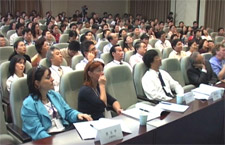
Participants in the 'Third International
Symposium of Stem Cells' in Shenyang.
© 2004 by CellNEWS; by the
courtesy of
Prof. Xinshan Jia.
|
Many
of China’s most prominent stem cell groups and researchers were presenting
their latest results at the Shenyang meeting. More than 300 Chinese
participants, together with 22 international scientists, presented a wide
range of work during the three-day symposium. Some 21 different research
groups from all over China and 14 from Japan, Sweden, Switzerland and
United States were represented at the meeting. The Chinese groups came from
as far apart as Hong Kong in the south and Haerbin in the north of the
country. Still, there are many more groups known in China concentrating
their efforts on stem cell and regenerative medical research.
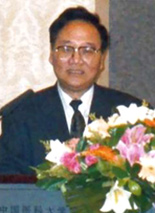
Professor Xinshan Jia.
© 2004 by CellNEWS; by the
courtesy of Prof. Xinshan Jia.
|
According to Prof.
Xinshan Jia,
the symposium included a broad program presenting basic research with
animal and human stem cells of both embryonic and adult origin. More
specifically the scientific program included studies of neural,
mesenchymal, hematopoietic stem cell biology and transplantation,
spermatogonial stem cells as well as stem cells of the heart, blood vessels
and as therapy for diabetes patients. The clinical uses of stem cells, and
the ethics of stem cell research, were intensely discussed during the
meeting.
Chinese scientists have made rapid progress in all areas of stem cell
research over the past few years and have mastered the technology for
separating, purifying, freezing and rejuvenating stem cells from embryonic,
foetal as well as adult sources. For example, foetal stem cell banks can
now be found in a number of Chinese regions, including Beijing Municipality
and Shandong and Guangdong provinces.
This symposium shows how broad spectrum approach Chinese scientists have
taken with basic stem cell biology and research. They are not only doing
some spectacular experiments in this area, which sporadically are reported
in western press and in the US in particular. The Chinese approach is
basic, broad and extensive, utilising all kinds of model systems available
to gain more insights to reach the ultimate goal – safe and efficient
therapies for a multitude of diseases.
Top
Highlights from the 'Third
International Symposium of Stem Cells'
September 15-17, 2004.
by Xinshan Jia
- Norio
Nakatsuji from Kyoto
University, Japan, reported that mouse, monkey and human ES cell lines
has been established for biomedical research in their institute, which
also distribute ES cells to other institutes in Japan. So far they have
established and characterised three human ES cell lines: KhES-1,
KhES-2 and KhES-3.
- Shoen Kume from Kumamoto University, Japan, reported that the final
goal of their project is the understanding of endodermal induction and
organogenesis of the pancreas. They specifically aim at studying the
developmental biology of the gut endoderm, and particularly focus on
the organogenesis of pancreas and the development of functional
pancreatic endocrine cells in culture. The achievements will provide a
source of insulin producing cells for the treatment of diabetes
mellitus.
- Zhixu He from Guiyang Medical College, Guiyang, reported on their
studies on in vitro generation of hematopoietic (blood)
precursor cells from a mouse embryonic stem cell line to reconstruct the
hematopoietic system. They found that embryonic stem cells have broad
potential for differentiation to variety of hematopoietic stem cells
(HSC’s). However, it is very difficult to control the stage of
differentiation for ES cells in vitro. They search for a
useful method for the generation of HSC’s by induction of ES cells: a
three-step differentiation procedure. Mice ESC’s were induced to
optimal differentiation into HSC by co-culture with BMSCF (bone marrow
stromal cell feeders) plus SSCFL (supernatant of stromal cells from
mice foetal liver) and the combination of SCF, VEGF, IL-3, IL-6 and
EPO. The results showed that the three-step differentiation and the
culture conditions described, gave good support for the
differentiation of ESC into HSC’s. The HSC’s from ESC were safe
without formation of any teratomas in the body, and it reconstructed
the haematopoiesis.
- Shunong Li from Sun Yat-Sen University of Medical Sciences,
Guangzhou, reported the effects of stromal cell conditioned medium
(SC-cm) from mouse yolk sac, fetal liver and bone marrow on the
hematopoietic differentiation of mouse ES cells.
- Hongmei Peng from Peking University Stem Cell Research Center, Beijing,
reported the derivation and mass culture of human embryonic stem cells
and induction hES cells into o4+ cells (which is
a marker for undifferentiated human ES cells). From initially 64
donated mature oocytes and 12 spare 3-day-old embryos, they cultured
50 of them. Thirty of these grew to the blastocyst stage, and from
these they could isolate 15 ICM (inner cell mass) to grow ES cells
from. Four of these gave vigorously growing cell lines: B4, B7, PKU1
and PKU2. All of these had a variety of characteristics of human ES
cells and could be grown for extended times. Two lines have normal 46
XY karyotype, while the other two lines have normal 46 XX karyotype.
- Xining Pang from China Medical University in Shenyang reported that
mesenchymal stem cells could be induced to differentiate into neural
cells in vitro, by the antioxidant beta-mercaptoethanol. Other
antioxidants, like glutathione, ascorbic acid or vitamin E, did not
have this effect.
Shenyang, Monday, October 04, 2004.
|
|
