|
|
Chinese Researchers Make Cloned hESC’s in Rabbit Eggs
Saturday, 16 August 2003; Updated 17 Aug. 2003
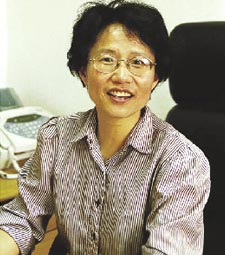
A team led by Huizhen Sheng has devised
a technique for reprogramming adult
human cells by fusing them with empty
rabbit eggs.
|
A research group based in Shanghai, China, has succeeded to clone and
isolate human ES cells using rabbit eggs as ‘carriers’. More than 100 of
the hybrids, made by fusing human skin cells with rabbit eggs, were allowed
to develop in laboratory dishes for several days before the scientists
destroyed them to retrieve embryonic stem cells from their interiors. The
researchers, led by Hui Zhen Sheng of Shanghai Second Medical University,
describe the details of their work over the last several years in this week’s
online edition of Cell
Research. The Cell
Research is a peer-reviewed bimonthly scientific journal affiliated
with the Shanghai Institute of Cell Biology and supported by the Chinese
Academy of Sciences. The paper will appear in print later this month (Y.
Chen et al. Cell Res. 13, 251–263; 2003).
Few experts think that the rabbit-human hybrid embryos could be developing
beyond the earliest stages. Cells from the hybrid embryos contain a tiny
amount of rabbit DNA in their mitochondria, the structures that supply
chemical power to the cells. However, the Chinese group suggests the cells
might be useful for human therapies and at least important in the further
research on ESC’s since it would ease the requirement of human eggs in
creating stem cell lines.
Sheng's work has already created a buzz after rumours of it circulated in
the scientific community and were reported in The Wall Street Journal
already early in 2002 (see Nature
419, 334–336; 2002). The publication will probably again provoke
the debate over the ethics of cross-species reprogramming. But cell
biologists say that having the data available for public discussion will
help researchers and regulators to decide what kinds of cross-species work
should be pursued.
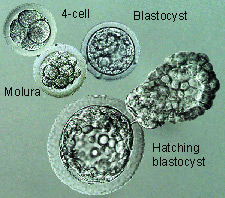
Development of rabbit oocytes carrying
human somatic cell nuclei (‘nt-units’).
|
The immediate receptions of Sheng’s paper show that it is unlikely to calm
the already fierce debate. It has already been hailed as an important
scientific advance, questioned for its scientific rigour and
sensationalised as a bizarre mixing of human and animal.
The team said it retrieved foreskin tissue from two 5-year-old boys and two
middle-aged men, and facial tissue from a 60-year-old woman, as a source of
skin fibroblasts. They fused those cells with New Zealand rabbit eggs from
which the vast majority of rabbit DNA had been removed. More than 400 of
those new, fused entities grew into early embryos, and more than 100
survived to the blastocyst stage — the point at which ES cells can begin to
be harvested.
Although this is the first creation of a human "chimeric"
embryo — a reference to the fabulous chimera of Greek mythology, which had
a lion's head, a goat's body and a serpent's tail — it is not the first
time scientists have blended human cells into lab animals. Scientists at
ACT in Massachusetts, USA, had previously mixed human cells and cow eggs in
a similar attempt to make hybrid embryos as a source of stem cells, but
those experiments were not successful.
Because human egg cells are difficult and costly to retrieve from women's
ovaries — and because human egg retrieval poses risks to the donors —
scientists have been wanting to know whether animal eggs may serve as well
for the process of cloning. A major question has been whether the remnants
of mitochondrial DNA that typically remain in an animal egg would be
compatible with the nuclear DNA contributed by the human cell.
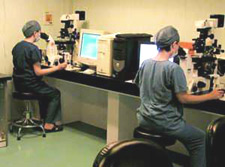
Scientists performing stem cell research
at the Center for Developmental Biology
at Shanghai No 2 Medical University.
|
The work by the Shanghai group suggests that the answer to that question is
yes — though with a number of cautions. Most important, researchers said,
the paper stops short of proving beyond a doubt that the stem cells
retrieved from the hybrid embryos are truly capable of growing for long
periods of time in lab dishes, and that they can turn into every known kind
of cell. However, if one carefully read their manuscript they state the
cells have been cultures for 26 generations so far.
Another objection from some experts is that the rabbit mitochondria left in
the enucleated oocyte would not support the growth and development of
‘human’ derived embryonic cells. However, since whole human fibroblasts
(including their mitochondria) were fused with the rabbit oocyte cytoplasm,
it is reasonable to assume that there would not be any problem due to the
interspecies mix of mitochondria. Both types of energy producing organelles
might grow in the initial stages, but be overtaken by the human derived
later during development.
Douglas
Melton, a Harvard
University cell biologist and cloning expert, said the work is a big
advance because it offers a new system for exploring the mechanisms by
which egg cells get adult cells to be reprogrammed into embryonic cells. The
Chinese work, Melton said, is "...extremely interesting, and I hope
they pursue it," according to a report in Washington Post.
R. Alta Charo, an associate dean of law and professor of bioethics
at the University of Wisconsin at Madison, noted that the work passed the
scrutiny of Chinese ethics authorities, who had demanded, among other
things, that the embryos not be allowed to grow more than 14 days.
"Short of putting one of these embryos into a woman's body for
development to term, I don't think this work harms anyone alive,"
Charo said.
The experiments should force opponents of cloning research to identify more
clearly than they have until now exactly where they would draw the line
against human embryo cloning — in other words: How human does an embryo
have to be to have the moral standing these advocates confer on embryos?
The group in Shanghai have earlier performed and studied other
cross-species somatic cell nuclear transfers (SCNT), like macaque monkey
and rabbit, and panda-rabbit mixes. On the whole, the article published now
in the online edition of Cell
Research, gives a detailed and credible impression of their
work. Of course, repeating the result in other independent laboratories
would be of utmost importance in this case, since the results are so
controversial already.
Source: Embryonic
stem cells generated by nuclear transfer of human somatic nuclei into
rabbit oocytes.
Cell Research (2003); 13(4):251-264
|
|
