|
|
The Final Frontier
Depending on whom you
ask, stem-cell research is either a medical godsend or further proof that
God is dead.
by Steven Kotler
Tuesday, 04 March 2003
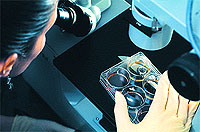
It’s elementary: Taking a closer
look at
the seminal cells
(Photo courtesy R.
Alta Charo,
University of Wisconsin) |
IRV
WEISSMAN'S HOME IS ABOUT 20 MINUTES FROM Stanford University, hidden from
the road by a tall stand of trees. Inside, all of the rooms are spacious,
but the living room is more so. The ceiling is high and broad-beamed; the
furniture, Western chic: chairs hewn from tree branches, tables built from
tree trunks. The couch is a curving affair that looks a little like a
giant, gold earthworm caught in a pillow fight. Spread out in front of the
fireplace is a bearskin rug. This bear has seen better days. Irv Weissman
is talking about how those days came to an end.
"We ate him. Rare. We were a little nervous about it because most wild
bears have trichinosis, but what the hell."
Irv Weissman doesn't look the bear-eating sort. He's of middle height,
middle weight, mildly balding, with fine clothes, a jovial aspect and a
long, wispy beard. He is a scientist, yet looks more like a Russian poet or
an aged food critic. Beneath this exterior, however, he's just a boy from
Montana — the grandson of a Jewish homesteader who, upon arriving at Ellis
Island, walked across the country and tried his hand at mining, fur
trapping and eventually opened a hide shop that became a group of hardware
stores; the son of a man who, when wounded by a knife-wielding assailant,
was tough enough to fight back and beat the man silly — so silly it made
the papers. Which is to say Weissman comes from a culture of bear eaters.
So why is he living among Stanford academics and
not in Great Falls, Montana, with other bear eaters? When Weissman was 10,
he read Paul de Kruif's book Microbe Hunters, which describes the
work of Ehrlich, Pasteur and other early bacteriologists. He quickly
decided science was more interesting than hardware. By the time he was in
high school, he worked at a
lab in Great Falls doing transplantation research. He
published two papers, on cancer and transplantation, before he was 18.
Weissman entered Dartmouth College but found that he didn't fit in with
either the East Coast Jews or the East Coast non-Jews. After two years he
transferred back to Montana State University in Bozeman, where he could
study premed without worrying about how a Jew from Montana was supposed to
behave on the East Coast. He left the state again in 1960, entered Stanford
Medical School and one way or another has stayed for the duration. Currently,
he's a professor of cancer biology and a professor
of pathology. In 2002, he was voted California Scientist of the Year.
True to his roots, Weissman approaches science like a Montana boy —
charting unexplored realms, pioneering in the lab. His early work focused
on how the cells of the immune system fight cancer. He spent much of his
time studying the relationship between blood cells, cancer and radiation. Because
of the research that emerged after the explosion of the atomic bombs over
Hiroshima and Nagasaki, scientists knew that exposing the human body to
radiation wiped out both blood cells and cancer cells.
They also knew that after irradiating the body (chemotherapy), you could
perform a bone-marrow transplant using marrow from a healthy, cancer-free
donor and that something in that new bone marrow would begin producing all
sorts of cells. "We knew there must exist a very rare cell inside the
bone marrow that would give rise to all types of cells — but this was only
a theory," says Weissman. "No one had ever isolated that cell. I
started wondering how to tease it out from all the others."
This was in the late '60s. For years, Weissman worked in his lab sorting
cells. An easy way to think about this is that he took mouse blood and
poured it through a long series of strainers. With each pass a different
kind of cell was removed. Out came the T cells, out came the B cells, the
red blood cells, the white blood cells and on and on until there was only
one kind of cell left. Finally, in 1988, Weissman managed to do something
that no one else had ever done, something that most people didn't even
think was possible: He isolated a cell that gave rise to all other kinds of
blood cells, a blood-forming stem cell. He also became one of the first
people on the planet to realize the promise of what he had done. This has
made him a controversial man.

Mice and men are working
together on
cell research
at UCSD.
(Photo by
Joe Klein)
|
If you've been living inside a Himalayan cave, perhaps you haven't heard
about stem cells, but otherwise the gist has been hard to miss. Scientists
from all fields have been harping on stem-cell research as the most
important directed medical-research effort ever. When Irv Weissman started
working with mouse cells, he realized, nearly from the beginning, that he
was onto something that could potentially save millions of lives. "I
knew that if I could ever do this in humans," he says, "I would
be able to use chemotherapy to wipe out cancer cells and then transplant in
new stem cells that would be completely disease free."
Cancer wasn't the only thing on his mind. Weissman knew that a great number
of the body's terrible diseases — Alzheimer's, diabetes, Parkinson's,
others — are caused by misbehaving cells and that it might be possible to
remove the bad cells and replace them with normally functioning stem cells.
In America, 1.3 million people have cancer; 4 million have Alzheimer's; 1.5
million have Parkinson's; 17 million have diabetes. This doesn't include
those in need of a new kidney or bladder or spinal cord — which stem cells
could possibly be used to grow. That's a lot of lives to save.
What Irv Weissman didn't understand at first is that his own government
could politicize these stem cells and decide that potentially saving
millions of lives was a bad idea. What he didn't understand then, but has
come to understand since, is that without his rugged Montana perseverance,
he might not ever get the chance to save these millions of lives.
R. ALTA CHARO, A PROFESSOR OF LAW AND MEDICAL ethics at the University of
Wisconsin, Madison, who served on Bill Clinton's bioethical council and who
has been a part of this discussion since nearly the beginning, likes to
say, "The stem-cell debate is a debate about everything but what it's
about." Which is to say that the stem-cell debate is not, actually,
about stem cells.
Really, it is about George Bush trying to win a second-term election after
not actually winning the first. It's about the son not making the same
mistakes as the father and losing the religious right. And it's about the
religious right trying like hell to pave the way for the Supreme Court to
take away a woman's right to have an abortion.
A discussion of this requires a little more background on the five ways
scientists obtain stem cells. The principal method is through a process
called somatic cell nuclear transfer, which we'll get to in detail soon. But
for now we'll concentrate on the other four. One of those ways is through
parthenogenesis, the Greek word for virgin birth. In this process, an
unfertilized egg is tricked into cell ä division and then mined for stem
cells. Another way is to take one of the existing 60 cell lines and form
another cell type to create new lines. Both of these ideas are exciting,
but no one really knows if or how well either will work, and so, for now,
both are off the radar.
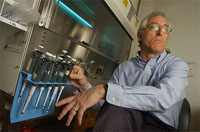
Soft cell? Larry Goldstein
wonders how
something so
modest could stir
such
controversy.
(Photo by Joe
Klein)
|
In the remaining two methods, fetal stem cells are culled from aborted
fetuses and embryonic stem cells are removed from unused embryos taken from
in-vitro fertilization clinics. Because of these methods, stem cells sit smack
in the middle of America's reproductive-rights debate. In fact, some have
argued, the debate over the process of culling stem cells is the best thing
to happen to the religious right's anti-abortion crusade in decades.
"Every year since Roe v. Wade thousands of women have been
having abortions," explains Charo. "That's 30 years, an entire
generation of women who have experienced the ability to choose. That's a
huge demographic imperative. The evangelical right is fighting against a
culture of tolerance for embryonic destruction, and they're losing that
fight every time a woman knows she can make a choice. The conflation of
cloning and stem-cell research has allowed [the religious right] to argue
for the embryo in the context of a technology — reproductive cloning — that
has a near-universal shock value."
It's a tricky thing to try and overturn a Supreme Court decision like Roe
v. Wade. Nonetheless, for 30 years, foes have been chipping away at it.
One of the main reasons it has held fast hinges on this idea: A human
embryo does not have the same rights as a human being. To overturn the
decision you need at least a couple of things. One is a pro-life Supreme
Court (which is a whole other can of worms, but it starts with what we just
got — a pro-life Senate). The other is evidence that supports the idea that
the American public now feels that embryos are people too.
For the benefit of reporters and congressmen locked in this debate, Irv
Weissman does an interesting experiment. He walks up to strangers on the
street and asks them to draw an embryo. "Invariably," he says,
"every time, without fail, they draw a fetus with a face." A
fetus with a face is not an embryo. An embryo is a scientific term used to
describe the period of time from when a zygote is formed until the time it
begins to have discernible organs. Meaning, specifically, that the word embryo
was created to distinguish it from a fetus. It is nothing like the cartoons
that people draw. In fact, under a microscope, an embryo is even less
spectacular than stem cells.
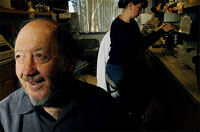
Man from Montana: Dr.
Irv Weissman is
a
stem-cell pioneer.
(Photo by
Paul Myers)
|
If you want to prove to the Supreme Court that both the scientific
community and the American public have changed their minds about the status
of the embryo, then you need a series of precedents. These are not just
legal precedents; these are psychological precedents as well. The high
court would need to decide that the country's opinion has changed, and to
do this you would need to show that in related — but not abortion-specific
— departments the embryo is now being afforded the same protections as both
fetus and adult.
To this end, Bush has stacked a bevy of anti-choice judges in the lower
courts and appointed an anti-choice attorney general in John Ashcroft. And
while you could argue that this is just party politics — and it is — behind
the obvious partisan court appointments there are covert anti-choice
precedents being set.
Last October, the Bush administration changed the section of the Health and
Human Services charter that regulates research done on human subjects. This
legislation exists so that if you volunteer for a sleep study, you don't
end up dead. The old charter granted legal protection to adults and
fetuses. The new version protects embryos as well.
For a long time, women's groups have been lobbying the government to
provide health care for pregnant women. To this end, the Bush
administration extended the reach of the State Children's Health Insurance
Program to cover both embryos and fetuses but, oddly, not pregnant women. So,
while pregnant women still can be without health care, the groups of cells
dividing in their uteruses now have more health coverage than their
uninsured mothers.
Bush has also lobbied hard for a ban on partial-birth abortions, which
technically eliminates the already rare late-term abortions but in effect
criminalizes the procedure. Bush also reinstated Ronald Reagan's gag rule
that bars federally funded family planners from discussing abortion as an
option or from providing abortion services.
"The point of these things," says Allison Herwitt, director of
government relations for the National Abortion and Reproductive Rights
Action League "is to weave embryonic rights into law. These are not
individual occurrences. These are a well-crafted strategy to end legal
abortions. And one of the next steps in that strategy is to outlaw
stem-cell research — not because the research itself is in question, but
because banning the way that research is conducted can help them to achieve
their true goal."
UNDER A MICROSCOPE, STEM CELLS aren't much to look at. They grow in clusters
and even when magnified 10 times are individually smaller than pinheads. They
look like slimy, slightly metallic grapes. Under a microscope, it would be
easy to mistake them for something utterly inconsequential, like tadpole
snot.
"It's almost funny," says Larry Goldstein,
"that something so dull-looking could cause such a fuss."
Goldstein, another scientist in the middle of this stem-cell storm, is a
plain-spoken, energetic man in his late 40s. He has gray hair and a long,
handsome face. As an investigator and professor of cellular/molecular
medicine at the University of California, San Diego, he oversees a lab that
employs 23 people and thousands of mice. Both mice and men are working
toward answers to the same set of questions: how biological complexes
(proteins, lipids and organelles) move through the neurons and brain cells.
He wants to know these things because he thinks the answers will go a long
way toward providing a cure for Alzheimer's, Huntington's chorea and Lou
Gehrig's disease. To get the answers, he needs stem cells.
Stem cells are the body's rawest materials. From them, developing embryos
build all other cells that eventually form the body. Unlike specialized
cells that can only form one thing — a liver, say, or a nose — stem cells
can change into any other kind of cell.
Currently, much of Goldstein's work involves non-human-derived stem cells,
which are not technically a point of contention. "But five years from
now, if I want to actually cure these diseases, I'll need access to human
embryonic stem cells, and I want to make sure they're available."
The issue of stem-cell availability is at the root of a war of terminology.
Both sides are using big words, and some of those words have frightening
connotations. Ignorance is part of the problem. Because of the complexity
involved, the media often choose brevity over accuracy, and the combatants
fuel the war by co-opting partially defined words to their own ends.
Cloning is one of the biggest bombs in this terminology war. "You
have to understand something," Weissman says. "Cloning has as
many meanings to a scientist as ice to an Eskimo or love to
Oprah Winfrey." On the other hand, cloning, to a man like Leon Kass, means only one
thing: producing carbon-copy human beings.
Leon Kass is
yet another controversial man at the center of this battle. He is a
University of Chicago bioethicist who believes that life begins at
conception and who now heads up President Bush's Council on Bioethics. Time
magazine called him the president's "ethics cop." The council is
charged with advising Congress and the administration on stem cells. A few
years ago Kass wrote a now-famous article for The New Republic
titled "Preventing a Brave New World or Why We Should Ban Human Cloning
Now." He explained the aforementioned procedure called somatic cell
nuclear transfer (SCNT), the principal means of obtaining stem cells, and
disingenuously equated that process with the cloning of people. Here are a
few lines taken from Kass' article:
What is cloning? Cloning, or asexual reproduction, is the production of
individuals who are genetically identical to an already existing
individual. The procedure's name is fancy — "somatic cell nuclear
transfer" — but its concept is simple. Take a mature but unfertilized
egg; remove or deactivate its nucleus; introduce a nucleus obtained from a
specialized (somatic) cell of an adult organism. Once the egg begins to
divide, transfer the little embryo to a woman's uterus to initiate a
pregnancy. Since almost all the hereditary material of a cell is contained
within its nucleus, the re-nucleated egg and the individual into which it
develops are genetically identical to the organism that was the source of
the transferred nucleus.
Scientifically, Kass is correct, except — and this is a big except — SCNT
stops short of transplanting that egg into a woman's uterus. What Kass
knows, but chooses not to acknowledge here, is that once that new egg
begins to divide, one of two things can happen. The first is it could be
implanted into a woman's uterus and develop those dreaded carbon copies. This
process is called "reproductive cloning," and almost every
mainstream scientist the world over, including Weissman and Goldstein,
opposes it.
The second thing that could happen is what opponents of this work like to
call "therapeutic cloning." Weissman prefers "nuclear
transplantation to produce stem cells." Either way, in this second
scenario, once that very early embryo (a cluster of 100 or so cells called
a blastocyst) is formed, there is a two-week window during which the stem
cells are extracted. In doing this, the embryo becomes unsuitable for
manufacturing the dreaded clones, or any other viable human form for that
matter. If you wanted to create another human being, you would have about
as much luck successfully implanting that enucleated embryo into a woman's
uterus as you would have growing a Buick by planting an engine block in the
ground.
Kass' apparent attempt to equate SCNT with the "production" of
cloned individuals becomes egregious because his knowledge and opinions are
being used to enact legislation that will then affect the entire country.
A clear indication of Kass' sway took place in the spring of 2001, when a
pair of cloning bills was introduced, one in the House and one in the
Senate. The original House bill went nowhere, but it was quickly rewritten
and reintroduced by Dave Weldon (R-Florida). On July 31, 2001, after three
hours of debate during which conservatives spoke about eugenics,
commodifying humanity, the peril of private-industry control over the human
genome, the need for science to operate within social and ethical norms,
and — of course — the Nazis, the House of Representatives passed the Weldon
Bill 265 to 162.
The bill (and its sister Senate bill, which was introduced by Kansas
Republican Sam
Brownback and is known as the Brownback Bill) seeks
to outlaw all forms of cloning — both reproductive and therapeutic — with
severe penalties of up to a $1 million and 10 years in prison for either doing
research or receiving medical treatment based on that research. This means
that if the French invent a stem-cell-based cure for Alzheimer's and you go
to France and receive treatment and try to
re-enter the United States, you're not passing go, you're going straight to
jail. The only good news is that since your Alzheimer's is now cured,
you'll remember the whole experience.
On August 9, 2001, President Bush, in his first address to the nation,
echoed Kass' fear-mongering and followed his lead: "We have arrived at
that brave new world that seemed so distant in 1932, when Aldous Huxley
wrote about human beings created in test tubes in what he called a
hatchery."
Bush then issued an executive order restricting federal research money to
the 60 previously harvested stem-cell lines. These lines were cultivated
between 1998, when human embryonic stem cells were first isolated, and the
moment Bush put the kibosh on further work. Never mind that the majority of
these lines have not been studied enough to know if they're actually safe
for use in humans.
"But the real problem with them," says Weissman "is that all
60 lines come from people who utilize in-vitro fertilization clinics. Part
of the problem is IVF clinics serve a very specific segment of the American
population. The stem-cell lines taken from IVF clinics are cell lines taken
from rich, white, infertile people. We have no idea if stem cells possess
ethnic, genetic variation — and they might. One of the fundamental
principles of bioethics is called distributed justice. That means when
scientists work on medical cures, they want to develop cures for everyone —
not just for rich, white, infertile people."
In other words, scientists want to study a rainbow coalition of stems
cells, but by limiting research to existing lines, compassionately
conservative George Bush has created a stem-cell policy much like his tax
cut: The rich get richer, the poor get screwed.
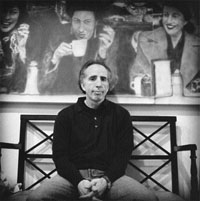
Hollywood loyalty: Jerry
Zucker founded
CuresNow
after his daughter was
diagnosed with juvenile
diabetes.
(Photo by Anne
Fishbein)
|
SPEND FIVE MINUTES WITH JERRY ZUCKER and you'll think that his life could
have gone either way. One wrong turn and he would have ended up still
working the coat check and living with his mother at 50. He wears
cardigans. In conversation, his voice is several decibels below
soft-spoken. Words hang up on his lips. He has soft features, bushy
eyebrows, errant hair and, all told, looks like someone in constant, mild
pain. The one thing he doesn't look like, and this may be his great genius,
is Hollywood royalty, or at least its court jester.
Zucker created his own brand of movies, a genre of wack-job comedy that
began with Kentucky Fried Movie, was perfected in Airplane!
and which includes the Naked Gun and Police Squad franchises.
He also made a sweet movie about a dead guy, a live woman and a pottery
fetish called Ghost.
Zucker Productions is a few modest rooms located in a peach-walled building
in Santa Monica. Zucker's movies are such flamboyant affairs, it's hard to
imagine them beginning in rooms this small.
It's also hard to imagine Zucker as the political type. Though he attended
the University of Wisconsin from 1968 to 1972, when Madison was a radical
hotbed (the legendary Vietnam protest documentary The War at Home was
filmed then and there), Zucker was, by his own admission, "never much
more than a weekend rioter." His politics are still
middle-of-the-road.
Since then, not much has changed. Yet everything has changed. In 2000,
Zucker found out that his 11-year-old daughter, Katie, had juvenile
diabetes. Immediately, he began researching the disease and hunting for
hope. In the summer of 2001, he started hearing about something called stem
cells and how they might be able to not just provide better treatment, but
actually cure the disease. That summer he also heard that the Weldon Bill
had passed, that President Bush was limiting research to 60 mostly moribund
cell lines and that the Brownback
Bill was heading for a vote in the Senate where only
seven members were in favor of keeping the research legal.
"As a director," says Zucker, "I tend to be calm. I don't
want to be another Hollywood maniac. I try not to get carried away or lose
my cool. What was going on with stem cells made me very angry."
Through sad coincidence, Zucker and his wife, Janet, had gotten to know
Douglas Wick (the producer of Gladiator, Stuart Little and Working
Girl), and his wife, Lucy Fisher, the former vice chairman of Columbia
TriStar Motion Picture Group. Wick and Fisher also have a daughter with
juvenile diabetes. The foursome had been active in the Juvenile Diabetes
Research Foundation, but wanted to be at the forefront of the stem-cell
debate and felt that if they started their own organization they could not
only act quickly, they could bring the full weight of Hollywood to bear on
the situation.
Together they hired a lobbyist and went to Washington. They took their
daughters and Caltech stem-cell biologist David Anderson along.
They called this new group CuresNow. This was in the summer of 2002. To
give you an idea of how strong the love affair between D.C. and Hollywood
is, what did CuresNow do to get in to see senators?
"Um," says Zucker, "I just called up and said this is Jerry
Zucker."
They looked at their trip as an educational crusade. They punched below the
waist. "We would walk in to a senator's office with my daughter and
her insulin pump attached to her belt and ask them what was more important
— my daughter's life or the life of a couple of cells?"
In a sense, CuresNow was fighting against the work of its founders'
business. In the minds of many, stem cells are directly linked to cloning,
and the public perception of cloning is directly linked to Hollywood. "We
spent the better portion of the 20th century making mad-scientist
movies," says Zucker. "One of the first senators we met — I can't
tell you his name — went on and on about how if we let this technology go
forward someone will try to create a new Hitler. How much of that is real
fear and how much of that is Hollywood?"
As they suspected, most of the politicians didn't really know what they
were voting on. The Hollywood crew explained things slowly, and slowly
began making headway. One of their early converts, who remains their
strongest ally on the right, was Utah Republican and pro-life advocate
Orrin Hatch. Centenarian Strom Thurmond joined their cause. Senate Minority
Leader Tom Daschle agreed not to put the Brownback bill on the
floor for a vote until CuresNow had a chance to talk to everyone who would
listen.
Hatch, alongside several other senators (Feinstein, Kennedy and Specter),
introduced his own bill that banned reproductive cloning but allowed
therapeutic cloning. Neither his bill nor Brownback's could gather the
votes needed to pass. Instead, Brownback tried attaching anti-cloning to
several other bills, but CuresNow was making headway. The word was getting
out, and none of the anti-cloning amendments have met with success. Currently,
60 senators favor stem-cell research, and the Senate vote is still pending.
Since the recent Republican gains in Congress, CuresNow knows that its
Washington work is not done. But Zucker and company are spending an equal
amount of energy in California because it's here that lines are being drawn
and the first major battle for stem-cell research is being fought.
"California is the country's biotech leader," says Zucker. "We
have brilliant scientists and a receptive state government. I want to see
California as a safe haven for stem-cell research. We have a history of
leading the nation in fights such as this. We have a great chance to add to
that history."
THE 10th AMENDMENT TO THE U.S. Constitution reads: "The powers not
delegated to the United States by the Constitution, nor prohibited by it to
the States, are reserved to the States respectively, or to the
people." Politically, this is the typically Republican turf known as
states' rights. It exists as a barrier to top-down, Washington-mandated
policy. It is the legal reason California was able to legislate lower
emission standards than the national standards mandated by the Clean Air
Act. The rest of the nation followed California's anti-emission movement;
car manufacturers, to their dismay, had to comply. California Democrats had
used one of the Republicans' favorite weapons — states' rights — to spark a
state-by-state subversion of the GOP's big-auto agenda.
This tactic doesn't always work. In 1996, California passed Proposition
215, making marijuana available with a note from your doctor, like any
other prescription drug. In the ensuing years, nine other states legalized
medical marijuana. George W. Bush promised in a 2000 campaign speech to
leave medical marijuana as a states'-rights issue, saying, inimitably,
"I believe each state can choose that decision as they so
choose."
But in May of 2001, the U.S. Supreme Court in U.S. v. Oakland Cannabis
Buyers Cooperative ruled against the 10th Amendment, and in 2001 the
Drug Enforcement Agency started raiding California's buyers clubs and
growers organizations, confiscating wares and imprisoning owners.
It doesn't take an astute political analyst to realize that two of the
engines driving the Republican Party are economics and morality. There are
many different ways of looking at the conflicting tales of emissions and
medical marijuana. The least cynical is to believe that the country was
ready for cleaner air and not ready for legalized drug use. A more
jaundiced view says that pollution laws had two things going for them —
they didn't contradict federal law and, since Californians buy more cars
than anyone else, compliance carried an enormous economic incentive. Medical
marijuana, on the other hand, goes against federal law and also lacks an
economic impetus since you can't tax its sale. Most important, it offends
the moral standards of the right.
The California biotech industry is a huge economic impetus. In 2001, when
President Bush limited stem-cell research to the 60 previously existing
stem-cell lines, he effectively yanked a huge segment of biotech research
to a dead halt. Moneys were drying up, and America's top scientists began
leaving the country and moving to places with fewer restrictions — an
effect that analysts quickly dubbed the "brain drain."
Almost immediately following Bush's August announcement, University of
California at San Francisco stem-cell pioneer Roger Pedersen packed
his bags and lab and moved to England, where stem-cell research is
permitted. Other countries, including Israel, Japan, France and Australia,
have made themselves friendly to the work. Last year, Singapore took an
even more aggressive stance, declaring itself a center for stem-cell study,
breaking ground on a $15 billion research park and quickly poaching top U.S.
minds including Edison Liu, once a leading researcher at America's National
Cancer Institute and now the head of Singapore's new Genome Institute. There's
even talk of an international consortium for stem-cell research similar to
the one that cracked the human genome.
To combat the brain drain and bring more biotech money into California,
state Senator Deborah
Ortiz (D-Sacramento) introduced Senate Bill 253. The bill
allocates the use of state funds and private donations for stem-cell
research within California.
If your idea of a senator includes gray hair, a stentorian voice,
pinstripes and steely eyes, then Senator Ortiz does not fit the bill. She looks
like a suburban housewife and acts like an endearing grandmother. On the
day we met, she arrived carrying Greek pastries that looked like failed
geometry experiments oozing filling. She is an easy woman to underestimate.
One gets the feeling that she spends her days nudging legislation into law.
In her day, she has nudged quite a bit of legislation into law. In 1993,
she was elected to Sacramento's City Council and fought a nasty fight for
safer neighborhoods and tougher gun control. In 1996, she was elected to
the state Assembly. That same year her mother was diagnosed with ovarian
cancer. In the Assembly, Ortiz gave state workers a long-overdue pay raise
and created a statewide after-school learning program for at-risk students.
At home she became an armchair cancer specialist. "I read all the
studies and I read the footnotes." But there was no cure in the
footnotes, and her mother died in 1999 during Ortiz's first state Senate
term. Knowledge led her toward advocacy. Ortiz earmarked $25 million for
ovarian-cancer research, but felt that wasn't enough.
"From the footnotes I came to believe that the cure for cancer has to
exist at the cellular level," Ortiz says. "Stem-cell research is
the next wave." When she was re-elected to the state Senate in 2002,
she turned her attention to stem cells. It wasn't just a cure for cancer
that drove her decision. She knew that California took a $12 billion hit in
the dot-com crash, and recent studies claim that the state's budget deficit
will exceed $35 billion in the next year and a half. On September 22, 2002,
Gray Davis signed SB 253. Ortiz had nudged perhaps her biggest bill into
law. California became the first state to legalize stem-cell research.
"By signing SB 253, we have opened the door to important life-saving
research in California," said Davis, when asked about the bill. "There
are strict parameters to stem-cell research built into the bill, but the
possibility of some of the industry's top science researchers finding a
cure to fatal diseases such as Alzheimer's and Parkinson's diseases,
spinal-cord injury, stroke, burns, heart diseases, diabetes and arthritis
is priceless. We fully expect stem-cell research to attract world-renowned
scientists to our state. Currently, there are 2,500 biomedical companies in
California that employ 225,000 people. During 2000, this industry paid its
employees $12.8 billion. While this life-saving research will continue to
bring the necessary [private] funding into the state, it will more
importantly save lives."
Almost immediately after Davis signed, other states followed California's
lead. New Jersey, Pennsylvania, Louisiana and Rhode Island have already
legalized therapeutic cloning, and Massachusetts and New Mexico are
considering similar proposals.
This grassroots, states'-rights movement on stem-cell research presents a
dilemma for Republicans. The old-school, economic Republicans are
interested in free enterprise and biotechnology — the economic imperative. The
new-school, moral Republicans are interested in homogeneous morality and
banning abortion. Stem cells split the two sides of the party. One of the
reasons for the terminology war is that the Bush administration needs to
create a cloning bogeyman in order to bridge the schism in his party. This
way he appeases the moralists while doing an end run around the economists
who would be rather pleased with biotech billions.
It is interesting to note that there is no Bush administration or
religious-right opposition to the in-vitro fertilization process, despite
the fact that in the normal course of in vitro, multitudes of embryos are
destroyed. During in vitro, ova that have been extracted from a woman's
body are fertilized in a petri dish. On average, 20 or so embryos are
created, but only one is implanted. The rest are temporarily frozen and
then eventually discarded. This means that while the administration and the
religious right are opposed to using those ill-fated embryos for stem-cell
research, they are more than happy to turn a blind eye to their destruction
in the name of pregnancy. This is because their anti-abortion legal
strategies call for defining life ever earlier and ever more clinically —
as early and clinically as a dish in a refrigerator (talk about weird
science). Also, they do not wish to confront sterile parents or hamper a
multimillion-dollar industry.
So sure, it's a tad dramatic to say that what followed SB 253 is a
high-stakes poker game with states' rights, Bush's second term, abortion
legality, the biotech industry and medical science as major players. In
less dramatic language, what's happened in California is that the two key
issues driving the Republican bus have come into head-on conflict with each
other, and it's because Democrats have forced the issue by playing the
states'-rights card.
JUST BEFORE DAVIS SIGNED ORTIZ'S bill into law, Andy Grove, the chairman of
Intel, donated $5 million to UCSF for a stem-cell biology program. Because
of Bush's restrictions, anyone wanting to do stem-cell research requires
facilities that are completely unattached to anything receiving National
Institutes of Health dollars — thus separate buildings, labs, equipment and
such must be constructed. The $5 million won't pay for much of that, but it
was the first major private donation and a good start.
In Irv Weissman's home, on the evening of December 11, a small dinner party
was held to celebrate the next step — that being Stanford's announcement a
day earlier that it plans to capitalize on $12 million of anonymously
donated seed money and build a $120 million Institute for Cancer/Stem Cell
Biology and Medicine headed up by Weissman. Building on his previous
research with blood-forming stem cells, the Stanford institute will
initially turn its attention to discovering the stem cells that become the
other major organs of the body — that way, if these organs become
cancerous, they'll have new ways to fight the disease.
Weissman does not look like a man in celebration. His movements are
careful, his brow creased. He wears a chef's apron and stands at the stove,
studying the goose he's been busy cooking.
Around the dinner table sits a hungry crew. Weissman's sister Lauren, once
a Hollywood producer with five major films to her credit and now the
executive director of CuresNow, is there. As is Lee Hood, another top
scientist and the man who invented the DNA sorter that facilitated the
sequencing of the human genome; and Ann Tsukamoto, a scientist with
StemCells Inc.
Weissman maintains a robust wine cellar, and there are a number of
prestigious bottles sitting unopened on the counter and a number sitting
opened on the table. In between gobs of goose and glasses of grape,
Weissman explains the focus of Stanford's new research institute.
"It's not only new ways to fight the disease," he says. "That's
only the first step. We also know that there are cancer-forming stem cells.
If we can isolate these, we can get to the very root of every type of
cancer. This would give us new, biologically specific targets for drugs. And
because the institute is in this state, California will be the first place
these therapies will come out. Our biotech companies will produce them, and
Californians will get the first crack at these treatments."
Even this is only the tip of the iceberg. The institute plans to improve
the efficiency of SCNT, and once that's done they can begin growing
diseases from scratch — which means they'll develop a fundamental
understanding of how the body gets sick. So, when the Bush administration
says it opposes all forms of cloning, it is, in effect, saying it opposes
the best bet yet for curing cancer.
As expected, Stanford's announcement sparked a firestorm. All of the top
papers and top news shows reported the story, but not one bothered to
explain the tie-in between the stem cells and cancer. Instead the words human
cloning got heavy play. The Associated Press was the first to cover the
story, and its article began: "Stanford has said its new cancer
institute will conduct stem-cell research using nuclear-transfer techniques
— work that many consider to be cloning of human cells." ABC News
followed suit: "The president believes that the creation and
destruction of embryos for the purpose of research or reproduction is
morally wrong. He is against cloning of any kind and feels there are other
biomedical-research avenues."
Leon Kass
immediately issued a press release claiming that "Stanford has decided
to proceed with cloning research without public scrutiny and
deliberation," and went on to say that the president's bioethics
council does not endorse the Stanford institute, and then noted the council
wanted a four-year moratorium on so-called therapeutic cloning. Oddly, the
council never recommended a moratorium (which Brownback has recently been
calling for and which stem-cell researchers across the board consider a
terrible idea), and Kass issued his statement without bothering to consult
the rest of the council.
Not that any of this behavior is all that surprising. This is just a little
lying in the face of a bigger war — a war that is far from over. The
cloning debate rages on at all levels of government, refueled by the recent
Raelian announcement that they had created the world's first human clone. Never
mind that, just prior to that announcement, the Bush administration blocked
a worldwide U.N. ban on reproductive cloning that might have stopped the
Raelians in their supposed work. The ban was vetoed because it did not also
include therapeutic cloning and was insufficient for the religious right.
So the opposition continues twisting terminology. Scientists like Larry Goldstein and
the folks sitting around Weissman's dinner table are painted as
cold-blooded and immoral. The government is actively clouding the issues,
and the media has done little to engender understanding. Meanwhile, a
middle-of-the-road estimate of how many Americans will die from diseases
that stem-cell research might soon cure is 130 million.
Back at the stove,
Weissman pokes and prods and eventually nods his head sagaciously:
"That goose is cooked."
|
|
