|
Home | Archive | Links | Join Discussion! | Send Message | About CellNEWS |
||||||||||||||||||||||||||||||||||||||||||||||||||||||||||||||||||||||||
|
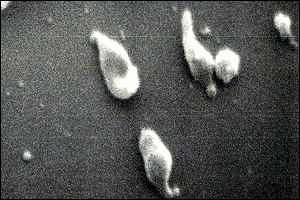
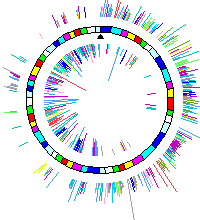
Hutchinson reported in 1999
that the mycobacterium M. Genitalium should get by with as
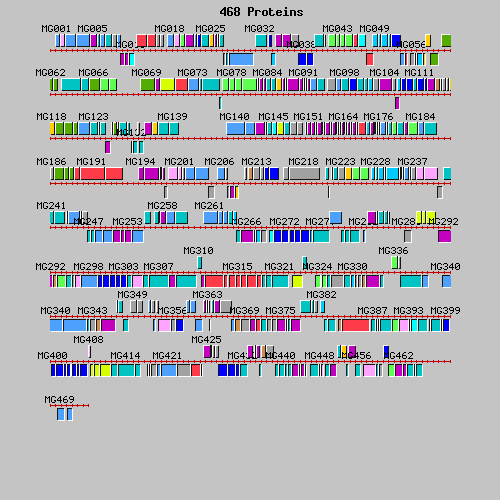
few as 265 genes (see Table 1). This could be thought of as the minimal set
of genes needed to sustain life. A piece of DNA containing these genes
might in principle be synthesized and inserted into a cell that had also
been assembled artificially, probably with bits and pieces from other cells.
| ||||||||||||||||||||||||||||||||||||||||||||||||||||||||||||||||||||||||

|
|
||
|
One letter code |
Functional category |
Number of proteins |
|
C |
Energy conversion |
28 |
|
E |
Amino acid metabolism and
transport |
11 |
|
F |
Nucleotide metabolism and
transport |
20 |
|
G |
Carbohydrate metabolism and
transport |
5 |
|
H |
Cofactor metabolism |
8 |
|
I |
Lipid metabolism |
6 |
|
J |
mRNA translation and
ribosome biogenesis |
94 |
|
L |
Genome replication,
transcription, recombination and repair |
35 |
|
M |
Outer membrane and cell wall |
7 |
|
N |
Secretion and adhesion |
5 |
|
O |
Chaperones |
13 |
|
P |
Inorganic ion transport |
4 |
|
R |
General function
prediction only |
15 |
|
S |
No functional prediction |
4 |
|
|
TOTAL: |
265 |
|
FIGURE 3. |
|
Already 1999, at a now famous speech at the annual meeting of the American
Association for the Advancement (AAAS) taking place in Anaheim in southern
California, Craig Venter argued that the creation of man-made
micro-organisms from a cocktail of small molecules could reveal how life
first evolved on Earth. At this occasion he also acknowledged such an
experiment would raised a multitude of ethical and security issues.
Now Dr. Venter has resumed Dr. Hutchison's project. If he succeeds in
creating a minimalist organism, he may then try to add useful functions to
it, he told The Washington Post yesterday. They were the first to report
that the project would get support from US Department of Energy (DOE) by a
grant of US$3 million.
|
|
Ari
Patrinos, a senior Energy Department
administrator who will help oversee the project, said the organism was an
attractive starting point to create a "minimal
genome" because it is so minimal already.
"We know even the simplest of
cells is incredibly complicated," Patrinos said — "too complicated, at least so far,
to understand completely."
"This is a case where we're
trying to cheat a little bit, to take the smallest and simplest and make it
smaller and simpler."
Comments:
J. Craig Venter is a South
African-born gene scientist that solved one version (his own!) of the human
genome two years ago.
J. Craig Venter and Hamilton Smith co-founded Celera
Genomics.
Profiles: Venter (Time)
- Smith
(at the Nobel e-Museum)
Articles on similar subjects from BBC:
First synthetic virus created - 11 Jul 02 | Science/Nature
Q&A: First synthetic virus - 12 Jul 02 | Science/Nature
Synthetic virus nearing reality - 21 Feb 01 | San Francisco
Scientists call for life creation debate - 10 Dec 99 | Science/Nature
Creating artificial bugs - 25 Jan 99 | Anaheim 99
LINKS:
IBEA - Institute for
Biological Energy Alternatives
TIGR -
The Institute for Genomic Research
HUGO -
Human Genome Organisation
A History of the Human Genome Project
MORE TO READ:
Building a Virtual Microbe, Gene by Gene by Gene
NY Times – Tuesday, August 16, 2005
IBEA receives grant (IBEA – Press Release)
Scientists to Create Life Form
Geneticists in Rockville will hatch a single-celled being for test
purposes.
Washington
Post – Thursday,
November 21, 2002
Scientists Want New Form of Life
AP – Wed, Nov 20, 2002
Report: Scientists Hope to Create New Form of Life
Reuters – Wed, Nov 20, 2002
Scientists to synthesize new life form
UPI - 21 Nov 2002
DOE Awards Venter Lab $3M to Build Synthetic DNA
GenomeWeb - Nov. 21, 2002
US government sets out to create artificial
life-form in the laboratory
Independent,
UK - 21 Nov 2002
Scientists try to create tiny life forms
The
Glasgow Herald, UK -
21 Nov 2002
Scientists plan to create new form of life in the
lab
Straits
Times, Singapore - 21
Nov 2002
In US lab, researchers plot a new life form
International
Herald Tribune, France
- 21 Nov 2002
Genome pioneer to build part-artificial life
ABC
Online, Australia - 21
Nov 2002
Creating a new life form
Sydney
Morning Herald, Australia
- 21 Nov 2002
Venter plans customized microbe
Baltimore
Sun, MD - 22 Nov 2002
Synthetic genome next goal for Venter
Business
Times, Singapore - 22
Nov 2002
Scientists attempt to create new life form
The
Globe and Mail, Canada
- 22 Nov 2002
Scientist prepares to create a new life form
The
Age, Australia - 22 Nov 2002
One-cell life studied as energy source
Boston
Globe, MA - 22 Nov
2002
Genetic Project Begins
Newsday - 22 Nov 2002
Creating Living Things
Washington
Post - 22 Nov 2002
L.
Ed.
CellNEWS
2002-11-24
Last updated: 16 August, 2005
|
^^ Back to top | Home | Archive | Links | Join Discussion! | Send Message | About CellNEWS |
|
|
|
|
|
|