 |
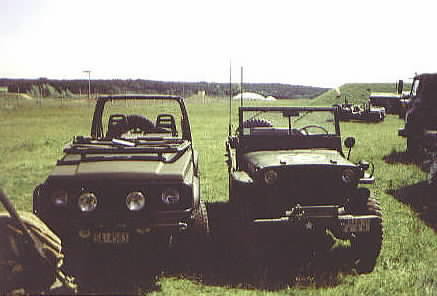
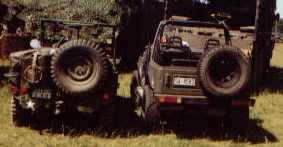
| Note: I wrote this piece for those with some SWB 4WD experience. Why a Samurai? To me the Samurai is a more modern version of the old Jeep; a simple, tough little 4wd truck. Here are some specifications to prove my point. Keep in mind, that these are stock vehicles: Jeep CJ 3B (1953-65) Suzuki Samurai (1985-95) Curb Weight: 2243 lbs 2094lbs Overall Length: 129 inches 135 inches Width (Body): 69 inches 60 inches Wheelbase: 80 inches 80 inches Track: 49 inches 51 inches Ground Clearance: 8 inches 8 inches Suspension: leaf springs, straight axles F/R leaf springs, straight axles F/R Engine: 2.2 liter, 4-cylinder 1.3 liter, 4 cylinder Horsepower: 72 hp @ 4000 rpms 64 hp @ 5500 rpms Torque: 114 lb-ft @ 2000 rpm 73 ft-lbs @ 3500 rpm Transmission 3-speed manual 5-speed manual with o/d Final Drive Ratio: 4.27 (5.38 optional) 5.30 (1.42 t-case reduc, 3.73 r&p) As you can see, things are pretty close on paper. What you don't see is the 30-plus years of technical refinements found in the Samurai. Check out these pictures of my Samurai parked next to a Willys Jeep. Still not convinced? Here is some more info: Initial Cost: A Samurai in decent running condition can be bought for as little as $500. A beater Samurai can be bought for as low as $200. Used spare parts are abundant and can be purchased for very little cash from salvage yards and over the net. Straight Axles Front and Rear: It is simple fact that straight axles perform better off-road. Also, straight axles allow a variety of suspension configurations. Suspension Modifications: The original suspension setup is a leaf sprung SPUA with flat springs in front and slightly arched springs in back. Lift springs, longer shackles, and front shackle reversals are all fairly easy modifications. The next step is the SPOA lift. This type of lift gives the Samurai enough room for 31" tires and really helps to smooth out the ride. The downside is that it does require welding but a few bolt-on kits have recently surfaced. For the more extreme off-roaders, 1/4 quarter eliptics, and coil spring kits are also available. Aftermarket Support: While the aftermarket support for the Samurai is nowhere near as large as it is for Jeep products, it has been blossomed during the past five years. A large variety of products are now available. Here's a brief summary of what's available: Bumpers: Over ten different designs with winch ready models are available for the front. About five different models are available for the rear. Engine kits: Kits are available for the 1600cc Suzuki (Sidekick/Tracker) 8 and 16-valve engines. There are also kits to swap in 4-cyl VW diesels, and Ford/Chevy V-6s. Engine Performance: Headers, carbs, cams, flat tops-all the classic power mods are available for the original 1300cc engine. Gearing: The classic lowbuck 4:1 t-cases to the latest 6.2:1 -tcases are available. An added bonus to the Samurai design is that a change in the low range ratio also changes the high range too. This means that costly R&P changes can usually be avoided. For R&P there are genuine Suzuki gears (4.30 to 5.62) available and several aftermarket ratios available. Traction: Detroit EZ Lockers, Lock Rites, ARBs, and a rear LSDs are available. Lifts: Lift springs, shackle kits, shackle reversals SPOA kits, coil kits, 1/4 quarter eliptic etc are all available.. PAGE 2 |
|
 |