

Review by: Roger Ebert
In the new Japanese animated film "Ghost in the Shell," the "shell" refers to bodies both artificial and organic, and the "ghost" refers to individual identity. Ghosts can move from organic to inorganic bodies, but an inorganic body cannot generate its own ghost; identity is a uniquely human trait. Then a very advanced computer program breaks through, attaining self-consciousness and independence. It moves freely through the internet, becoming known as the Puppet Master, "the greatest hacker of all time."
The film is set in the next century, when humans coexist with cyborgs, who are part human, part machine and part computer. The Puppet Master describes itself as "a living, thinking entity who was created in the sea of information." It once occupied a "real" body but was tricked into diving into a cyborg, and then its body was murdered. Now it exists only in the electronic universe, but is in search of another body to occupy--or share.
"Ghost in the Shell" is not in any sense an animated film for children. Filled with sex (*I disagree, though there is a couple of nude scenes), violence and nudity (although all rather stylized), it's another example of anime, animation from Japan aimed at adults-- in this case, the same college-age audience that reads Heavy Metal and other slick comic zines. Anime has been huge in Japan for years but is now making inroads into the world market; this film was co-produced with British money and includes a song performed by U2, "One Minute Warning," which runs nearly five minutes under apocalyptic images.
The movie has a tendency, as does a lot of traditional science fiction, for its characters to talk in concepts and abstract information. Sample dialogue: "Aside from a slight brain augmentation, your body's almost entirely human." Or, "If a cyber could create its own ghost, what would be the purpose of being human?" Or (my favorite), "You're treated like other humans, so stop with the angst!"
The lead character is a shapely woman named Major Motoko Kusinagi, a cyborg who runs an intelligence operation. Her unit is assigned to investigate an evil foreign operative who wants political asylum, but soon the case leads to contact with the Puppet Master, the "most dreaded cyber-criminal of all time." The major and other characters can change shapes, become invisible and dive into the minds of others-- which places them not so much in the future as in the tradition of Japanese fantasy, in which ghosts have always been able to do such things.
There is much moody talk in the movie about what it is to be human. All of the information accumulated in a lifetime, we learn, is less than a drop in the ocean of information, and perhaps a creature that can collect more information and hold onto it longer is... more than human. In describing this vision of an evolving intelligence, Corinthians is evoked twice: "For now we see through a glass, darkly; but then shall I know even as I am known." At the end of the film, the Puppet Master invites the major to join forces in its brave new informational sea.
Ghost in the Shell is intended as a breakthrough film, aimed at theatrical release instead of life on tape, disc and campus film societies. The ghost of anime can be seen here trying to dive into the shell of movie mainstream. I enjoyed its visuals, its evocative soundtrack (including a suite for percussion and heavy breathing), and its ideas.
Review by: Animelink
Ghost in the Shell is based on the manga by the famous Masamune Shirow.
Motoko Kusanagi is a top operative in Section 9, a special anti-cybernetic
terrorism unit of the Japanese government. The many hard missions have begun to
take their toll on her, and she is beginning to wonder whether she is more
machine than human now. Her doubts have made her become more philosophical, and
this change in attitude has made her partner Batou worried. When Motoko and
Batou encounter a ghostless mercenary during a data hack, it begins to lead them
on the path towards a more intense mystery. A secret American computer AI, one
designed to infiltrate and hack into target systems, has developed its own ghost
and is trying to gain its freedom. Called the Puppet-Master, this AI seeks to
communicate with a kindred spirit. Who better than the ghost-searching Motoko?
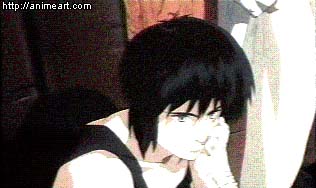
Okay, let me get one thing off my chest. The visuals are stunning and
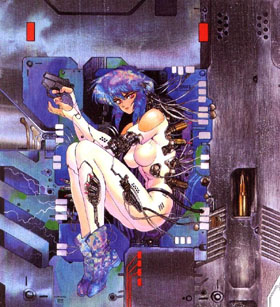
technically well executed. But I really loved Shirow's original Motoko character
design! The new one is borderline androgenous...argh! Now that I've vented my
anger...let me start by saying this is an excellent piece of animation. At
first, I despised it because it was way too popular and I didn't like the new
Motoko character design. But watching it over and over, it seems to have not
only kept Shirow's original atmosphere and story, but improved on it slightly.
The gritty feeling of the story is more present in the movie than in the manga,
although the manga does have Shirow's humorous touches (including a guest
appearance by the Puna sisters). Ghost easily holds its own against some of the
giants in the genre, including Akira and Wings
of Honneamise. The electric cityscape, the sound of heavy firepower slamming
into thick armor plating, the haunting soundtrack, the eerie look in Motoko's
artificial eyes, and even the stalwart attitude of Batou -- all of these
elements lend a credible and spectacular air to the well-adapted story. As a
result, to any science fiction fan, even ones who don't like anime, I say watch
this film. You will not regret it. Note: I saw the subtitled version, but
friends with the dub have not complained. Buy whichever you prefer normally.