| Pilot's Journals: Page 8 |
 |
| The following story is the property of the author and may not be reproduced without the author's consent. Schweinfurt by Robert (Bob) Slane, Col. (ret) USAF |
| BLACK THURSDAY: AFTERMATH |
| COMMENTARY: This continues the story of Col Robert Slane's experiences of the Raid on Schweinfurt and his time spent in a POW camp. |
 |
| Click button at left to return to our Table of Contents. |
| PRISONER ------STALAG LUFT III-------- ESCAPE Note: this true story is a continuation of the "Review of Events" previously published under the title "Schweinfurt" by robert M. Slane. That article is included in the "Stories" section of the 91st Bomb Group Web Site Master Copy. |
| Up to this date, physical adjustment to living conditions as a prisoner had not been too difficult. I had enlisted at age 18 as a private and maintained enlisted status while in pilot training. During the months both before and during most of my time in flight training, I lived in an open bay in the barracks where there was little privacy. I had been preconditioned to some degree to communal living. During the day light hours I tried to keep as active as possible. Located near block-137 was a set of wooden parallel bars. My daily circuits around the perimeter included a stop to do a short workout on the bars. Between workouts with the weights, the parallel bars and the walking, I was in relatively good shape. The major physical discomfort was a constant, gnawing hunger. All of us had lost weight but generally speaking the occupants of our barracks (136) were in relatively good health. Mental adjustment to prison life was an entirely different matter for me. Sometimes, in the mornings just as I was awakening, I would not let my mind accept the fact that I was a prisoner. I would keep my eyes closed and conjure visions of distant places hopeful that when I opened my eyes I would be home or anyplace other than in a prison. I battled with recurring thoughts of what might have been, �if we had not been captured by the enemy.� I relived the events that occurred on the day my crew was lost to enemy action. �If I had ordered crew bailout earlier would Sgt. Smith be alive today?� �If I had immediately descended to the �deck� after loss of two engines would we have had a better chance to return to England?� But, most of all, I thought of and dreamed of escape - I just had to find a way to escape. In the days before the North or South Compounds were built, the majority of the Allied flying officers captured and in German prisons were flying for Great Britain. These officers were from many nationalities and some had been prisoners since 1939. I was fascinated by the story about two Czech. pilots who escaped from the East Compound. The escape from the prison compound was successful and they made their way to the airfield located near the city of Sagan. They were also successful in somehow gaining access to a German aircraft and starting the aircraft engine. The problem they encountered was an inadvertent retraction of the landing gear while taxing out for takeoff. This story fueled my �daydreams� of escape and a good deal of my time was spent conjuring up all sorts of �Mr. Middy� situations where a fantastic and heroic escape was accomplished. We were all aware of a pending allied invasion for several months before it occurred but it had little meaning for us until it actually took place on 6 June,1944. News of the invasion was, for most prisoners, the greatest morale booster since being incarcerated. A map room in one of the blocks was utilized to post the latest available information on the two fronts - the Russian eastern front and the new western front in Normandy. These maps and supporting data reflected only that information that was made available to us by our captors. We continued to receive secret briefings based on information received through the prisoner �X� Activity. Protecting the source of this information required the vigilance of all prisoners. A new prison compound adjacent to our compound was opened in the late spring of 1944. Separation between the North and South Compounds and the newly opened West Compound was a road way that extended from a gate opening between two guard towers on the south and continuing on to the German occupied �Vorlager� located north of the West and North Compounds. The summer months of 1944 arrived and during these months the prison population was rapidly increasing. The majority of the prisoners (self-named �kriegies�) participated in one or more of the sport activities sponsored by individual barracks. A �kriegie� built theater was nearing completion and Bill Runner was a member of a band called the �Luftbandsters.� I worked on a sketch book that depicted scenes from our room and the outside gun towers that were referred to as �Goon boxes.� Decaro, Perkins and I continued our weight lifting program despite the fact that we had lost all visible body fat. During the warm days of early summer we took our weight lifting exercises outside near our room window .The weights and bench were stored in the room and the open window provided a convenient path to quickly return our equipment to the room in the event of an air-raid warning. We were sometimes joined by others who were interested in making their own weights or just wanted to participate in an exercise program. One participant was Maj. David Jones, a pilot and survivor of the famed �Tokyo Raid.� Major Jones , holder of two Distinguished Flying Crosses was piloting a B-26 light bomber when his aircraft was hit by flak and he was forced to crash-land in Tunisia, North Africa. His date of capture was 12 April 1942. His quiet manner ,quick humor and unique ability to communicate gained him the respect of all those with whom he came in contact. Regardless of the activity we engaged in, the main topic of discussion always centered around the progress of the invasion and we were all hopeful the war would be over before the winter months arrived. It�s the 5th of August, 1944 - my 21st birthday. August marked my tenth month as a prisoner of war. We had just received word that for the immediate future the weekly issue of Red Cross food packages would be reduced by 50%. Instead of a parcel per man each week, the issue would be one parcel for two men each week. It wouldn�t be long before the effects of the food reduction would become very apparent. Although our captors provided bread and some vegetables to prepare a daily soup in the communal kitchen, food from the Red Cross parcels was our main means of sustenance. It was late August when I finally found a man who would be willing to take the risks involved in a direct escape route through the perimeter fences. Glenn Oster, resided in room- 3, the room adjacent to room-4 in our same barracks. During an �appell� Glenn was standing in front of me and had heard my comment that �I�ve got to get the hell out of this place.� After the prison count he turned to me and said �you have got yourself a partner.� Glenn�s crew was downed on the 10th of October 1943.and he arrived at Sagan about the time I did. He was free for two days before capture in Holland. He said that he had been aware for some time that I was looking for an escape partner and he finally made the decision that he had, �enough of life as a Prisoner.� I wasted no time after Oster made his commitment to accompany me in an escape attempt. The first step was to outline the basic plan and then seek a meeting with Lt/Col. Clark, the chief of the mysterious �X� committee. Colonel Clark was one of the most prominent prisoners in the compound and the first American fighter pilot to be captured and imprisoned by the Germans. He was flying a British Spitfire when he was forced to bail out near the coast of France. A prisoner since July,1942,he had been held with British prisoners in both the East and North compounds. He had gained superior knowledge and first hand experience in matters pertaining to covert activities while living with the British prisoners. He had the admiration and respect of the entire prisoner population of the South Compound. I explained our plan to Lt/Col. Clark. It was a direct �crawl to the perimeter fence mid- way between two guard towers.� The location for entry would be just to the west of block 137 Criteria included a severe thunderstorm at night - preferably after midnight and hopefully during one of the frequent power outages that often occurs during a thunderstorm. We would dress in black and have blackened faces. We would be requesting assistance with wire cutters, maps and any other items that the �X� committee might suggest. Colonel Clark listened patiently. He was generally receptive to our need for assistance, but he had serious doubts about our chance for success and he indicated the senior Camp Commander would in all probability not approve the plan. I was again the spokesman when we visited the Compound Commander - an experienced, highly respected senior officer. Colonel Goodrich was brief and very frank in his total disapproval of my plan. He pointed out that since the escape in the North Compound, the German Commandant, Colonel von Lindeiner, had informed the senior Allied officer in each compound that any prisoner who escaped could no longer be guaranteed return to a P.O.W. camp, that escapees could be considered saboteurs or criminals and would be shot or sent to a concentration camp. He also reminded us that any prisoner found in the 20 foot area (no man�s land ) between the short wooden guard rail and the perimeter fence - even though still confined within the prison compound - would probably be �shot on sight.� He evaluated my straight �crawl to the wire plan� as suicidal. He emphasized that resources to support escape activities were limited and should be reserved for those individuals who speak fluent German and perhaps a second European language; qualified escapees could then be supplied with forged documents and credentials that would provide a fair opportunity, once out of the compound, to make it back to a neutral country. Although somewhat chastised and disheartened by the interview and the decision of the senior commander, I was still resolved to continue planning for escape. Lt/Col. Clark recommended further delay of any escape attempt, but encouraged us to continue study of maps of the local area, the airfield near the prison complex and increased study of the German language, concentrating on road signs and common terminology. Most important was a program to learn the German �start-engine� sequence for several types of German aircraft. True to his word, Colonel Clark�s �X� Committee provided an unbelievable amount of data regarding German aircraft. In the adjoining North compound were English pilots who had flown the Me-109, Hinkle-111 and several other German aircraft types. Glenn Oster and I continued to study this information, having given up the original idea of trying to escape in a heavy rainstorm at night. We thought we would have a better chance for survival if we planned for an escape during a heavy snow storm. The conversation with our senior camp commander had left us with additional doubts about our ( or my ) original �crawl to the wire� plan. Escape plans were generally limited to �over the wire,� �through the wire� or �under the wire.� Other more sophisticated plans such as impersonation or riding out in a vehicle would - with some logic - simply not be supported by the �X� activity unless our knowledge of the German language was vastly improved. Since March, when the British tunneled out of the North compound, there had been no escape attempted from either the North or South compounds. Tunnel activity continued; however there had been no change in the policy that limited the escape route to those who were fluent in German or a European language. As previously mentioned, for those who lacked the credentials to qualify for tunnel escape the alternatives for escape were generally limited to �over , under or through� the perimeter fences. Our plan was still �through the perimeter fence� and in planning it was essential that we consider the security forces to be encountered. The outer perimeter of all compounds was enclosed by ten foot high, double row barriers of barbed wire fencing. Spacing was eight feet between the two parallel fences. Rolls of barbed wire were placed in the space between the two fences. High guard towers with mounted light machine guns and search lights were spaced at intervals around the entire perimeter of each prison compound. The tower guards were further equipped with a high powered rifle as well as binoculars. The outer perimeter security was further reinforced by walking armed guards patrolling the area outside the compounds. At night all prisoner barracks ( Blocks ) were locked by placement of cross bars on the outside entrance doors on both end of the barracks. Armed guards, one or two with trained German Shepherds, patrolled all areas within the compound grounds. These special patrols were brought into the compound after �lock-up� at night and, with guard relief changes, remained until morning. Barracks doors were barred starting about 9PM and prisoners were forbidden to be outside their �Blocks� after closure. At least one bed-check, prisoner count, was conducted nightly. The summer of �44� was gradually passing and there were few changes in prison living conditions except for the addition of new prisoners. Their arrival provided confirmation of war news and it appeared the German air capability was considerably less since our fighter escort range had improved. I was receiving news from home, but the letters received were written between two and three months earlier. I received many letters from a beautiful little student nurse that I met during B-17 phase training in Boise, Idaho. Her name was Mary Lee Valentine and she captured my heart at first sight. After leaving phase training in Boise, I wrote her a letter from Pendleton, Oregon asking her to marry me. Strangely, in her next letter she never mentioned or acknowledged receiving a proposal that I had considered to be one of the most momentous decisions I had ever made. She was only 18 and happily engrossed in life and her training. Her lack of response was probably best for both of us. So many men had received �Dear John� letters that I didn�t dare to hope that she would still be single when or if I ever returned home. Like most prisoners I read and reread every letter received. Joe Johnson�s wife had twin boys and Glenn Foster�s wife had a baby girl. My mother was attempting to make contact with the families of the other crew members and through her help I received a letter from S/Sgt Groth�s sister. Charles Groth was well and imprisoned in another camp for aircrew members. She reported he was also with Louis Brown. Glenn Foster�s wife was able to tell my mother that Glenn was interned in a neutral country. The people at home confirmed Sgt Claude Smith�s death. I finally, after almost a year, had an accounting of all of my crew members. One day I was surprised to receive a food parcel from a family in England ( Harveys� from Tannington ). On the 10 of October,1943 I crash landed a B-17 in a farmers beet field in East Anglia. We were out of fuel and I made the landing on a fog shrouded afternoon. Two local families provided food and housing for my crew until arrival of transportation from our base unit, the 91st Bomb Group. Some how this family had received word that my crew did not return from the combat mission flown four days later to Schweinfurt, Germany and that I was a prisoner in Stalag Luft III. Receipt of this unexpected package created a remarkable and emotional day for me. The summer months had passed and fall weather was about to give way to winter. The war news was encouraging and the driving urge to escape was lessened. I just couldn�t make myself believe that we would be forced to spend another Christmas as prisoners. Late in November a major change in compound security took place. All of the guards had been removed from the guard towers located between the new West compound and the South and North compounds. This reduction was probably made to conserve manpower, but for me it opened up a new route to freedom. Removal of the guards meant that access - without detection - to the corridor road between prison compounds was now possible. After access to the corridor road was accomplished , the escape route in the corridor road would not present a direct visual line to the corner tower guards because their primary area of interest and responsibility would be in their respective compounds. The corridor road between the compounds was German territory. The north end of the road terminated in the German �Lager� and living quarters. The south end terminated at a gate between two guard towers. This gate was unmanned and was used as access for delivery of certain utility items. The waste disposal wagon ( Honey-wagon ) used this gate for access to the corridor road before entering the gate at the entrance to the South Compound. The long, covered coal shed in the south end of the corridor road was empty as the supply of coal had been depleted. Concurrent with removal of the guards from these towers, I prepared a new route of escape and briefed Lt/Col Clark and selected members of his committee on the changes. This plan was indorsed by the committee and I was told that Colonel Goodrich had been advised of the committee recommendation for approval and that he offered no objection to the plan. Col Goodrich still advised delay of any escape attempt in view of the favorable war news. Motivated by the news that the escape plan had been approved, Glenn Oster and I spent hours re-studying the maps of the local area. We began collecting the additional clothing we would need for the cold weather. White hoods were needed as well as white cloth covers for our feet and hands. I gave Joe Johnson a $50.00 IOU for his leather A-2 jacket. Other roommates provided oversized long-johns to be worn over our clothing. Two new additions to room-4 were particularly helpful, providing me with gloves and long-johns.. Horace Mockett, a B-17 pilot, was shot down in August , 1944, but was hospitalized with a flak wound in his knee. He didn�t arrive in Stalag Luft III until the 29th of October, two months late, Andrew Poggi, a B-24 bombardier flying out of a base in Italy, went down on his last scheduled combat mission. He had been assigned to room-4 since mid June, 44. Total room-4 occupancy was 14 by the end of November,1944. The �Battle of the Bulge� in mid-December brought depressing news. The German media was loud in acclaiming a �great victory� for their forces. For me and most other prisoners it just meant further delay in our eventual release. However, during this period - just a few days before Christmas - as I was making the circuit around the perimeter, I noticed a change in the appearance of the gate area at the south entrance to the corridor road located between the two guard towers. There was a double gate at this location and, probably as a matter of convenience to permit easier access, the inner gates had been left open and the barbed wire barricades normally placed between the two gates had been removed and repositioned alongside the open inner gates. Now, only one single-strand fence prevented access from the corridor road to the outer perimeter road. A wooded forest area was located just across the outer perimeter road. I contacted Oster and told him that I was going to seek final approval for an escape based on the weather conditions. I received assurance from Lt/Col. Clark that the escape was fully approved and that cutting materials would be provided just prior to our departure from a designated barracks near the corridor road fence. The route from this barracks would provide us maximum distance from the guard tower search lights during the first critical phase of the escape plan. All that was needed now was a good snow storm. Christmas Eve was quieter than normal. Unlike Christmas of 1943 there was little celebrating. We had all hoped for a promised �double issue� of Chrismas parcels, but there was a delay. I went by �Moose� Moss�s room and gave him a $50.00 IOU. I had lost the bet we made last Christmas. My good friend Chester Lott gave me his most prized possession - a small,penny sized �escape� compass. I couldn�t have received a better gift. It snowed Christmas day and for a while I was sure it was going to be �the day�. It stopped snowing by late afternoon so there was nothing to do but be patient. I wrote a letter to my mother and dad, sealed it and gave it to Chester Lott. He assured me that he would deliver it in person if I was unable to make it home. I just wanted them to know that I loved them, that I was aware of the risks, but that I was doing something that I just had to do. THE ESCAPE It was late in the afternoon on the 17 of January 1945. I was walking the perimeter when the snow first began to fall. There was a light snow covering on the ground from a previous snowfall. I felt a surge of excitement and fear, and my adrenalin level was surging to a new high - the escape night had finally arrived ! The plan was simple -- cross the clearing from the barracks to the wooden warning rail; crawl under the guard rail and continue on to the double roll of fence at a location next to the shadow of one of the abandoned guard towers. Cut through the wire on the first fence; crawl into the area between the two fences and cut through the center barrier of barbed wire; cut the outside fence; crawl through the outer fence; splice the fence together so the openings are not obvious; cross the corridor road to a shallow ditch on the opposite of the road; crawl south along the corridor road for about 150 feet and carefully pass the guard at the main entrance to the South compound. With the heavy snow fall and cold weather the guard ( if past practice is followed ) will frequently take shelter in the one-man guard house and in so doing he will face the South compound --looking away from the corridor road. Once past the main gate guard, slow down and continue crawling toward the gate at the end of the corridor that is located between the two compounds and their respective guard towers. Use the shadow of the empty coal shed where possible; stop all movement whenever the click of the search light is heard; start again when the light is switched off. Pray that both guards in the towers are concentrating on things in their respective compounds; check for the location of the outside perimeter guard to insure that he has passed by the gate area before departing from the shadow area of the coal-shed; crawl the last critical 30 feet to the gate fence centered between the two towers; use the out of place �barbed-roll� barricades for partial coverage. While making the last two or three cuts in the remaining single fence (gate), pack snow around the wire cutters before each cut to soften the sound; go through the outer fence and crawl across the perimeter road and take cover in the road ditch; check for the perimeter guard; if clear, crawl about 150 feet to the forest, then --into the woods. We were dressed by 8:00 pm--layers of white underware over heavy clothing; white hoods over stocking caps; white socks covering shoes and white mittens plus two spares made from white socks. Food was limited to two �D� bars of chocolate. We had one general area map. We were briefed that small diversion activities would be initiated by members of the �X� committee to hold the attention of guards in the end towers adjacent to our escape route. Several senior officers were in our scheduled departure barracks to assist where possible. Lt/Col. Clark was there providing last minute advice and checking our clothing. Lt/Col Melvin McNickle provided us with side cutters and the area map. I had a warm feeling toward these men as they were the ones who surfaced as leaders in an environment that placed heavy demands on those who served their fellow prisoners. We departed through the north door of the barracks at about 8:15 p.m., equipped with three side-cutters, a large pair and a smaller set with attached long hickory handles, and an emergency hand-made cutter made from a pair of ice skates. It was snowing fairly heavy. Glenn Oster ,with wrists as thick as the average man�s ankle, would do the cutting. I would pack snow over the cutters to subdue the sound. Guards would be at each barracks at 9:00 p.m., so, it was imperative that we get through the first double row fence and if possible past the stationary guard at the main gate before 9 o�clock. We crawled on our bellies toward the warning fence; each time a tower search light came on we froze in position. Oster was leading the first time the tower light came on - this was the initial test. Were the lights so bright, as we had been led to believe, that the guards would have difficulty in identification of objects during heavy snowfall? It seemed the first light was on us for a long time. I could almost feel the impact of a bullet, then the light direction shifted and finally was turned off. We had passed the first test! Oster was at the perimeter fence and made the first cut as I was crawling in the area between the guard rail and the fence. The cut sounded exactly like a rifle shot. Oster had made the first mistake--cutting without waiting to pack snow over the cutter head. We both froze in position for a minute or so and Oster waited until I reached the fence. We agreed that there would be no further cuts without using the packed snow technique. The large side cutters would not work after the first cut They were dull and required too much additional leverage to be effective. The small lineman�s pliers with the hickory handle attachments turned out to be the best tool. Three cuts and Oster was inside, between the two fences. I worked from outside the first fence, reaching in to pack snow over each wire cut. After entering the area between the two fences my job was to twist the severed wires back together to cover any obvious hole in the fence material. We kept a close watch on the guard at the main gate to the South compound since he was fairly close to the area where we were making the wire cuts. Oster made it through the second fence and on to the corridor road and he was crawling into the ditch alongside the road when the guard at the gate suddenly started down the fence line in our direction. I had just started exit from the outside fence and the guard would step on me if I remained in that position. I scrambled back between the two fences, pulled the severed wires together and froze in a face down position. The guard passed my location, continued to the corner of the of the South Camp compound, then reversed direction, walking back up the fence line to his main gate position. The guard had walked by me twice, within three feet, and he also failed to see Glenn who was lying in the shallow ditch opposite my location. Our plan had passed a second critical, but totally unplanned test. After the guard returned to his station at the main gate, I crawled back through the outer fence, spliced the wires together and joined Oster in the shallow ditch on the opposite side of the corridor road. We were out of our compound, and thus far, on schedule. The next critical step was to crawl up the road toward the gate and when the guard sought shelter in the one-man gate house we would pass his location on the opposite side of the road. The snow fall was lessening when we reached the position where we would wait for clearance of a path that would take us past the guard at the main gate; however, this guard for some reason would not take shelter in his guard house. The weather was freezing cold, but the guard, unlike most , simply wasn�t ready to use the shelter. We hoped he might take another trip down the fence line but he maintained his position at the gate. To attempt to crawl past him while he remained stationed outside at the gate would be too risky since we would pass within 10 feet of his location and the lights at the gate would make us fully visible if he should glance our way. We waited and we waited, shivering in the snow, shifting positions, with ice beginning to form thus making the outer underware stiff and creaky. A ring of ice formed on the face of our hoods from our rapid breathing. Glenn, who was a body length ahead of me, finally pushed back alongside me. We discussed losing time and the increased chance of being caught in a guard change. We had finally decided to move up closer to the guard position when I detected a sound behind us on the roadway. Looking back, I could see a group of guards coming up the road ---we had been delayed too long! Oster was moving ahead of me, not having heard any thing. I grabbed his ankle--jerking on it--and pointed behind me. We both �scrunched� down as far as possible. Glenn Oster�s body looked as big as a whale to me. My heart was pounding so hard that I was sure it could be heard; but we lay as still as possible - hardly daring to breathe. The first three guards passed quietly. The next three were talking and laughing and again we were fortunate. One single guard was trailing behind the other six and he came by more slowly, but did not glance our way. I thought we were in the clear, but looking back, I saw a German shepherd coming up the road way. The dog, lagging about 30 feet behind it�s master, passed our positions; but suddenly stopped, turned and looked in our direction. It came back toward us and in a playful gesture spread it�s front feet in front of me and barked twice. The guard by this time was already at the gate talking to the gate guard and beginning to enter the compound. He whistled and the dog turned back, ran to the gate and entered the compound with his master. We couldn�t believe our luck! I crawled up next to Glenn and as cold and scared as we were, we elbow-punched each other with joy. However, our good luck was dampened by the reluctance of the gate guard to enter his shelter. He was continently turning, looking back into the West camp compound and taking short trips along the perimeter road, stopping just short of our position in the corridor. It had stopped snowing and the search lights seemed brighter than before. We continued to wait and wait, probably for another hour, and we began to fear that we would be caught in another guard change. Oster kept insisting that we needed to continue past the guard and take our chances that the guard would not hear us or glance in our direction. I felt it too risky--that we had to wait. Finally, after further delay ,we both agreed that the guard was never going to enter the shelter. We would just have to attempt to crawl past him, within ten feet and in a lighted area. We had moved to perhaps fifteen feet of the gate-guards position when the guard suddenly turned and entered the shelter. The shelter faced the entrance gate to the South compound and there was no visibility to the guard in our direction .It took us no more than three minutes to finally pass the main gate guard area and enter the shadows cast by the poles supporting the roof of the long, empty coal shed. It had taken us over two hours to cross an area that we had planned to cover in less than thirty minutes, but we had finally overcome the third major obstacle placed in our path. The remainder of the route meant crawling ever closer to the guard towers and the search lights, so, we had to be extremely cautious; crawling when the search lights were off; remaining completely immobile when the lights clicked on. We were now close enough to the towers to see the bundled up figures of the tower guards and hear the clicks of the switches as the search lights were turned off and on. The hoped for heavy snowfall had ceased altogether. We would often lay still for as long as three or four minutes when a search light from one of the towers was on; however, as we had hoped, the primary beam of the lights was generally focused in areas within the two compounds. We finally, after what seemed an eternity, arrived at the south end of the coal shed. We were less than thirty feet from the two guard towers; twenty feet to go to reach the shadows produced by the barricades that had been removed from the area between the gates. The inner gates were still wide open. We had estimated that if we just had the outer gate to cut through, only two cuts would be required. Another wait, this time for the outside perimeter guard to make his rounds. After this guard passed the towers we would have about ten minutes before he would pass by again. The perimeter guard finally passed by the two towers; calling up greetings to the two tower guards. We started the last stretch to the gate, Glenn Oster one body length ahead of me. If a tower guard looked straight down next to his tower, we would be in his line of sight; any movement might be detected. Since it was bitter cold nearly all the guards had their overcoat collars turned up and some wore earmuffs; hopefully, these two would be in that category. We were more than halfway between the coal shed and the fence; about eight feet to go and we would have shadow coverage beside the rolled up barricades. I suddenly became aware of a dog growling. I stopped, looked back, and saw a blur of animal leaping at my face. I put up my left arm and the dog grabbed it. The guard with the dog let out a scream of terror and was busy shouting while trying to get his gloves off so he could use his rifle. I managed to get to my feet with the dog hanging on my arm. I shook the dog off and raised my hands, asking the guards in loud German not to shoot. The dog continued to lunge at me, shredding the outside iced clothing. Glenn Oster was on his feet now. The guards in the towers had their search lights on us with their machine guns uncovered and ready. The fence--so close--was still a barrier to freedom. There was no place to go--to run to. What turn of fate caused the guard to exit the South compound and enter the corridor? He was not prepared to find us. He had his rifle still strapped to his shoulder and his scream was one of surprised fright. It was well after midnight when we were captured. We were stiff with cold and a sheet of ice covered our chests and legs. We needed five more minutes, maybe even less, and we would have been through the last barrier, across the perimeter road and into the forest-- then again --perhaps in that same period a tower guard might have sighted us and opened fire. I was thankful. I had not dared--during all the planning-- to ask God to spare my life. I had just asked him to give me the courage to do what I had to do when the time came, regardless of the fear I might have. That prayer was answered. NOTE: This true narrative is the 2nd Part of The �REVIEW of EVENTS� written by Robert M Slane . A 3rd and final Part is still to be written! |
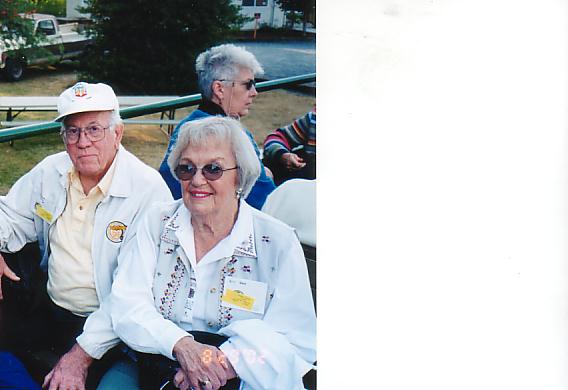 |
| At left is Col Slane and his wife Lee. This picture was taken at a reunion of the 91st Bomb Group in August 2002. |