THE MOON
and
QUICKCAM
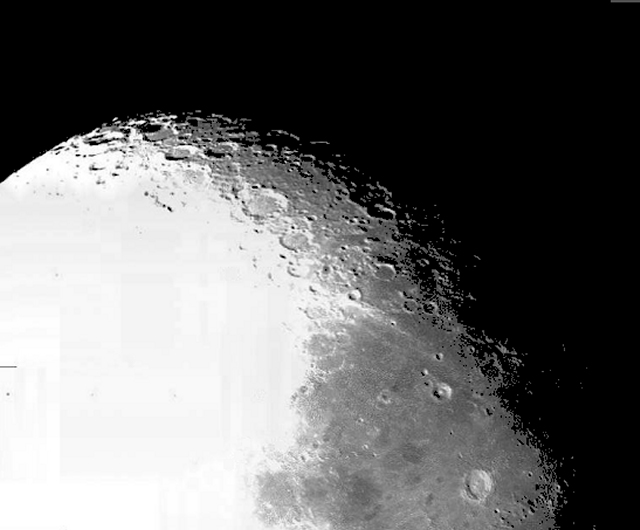
The picture above is a mosaic from images made with a Connectix GreyScale QuickCam, slightly modified to mount on a Questar 3-1/2 inch Catadioptric Telescope. The images were substantially modified in PaintShopPro 5.0. I adjusted gamma, brightness and contrast, converted to maximum color levels, and then used unsharp masking and despeckling. I stitched four or five images (taken 10 seconds apart and thus scanned by the rotation of the earth) together using StitchIt from Live Picture horizontally to make four strips. I cropped the strips to be the same size, and then vertically stitched them into the image displayed here.
To adapt the QuickCam to this service I followed the leads given in "QuickCam Astronomy" by John Buchanan in "Sky and Telescope", June, 1998, page 120. I found how to take the QuickCam apart on the web at a German page carrying the name of "hmueller" but the pages have disappeared from the URL I had. I removed the QuickCam lens by breaking the red glyptal and unscrewing it. When the QuickCam was back together I cemented it to an extension ring for the old Pentax screw thread lenses I use. To keep from doing anything irrevocable I used a casein glue sold in the U.S. as "Elmer's Glue". It's not very strong, but you can scrape it off most things you put it on. The Questar has an accessory to attach the Pentax extension tubes (or the camera) to the back of the telescope:
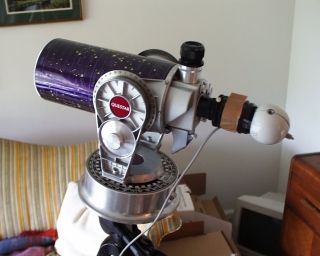
The QuickCam can be coupled to any kind of camera lens or telescope this way. If the lens or telescope has a very long focal length, however, it will be very hard to aim the assembly at the target you want. The Questar and other astronomical telescopes have finders to help with this.
In fact, however, there can be difficulty in using the finder. In the Questar the same eyepiece is used in finding as in viewing. It turns out that when the QuickCam is mounted, it is not "parfocal" with the eyepiece, no matter which use is being made of the eyepiece, for focusing or for aiming. Life is rarely simple.
The individual images that were used to make the mosaic at the top of the page had dark spots:
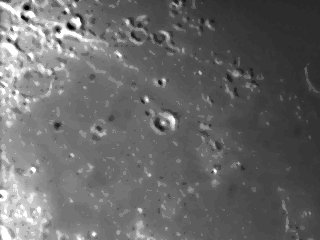
Chas, one of the users of the QuickCam, identified these as dust spots. I removed the infra red rejection filter that is in the QuickCam by unscrewing the screws that hold it to the circuit board. Some of the spots disappeared:
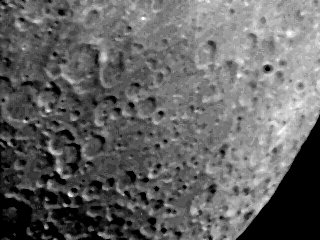
In the mistaken view that more is better, I later used a fine camels hair brush to try to remove more dust from the ccd array. Don't do it! Here is an image of the sun (using a metallized solar filter on the telescope) after the brushing of the ccd:
Now I'm trying to decide whether to buy another QuickCam!
e-mail:
[email protected]
My Other Pages


|