|
|
|
|
|
|
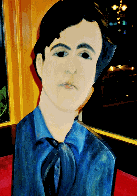
Amedeo
Modigliani
the chair
in the blue shirt, black hair and big black eyes.
A painter, known not only for sensuous nudes, mannered portraits,
but equally for his excessive lifestyle, which became
a legend.
Born in Livorno, Italy in 1884, he spent half on his brief
life in Paris where he died in 1920. Brought up in comfortable
bourgeois surroundings, Modigliani became the quintessence
of a bohemian. As opposed to his contemporaries like Picasso
and his satellites, Modigliani did not ignore the old masters
and he never took interest in aligning himself with
one of the "camps" - Cubists, Fauves or Futurists.
|
|
|
|
|
|
|
 |
|
|
|
|
|
Rejection
was the feeling he experienced most. Modi was never to know
glory or success. According to Pierre Sichel, his biographer,
Modi drew strength from the realization that he was an unrecognized
king and he looked at his subjects with superb arrogance.
Indeed, some of his contemporaries remembered Modi as a
drunkard, a proud, doped - up buffoon, a grotesque bohemian.
Others knew him an as a sensitive, cultivated, generous
and charming man. He was both. Alcohol and hashish
helped him to escape from cruelty, horror, poverty and people,
but destroyed his body, already weakened by tuberculosis.
Modi was driven towards people marked by pain and torment,
like Utrillo or Soutine. Nothing worked in his life, as
he wanted, until the day of his death.
While alive, his affairs and scandals overshadowed his art.
Shortly after he passed away, prices of his paintings skyrocketed,
leaving those who once threw his drawings in the garbage
with a feeling of regret.
His longing for a true love materialized three years before
his death in a relationship with a beautiful and understanding
person - Jean Hébuterne.
|
|
|
|
|
|
|


