>on-chip instruction and data cache
>built-in memory management hardware

As early as 1986 Atari realized they
would begin taking steps to exploit the added power of the 68000
CPU's predecessors. The early TT's were formed around the new
68020, the first 32/32 bit chip.
By 1990, Atari changed over to the newest design, the Motorola
MC68030 cpu
<<NEW>>click
on images for photo gallery, lots of new pics will be added !!!
>>MC68030 features:
>address up to 4
Gbytes RAM (no EMS/XMS, bank switching, etc...)
>on-chip instruction and data cache
>built-in memory management hardware
Atari TT030
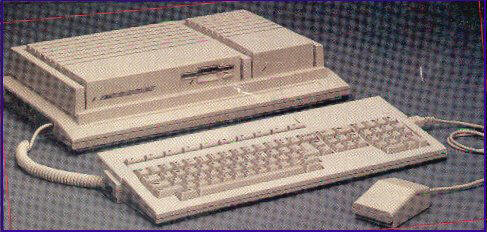
1990: The first 32-bit Atari arrives in a
new case with an improved detached keyboard.
technical features:
in addition to features found on the STE series
>CPU: Motorola
68030 running at 32MHz - yields 7.68 MIPS
>FPU: Motorola 68882 running at 32MHz
>Bus: 64-bit
memory; 32-bit data; 32-bit address
>RAM: uses DRAM expandable to 26 Mbytes
>ROM: 512 Kbytes internal (includes TOS 3 and GEM), 128K
external plug-in
New desktop with enhanced features such as installing custom icons onto the desktop to represent drives, programs, and files
Expansion bus
>VMEbus architecture. Single VME Eurocard (3U) internal slot
>A24/D16 and A16/D16 slave-only interface
Telecommunications ports
>ports 1/2
are ST compatible, 68901 chip ,RS232C
>ports 3/4 new 8530 Serial Communications Controller, one of
which is a Localtalk compatible 8-pin LAN connector
New video modes - in addition to ST compatibility modes:
TT-low : 320 x
480 x 256 colors
TT-med : 640 x 480 x 16 colors
TT-high : 1280 x 960 x b/w
color pallet = 4096 colors .....16 intensities R-G-B
hardware assisted horizontal and vertical scrolling on pixel basis
SCSI port with DMA for connection to external hard drive, CR-ROM, and laser printer (replacing the ST-style ACSI port)
UNIX V.4
compatible o/s
Atari
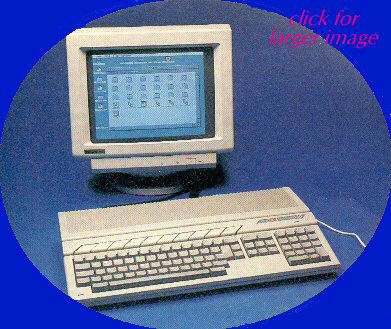
Falcon030
1992: Looking identical to a 1040STE, tha
Falcon is in fact the same case, somewhat darker, but inside the
Falcon is a powerful new system
Falcon030 technical
features:
>CPU:
Motorola MC68030 running at 16 MHz
>FPU: MC68881/2 socket, chip optional, operation at 16 MHz
>Bus: 32-bit data; 32-bit address - independent
>RAM: 1, 4, or 14 Mb configurations
>ROM: 512K internal includes TOS 4 and GEM, 128K external
Expansion bus: internal direct
processor slot for 80386 / 80486SX processor boards
Digital Signal Processor
>Motorola
56001 DSP running at 32 MHz
>16 MIPS performance at 32 MHz
>32 KWords of 0 wait-state static RAM
>external DSP connector for easy connection to modems,
voice-mail systems, direct-to-disk digital audio recorders
Graphics ... in
addition to ST-compatibility modes
Super VGA:
640x480 256 colors
True color 16-bit mode: allows display of up to 65,536 colors
color pallet: 262,144 colors
accepts external video sync signal to allow high-quality
genlocking
Overlay mode for easy video titling and special effects
Optional overscan mode, max. resolution of 768x480
Sound
Eight 16-bit digital audio DMA record & playback channels w/ up to 50 KHz sampling rate
Independent
16-bit digital DMA audio input and output
SDMA sound / DMA coprocessor
Blitter increased to 16Mhz
external SCSI-II port with Direct Memory Access (DMA)
High-speed LocalTalk compatible LAN port
Connector for VGA, composite video, RF, or broadcast analog RGB
Stereo microphone input plug / Stereo audio out plug
software included:
MultiTOS {true pre-emptive mutitasking OS}
AtariWorks {word processor, database, spreadsheet, & graphing package}
SpeedoGDOS {type manager for scalable outline fonts, can be used system wide}
also: System Audio Manager, Audio Fun Machine, CalAppt, Talking Clock, ProCalc, XControl, and 2 games
