The Beatles are a part of history; they appear in encyclopedias,
dictionaries, and your parents' childhood stories alike. And we all know that.
However, many people do not know that the Beatles themselves had some
very famous, historically-significant ancestors. We here at In My Own
Write... are thrilled to have discovered some fascinating details about the
Beatles' historical lineages.
Seen here in a rare etching depicting a scene from his musical version of
Hamlet, Lennon Shakespeare was a widely-respected 16th-century
author, playwright and pioneer of the electric mandolin. When his revolutionary
primal-scream opera, Two Avant-Garde Artists from Verona, flopped after
its premiere at London's famed Globe Theatre, he quietly retired from writing
and lived out the rest of his years on a yak farm in Tibet.
One of the world's most ruthless dictators, Ringoleon conquered Liverpool in
1810, and from there he overtook France, Germany, Switzerland and
Googlywooglystan (a country he invented solely for the purpose of conquering it).
He was always pictured with his hand inside his coat, to disguise the
fact that he had six fingers on one hand. Ringoleon's reign lasted until the autumn
of 1827, when he was killed by a group of French soldiers hiding in a giant
wooden drum.
Considered the most alluring sex icon even before Jean Harlow, Paulyn was the
belle of silent filmes and early talkies, frequently billed with her nickname, "The
Girl with the Large Ankles." Perhaps her most famous screen moment was the
scene in 1928's Blown Down South involving an air vent and a pair of
boxer shorts. Unfortunately, her star soon fizzled out, and she died tragically at
the age of 27 when a skyscraper fell on her head. To this day, however, she is
still being emulated by awkwardly-shaped actresses everywhere.
Perhaps one of the all-time most respected members of the Houses of
Parliament, Harrison-Lincoln (known affectionately as "Harry" by his
colleagues) was the first person to take a stand against, and eventually
abolish, the servitude of sled-dogs in Britain. In 1865, he invented the stovepipe
hat when he got his head caught in a chimney. (Never being able to get it out
again, he simply claimed it was a fashion statement, and before long, everyone
in Parliament was wearing some sort of chimney on their head.) In 1871
he died while watching a play in a crowded theatre, tragically bored to death by
the production.
Very little is known about the life of this Scottish monarch, who
reigned between 1555 and 1556. Never having bared any children, she left
the throne without an heir following her death, and a large goat was temporarily
brought in to serve as queen until a suitable replacement could be found. The goat
reigned for thirty-seven years unchallenged.
Between 1919 and 1957, Ford had a much-touted career as an explorer and
occasional folk singer. With his trusty guitar by his side, he
ventured into the hearts of the darkest jungles in Africa, bringing back numerous
trinkets, native relics, and a matchbox believed by some to be the Holy Grail.
He was also the first explorer ever to attempt to find Googlywooglystan
on a map, but sadly failed. He died in 1957, and retired soon after.
In 1989, a movie was made about his life, called Indiana Tones. Ford briefly
came back from the dead to reprise the role of himself in the film, and that year
he became the first dead-explorer-turned-live-movie-star to win an Academy Award
for Best Actor.
The most popular child star during the Depression, Shirley had a hugely successful
career in motion pictures from the ages of three to twelve. Beloved by moviegoers
for her curly locks, charming singing voice and adorably humongous nose, Shirley's
career began to wane when puberty set in, and her voice dropped twelve octaves.
She increasingly had trouble finding work, and eventually got so desperate that
she was forced to become a politician. Today she is Ambassador for
Googlywooglystan.
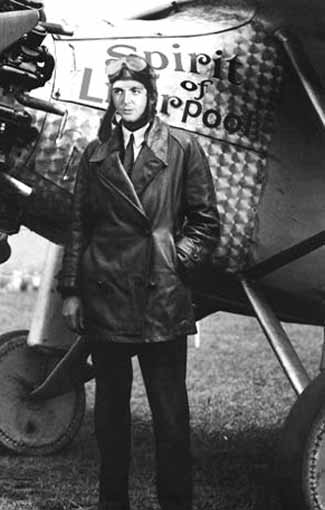
The first man to fly solo across the Atlantic while wearing a blindfold,
McLindbergh remains today the most revered pioneer of aviation. In 1926, he flew
in his plane, The Spirit of Liverpool, from London to New York in a
record-shattering event that launched the infamous "Flymania" of the '20s, with
numerous imitators attempting to match his feats. McLindbergh had a successful
career until his plane was stolen in 1932. Always frugal to a fault, he did not buy
another plane, but instead stapled
paper wings onto his Model-T and attempted to fly around the globe in it.
Miraculously, the car flew for some twenty miles before disappearing in the fog.
Although most people believe McLindbergh died during that flight, rumors have
long persisted that he is still alive and living under an assumed name on a
ranch in Scotland.

Lennon Shakespeare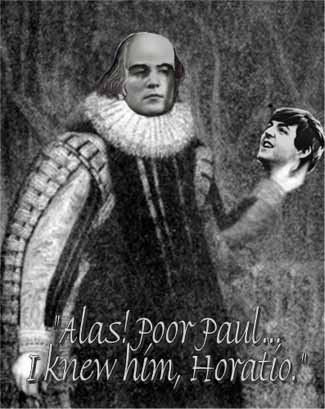
Ringoleon Bonaparte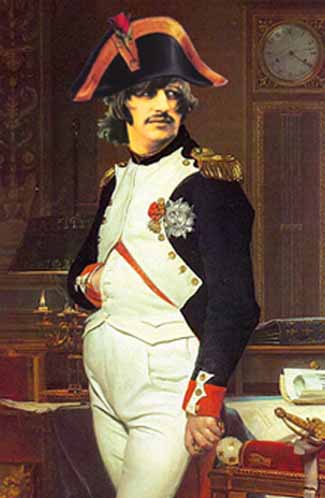
Paulyn Monroe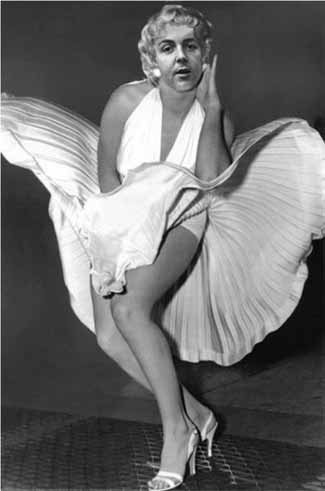
Abie Harrison-Lincoln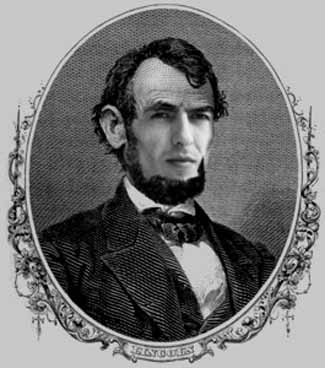
Johnny, Queen of Scots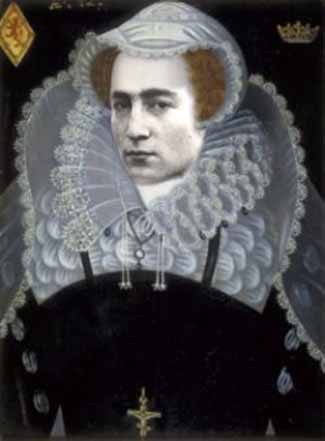
George Harrison Ford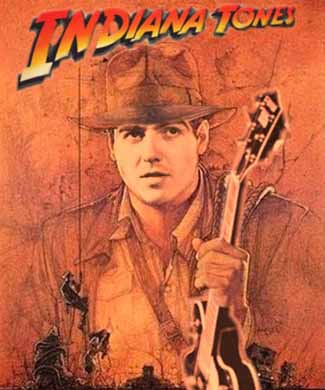
Shirley Starr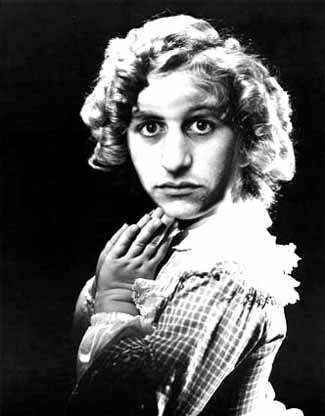
Paul "Lucky Lefty" McLindbergh