Cleopatra
(69 B.C.E.-30 B.C.)
Cleopatra, one of many Cleopatras, born sixty-nine years before the birth of Christ to General Ptolemy XII, was the only Cleopatra to ascend the Egyptian throne. General Ptolemy married an Egyptian princess so that his child could ascend the Egyptian throne according to Egyptian law. Thus Cleopatra was African and Asian.
She ascended the throne after her father's death in 51 B.C., and was the first and last of her dynasty to speak Egyptian.
Cleopatra was on the throne only two years when she was dethroned by the guardians of her younger brother, Ptolemy XIII. But Gaius Julius Caesar, who had fallen in love with this beautiful Black queen, used the might of his army to restore her to the throne. Her relationship with Caesar continued at such a romantic pace that she accepted his invitation to come to Rome where she stayed with Caesar until his murder in 44 B.C.
In 42 B.C. she met Roman leader Marc Antony, who ruled half the Roman Empire after Caesar's death. At their first meeting Cleopatra was dressed as Aphrodite and Antony fell in love with her and followed her to Egypt. In Egypt their love ripened. Antony's ambition was to possess Cleopatra and add the wealth of Egypt to the Roman Empire. |
Remember Egypt is in Africa
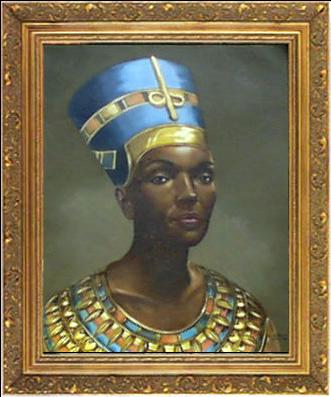
Cleopatra's ambition was to rule half of Rome and have her country as a partner to Rome rather than a conquered province. Antony built Cleopatra a dazzlingly beautiful palace. (In 1996 the palace was found by a French marine salvaging team, along with the home and temple of Marc Antony. They had sunken into the harbor of Alexandria, by an earthquake.)
In 40 B.C., Cleopatra thought that she could do better than Marc Antony, by bringing Octavian, the future ruler of all of Rome, under her spell. She failed in this attempt and in her frustration, killed herself. She was totally devoted to maintaining a policy of Egyptian nationalism. Her story has been dramatized in William Shakespeare's Antony and Cleopatra.
Cleopatra's Needle is the name given to three huge, inscribed, stone pillars called obelisks, all more than three thousand years old, one of which stands now in Central Park in New York City.
|